Canne de combat
A French sport using a lightweight cane for combat.
Last updated
Canne de combat is a French combat sport that uses a lightweight, tapered chestnut walking stick as its weapon. It was standardized for sporting competition in the 1970s by Maurice Sarry. Practitioners wear a padded suit and fencing mask for protection.
History
Canne de combat, also called canne d'arme, originated in early 19th-century France as a self-defence discipline, particularly among the upper classes in large, unsafe cities such as Paris. Some classify it as a French martial art, though its codification as a sport does not officially allow that name. Its history is closely linked to the development of savate boxing techniques, which earlier relied largely on kicks and later incorporated punches under British influence.
Gentlemen trained in savate mastered the cane for fighting from a distance as well as close combat kickboxing. The cane was more common in cities, while a staff akin to a European quarterstaff was more popular in rural areas. Techniques of savate and canne d'arme were used by military and police forces until World War I. The deaths of many practitioners during the war caused substantial decline, though techniques continued in a few savate boxing clubs that survived both world wars. There is reputed to be a group that used cane techniques for assassinations during the Nazi occupation.
Revival efforts in the late 1950s and 1960s influenced cane fighting techniques. In the late 1970s, Maurice Sarry codified the techniques to rehabilitate it as a sport, leading to the discipline associated with the Federation de Savate Boxe Française. Self-defense techniques, such as the Master Lafond technique, remain alive.
Variations
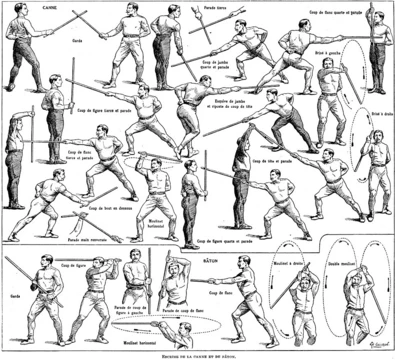
Canne de combat has several variations. Canne is the basic form using one stick; double canne uses two sticks. Bâton refers to quarterstaff techniques, and double bâton uses two quarterstaffs. Canne défense is self-defense with the stick, while canne chausson combines savate kicks with canne techniques.
Canne fouet is a variant of canne chausson and canne défense. Canne is the largest part of the sport. In canne bouts, competitors hold one stick, wear protective suits and fencing helmets, and score points by hitting the head, the torso (for males only), or the calves.
Prescribed defensive and offensive techniques are used, along with jumps and vaults. No simultaneous attack is allowed; if one player starts an attack, the other must parry or evade before counterattacking. The stick may be held in either hand, and changing hands during a match is permitted.
In double canne, competitors hold sticks in both hands, using similar techniques but allowing faster attack and defence. Bâton is based on medieval longsword and longer countryside walking stick movements, extended with canne movement. Canne défense expands basic techniques to include thrusts, slashes, parries, counter-attacks, neck- and hand-locks, and releases from holds; every vulnerable body part is a legitimate target. Because of its danger, canne défense has no competitions or free sparring, only paired techniques.
Techniques
Canne de combat is based on six techniques: brisé, croisé tête, latéral croisé (head, torso, leg/low), latéral extérieur (head, torso, leg/low), enlevé, and croisé bas. These are combined with jumps, voltes, and hand switches. For a strike with the cane in the right hand, the practitioner keeps the point forward, turns the upper body slightly right, draws back the right hand while lifting the left heel, and flips the cane out behind so the arm and cane are in line and fully extended rearward.
The arm and cane then travel horizontally from rear to front through a 180-degree arc. For a head target, the practitioner remains upright with the arm straight throughout. The strike is delivered with the palm facing down so the thumb side of the stick hits the target, helping keep the arm straight. For another technique with the cane in the right hand, the practitioner turns the upper body left, draws the right hand (palm up) across the chest, transfers weight to the back foot, raises the front heel, flips the cane out behind over the left shoulder, and brings it horizontally from rear to front.
Again, for a head target the practitioner remains upright with the arm straight. Acceptable defenses are the parry and the evasion, which can be a step, jump, or crouch. No simultaneous attack is allowed; a competitor must parry or evade before counterattacking.
Grades
The grading system begins with technical requirements of balance, quality, the six techniques, the eight parries, and dodgings, along with theory of the weapon and its history. The next level focuses on the two hands working together, with the topic 'I touch and I am not touched'; technical requirements include slits, voltes, and framing, and theory covers criteria for a valid hit. The co-operation to the opposition level has the topic 'I am not touched and I touch', emphasizing defensive organization and the concept of response; technical requirements include shift, overflow, opposition, and management of effort, with theory on regulations, equipment, behaviour, players' obligations, judgement principles, and sanctions.
The next level allows the practitioner to be initiator and enter confirmation, with the topic 'I touch before being touched' and the principle of anticipation; technical requirements include behavioral diagram, a prepared sequence for demonstration, and interiorization of practice, with theory on the file of J/A, age categories, and competition types. The pommel of the acquisition level has the topic 'I disturb for touching' and the principle of pretence; technical requirements include work in single cane, double cane, and stick, and theory requires a diploma of regional training J/A and participation in official and semi-official meetings. This level allows the practitioner to be an instructor.
Did You Know?
- In the USA, Jean-Noel Eynard brought canne de combat to the east coast in combination with savate; the first real FFBFSDA/FIS club opened in 1983 in Philadelphia.
- A normal walking stick is usually within legal self-defence boundaries, but a loaded cane weighted with lead may be considered a weapon in some jurisdictions.
- In modern sporting canne de combat, thrusting or stabbing blows are prohibited; strokes are made horizontally or downward.
More in Stick-fighting
Sources
Compiled from Wikipedia and the sources listed below. Text from Wikipedia is available under CC BY-SA 4.0; this entry is adapted from it.
- Wikipedia: Canne de combat (CC BY-SA 4.0).
Spotted an error? Know more?
Reader corrections go straight into our review queue. Suggest an edit · How this site is sourced