PSR J0952−0607
Most massive neutron star known, second-fastest-spinning pulsar.
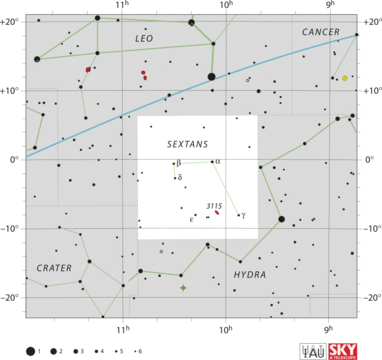
PSR J0952−0607 is a millisecond pulsar in the constellation Sextans, located between 970 and 1740 pc from Earth. It is the most massive neutron star known, with a mass potentially near the Tolman–Oppenheimer–Volkoff upper limit, and rotates at 707 Hz, making it the second-fastest-spinning pulsar and the fastest within the Milky Way.
Quick Facts
- Distance
- 970–1740 pc
- Rotation frequency
- 707.31 Hz
- Rotation period
- 1.4137 ms
- Mass
- most massive neutron star known
- Surface magnetic field
- 6.1e7 G
- Orbital period
- 6.42 hours
Facts from the source article.
Discovery
PSR J0952−0607 started out as a gamma-ray source with no known counterpart, spotted during the Fermi telescope’s first seven years of scanning the sky. Its position far from the busy Galactic Center and a gamma-ray peak at 1.4 GeV made it a strong candidate for being a millisecond pulsar. On 25 December 2016, the Low-Frequency Array in the Netherlands confirmed it as a pulsar, picking up a 707-Hz radio pulse rate and signs of acceleration from an invisible binary partner. More LOFAR observations ran from January to February 2017, and the Green Bank Telescope followed up in March 2017. The Isaac Newton Telescope on La Palma spotted the companion optically in January 2017, finding it very faint at magnitude 23.
Binary system
The PSR J0952−0607 binary system consists of a massive pulsar and a substellar-mass companion in close orbit, classifying it as a black widow pulsar. The companion loses mass through ablation by the pulsar's intense high-energy solar winds and gamma-ray emissions, with some material accreting onto the pulsar. The companion orbits at a distance of 1.6e6 km with an orbital period of 6.42 hours and is likely tidally locked, with one hemisphere always facing the pulsar. The orbit is nearly face-on with an inclination of 60° and appears circular with negligible eccentricity. The companion, likely a former star reduced to the size of a large gas giant or brown dwarf, has a present-day mass of either 0.028 or 0.034 solar masses according to radial velocity measurements. Intense irradiation bloats the companion's radius to 80% of its Roche lobe, giving it a thermal luminosity that accounts for much of the system's optical brightness. The bloating results in a low density, making it susceptible to tidal deformation. The irradiated hemisphere reaches a temperature of 6200 K, while the unirradiated side is at 2900 K, causing significant brightness variability with an amplitude greater than one magnitude in the optical light curve.
Rotation and age
PSR J0952−0607 rotates at 707.31 Hz, corresponding to a period of 1.4137 ms. Assuming a standard neutron star radius of 10 km, its equator moves at over 44400 km/s, about 14% the speed of light. Timing data from gamma-ray and radio observations over seven years indicate a spin-down rate of less than 1e-20 seconds per second, yielding a characteristic age of 4.9 billion years.
Magnetic field
The pulsar's spin-down rate implies a surface magnetic field strength of 6.1e7 G, among the ten weakest known for pulsars. Ordinary pulsar magnetic fields are typically on the order of 1e12 G, over 10,000 times stronger. Other millisecond pulsars also show similarly weak fields, suggesting a common but unknown mechanism, possibly involving accreted matter burying the surface field or heat-driven evolution of the crust.
More in Stars of Sextans
Spotted an error? Know more?
Reader corrections go straight into our review queue. Suggest an edit · How this site is sourced