R Doradus
Red giant variable star with the largest apparent size from Earth.
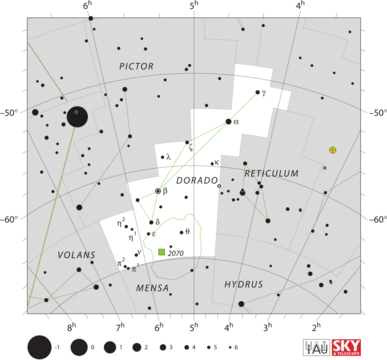
R Doradus, also cataloged as HD 29712 and P Doradus, is a variable red giant star located in the southern constellation Dorado, near the Reticulum border. At 178 light-years away, it is believed to have the largest apparent size of any star beyond our Sun when observed from Earth.
Quick Facts
- Distance
- 178 ly
- Visible magnitude range
- 4.8 to 6.3
- Variable star type
- SRb (semiregular)
- Discovery year of variability
- 1874
- Discoverer
- Benjamin Gould
Facts from the source article.
Did You Know?
- The angular diameter of the next-largest star, Betelgeuse, is around a certain value.
- Its uniform disc diameter when viewed at a certain wavelength is a specific value.
Variability
R Doradus is a star whose brightness in visible light shifts between magnitudes 4.8 and 6.3, typically making it just barely visible without a telescope. However, when viewed in infrared, it becomes one of the sky's most luminous stars. In the near-infrared J band, its magnitude of -2.65 places it behind only Betelgeuse (-2.9) and Antares (-2.73). In the K band of infrared, it occasionally outshines all other stars, though Betelgeuse is usually brighter. Astronomers classify it as a semiregular variable of type SRb, meaning it is a giant star with slow, poorly defined brightness changes that sometimes follow a pattern and sometimes do not. Studies have found it switching between cycles of roughly 175 and 332 days, with a separate period of 117.3 days also detected. When its variations become more regular, it resembles a Mira variable, but its brightness swings of only 1.5 magnitudes are smaller than those of true Mira stars. Benjamin Gould discovered its variability in 1874, and it was given the designation R Doradus.
Properties
The bolometric luminosity of R Doradus, derived from its bolometric flux at a distance of 178 ly, is known. The measured angular diameter, again assuming a distance of 178 ly, gives a radius. The angular diameter and bolometric flux of R Doradus derive a cool surface effective temperature. Comparison of its properties with theoretical evolutionary tracks gives an age of between 6 and 14 billion years. R Doradus has lost part of its mass during its evolution, and currently has a mass of either value. Its initial mass would be either value. Because of the enlarged surface and low mass, R Doradus has a surface gravity of only 0.026% that of Earth. It is on the asymptotic giant branch having exhausted helium at its core. The radius means that the diameter of R Doradus is 415 million km. If placed at the centre of the Solar System, the perihelion of Mars would be within the star. R Doradus has a projected equatorial rotation velocity. It is calculated to take a certain time to rotate once on its axis. While such value is very slow if compared to stars like the Sun, it is more than 100 times faster for a typical AGB star, suggesting R Doradus may have a close companion modifying its rotation. Using ALMA facilities, researchers at Chalmers University, in July to August 2023, were able to record the movement of hot gas bubbles on the surface of the star. Such bubbles, witness of the convective activity linked to deep nuclear fusion, would have a life of about a month, and a size more than 75 times that of the Sun.
More in Stars of Dorado
Spotted an error? Know more?
Reader corrections go straight into our review queue. Suggest an edit · How this site is sourced