Sigma Canis Majoris
A cool supergiant variable star in Canis Major.
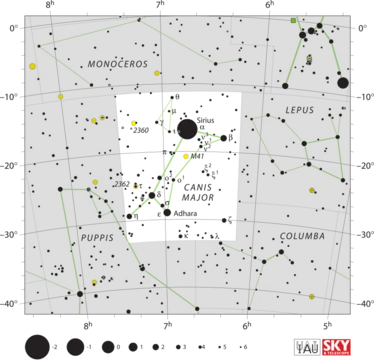
Sigma Canis Majoris is a variable star in the southern constellation of Canis Major, visible to the naked eye with an apparent magnitude that varies between 3.43 and 3.51. It lies approximately 1290 light-years from the Sun and is drifting away at a line-of-sight velocity of +22 km/s. The star bears the proper name Nganurganity, historically written as Unurgunite.
Quick Facts
- Proper name
- Nganurganity (historically Unurgunite)
- Distance from sun
- approximately 1290 ly
- Apparent visual magnitude
- 3.43 to 3.51
- Line-of-sight velocity
- +22 km/s
- Stellar classification
- K5 Ib
- Radius
- 290 times the Sun's radius (1.38 AU)
Facts from the source article.
Nomenclature
The Bayer designation for this system is σ Canis Majoris, Latinised to Sigma Canis Majoris and abbreviated Sigma CMa or σ CMa. In the culture of the Boorong, a clan of the indigenous Maligundidj people of northwestern Victoria in Australia, the star is identified as the nganurganity, or "Jacky lizard", an ancestral figure who fights the Moon, flanked by his wives (Delta and Epsilon Canis Majoris). Settler William Stanbridge transcribed the name as "Unurgunite" in the 1850s, with the initial ng- typically ignored in transcriptions of that era. The International Astronomical Union's Working Group on Star Names approved the name Unurgunite for σ Canis Majoris on 5 September 2017, later correcting the spelling to Nganurganity.
Properties
Sigma Canis Majoris is a supergiant star with a stellar classification of K5 Ib, indicating it is in the late stages of evolution after consuming its core hydrogen. It has expanded to 290 times the Sun's radius, equivalent to 1.38 astronomical units, which is 38% larger than the average Earth–Sun distance. The star radiates over 15,800 times the Sun's luminosity from its outer envelope at an effective temperature of about 3,800 K, giving it the cool orange-red hue of a late K-type star. Its variability was noted in a list of bright southern stars studied at the Cape Observatory, confirmed in 1963, and it is classified as an irregular variable star with brightness ranging from magnitude +3.43 to +3.51. The magnetic field strength is below 1 G. It is suspected of being a member of the Collinder 121 stellar association, though this is disputed, and it is listed as a potential type II supernova progenitor.
More in Stars of Canis Major
Spotted an error? Know more?
Reader corrections go straight into our review queue. Suggest an edit · How this site is sourced