MWC 480
A young Herbig Ae/Be star with a protoplanetary disc.
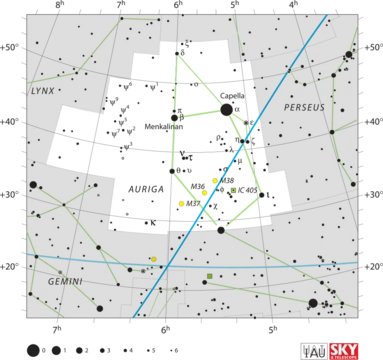
MWC 480 is a solitary star situated roughly 510 light-years from Earth in the constellation Auriga. It lies within the Taurus-Auriga Star-Forming Region. The designation originates from the Mount Wilson Catalog, which lists B and A class stars that exhibit strong hydrogen lines in their spectra. Its apparent magnitude is 7.62, making it invisible without a telescope.
Quick Facts
- Distance
- about 510 light-years
- Constellation
- Auriga
- Apparent magnitude
- 7.62
- Age
- about 7 million years
- Mass
- about twice the mass of the Sun
- Radius
- about 1.67 solar radii
- Spectral type
- Herbig Ae/Be
Facts from the source article.
Did You Know?
- In 2017, the brown dwarf or planet 2MASS J04574903+3015195 was discovered to possibly orbit the star about 232,000 AU away.
- Imaging of gas flows in the circumstellar disk in 2021 suggested a shrouded Jupiter-mass planet about 245 AU from the star.
Properties
MWC 480 belongs to a category of young stars called Herbig Ae/Be stars, which have spectral types A or B but have not yet reached the main sequence. At roughly 7 million years old, this star has about twice the mass of the Sun and an estimated radius of 1.67 times that of the Sun. Its X-ray output is similar to other pre-main-sequence Herbig Ae/Be stars, though it shows about ten times more photoelectric absorption. The star is wrapped in a gas-and-dust envelope and is encircled by a protoplanetary disk with a mass around 11 percent of the Sun’s. This disk is tilted about 37 degrees relative to our line of sight and has a position angle of roughly 148 degrees. Observations with the Atacama Large Millimeter/submillimeter Array have revealed significant amounts of methyl cyanide and hydrogen cyanide within the disk. So far, no evidence of planet formation has been found around MWC 480.
More in Stars of Auriga
Spotted an error? Know more?
Reader corrections go straight into our review queue. Suggest an edit · How this site is sourced