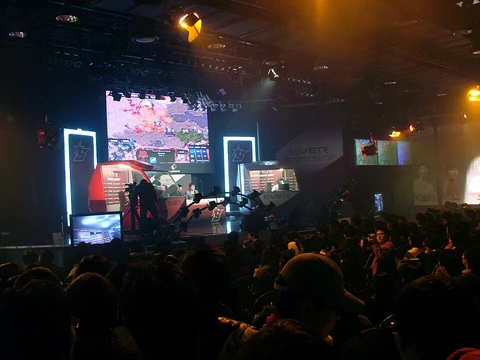
Global StarCraft II League
Last updated
It is notable for being one of the longest-running and most prestigious individual leagues in esports, originally featuring a two-league system of Code S and Code A before consolidating into a single tournament. The league has been hosted by Soop (formerly afreecaTV) since 2016, with an English-language stream aimed at a global audience.
History
The GSL began with three Open Seasons in 2010, which had a combined prize pool of 600 million Korean Won and awarded 100 million Won to each winner. These events were used to sort players into Code S and Code A for the 2011 season. Code S, the major league, consisted of 32 top Korean players, while Code A was a minor league of 32 players. The winner of Code A automatically qualified for Code S, and the top seven Code A players and bottom eight Code S players competed in Up & Down Matches to determine Code S spots.
Code A qualifiers were open to top-ranked players on the Korean Battle.net server and invited foreign players. In November 2011, the format changed to a dual tournament with double-elimination four-player groups, where losing players in Code S dropped to Code A, eliminating the separate Code A champion. The 2012 season was extended, resulting in only five GSL tournaments that year. In 2013, the GSL and OnGameNet Starleague jointly ran the Korean qualifier for Blizzard's World Championship Series under the name WCS Korea.
After OnGameNet stopped its StarCraft II activities in 2014, the GSL became the sole individual league in South Korea, running WCS Korea under its own name. In 2015, the GSL and SPOTV's StarCraft II StarLeague ran parallel, each with three seasons, for a total of six individual league seasons that year.
Casters
For many years, the English-language broadcast was performed by Dan "Artosis" Stemkoski and Nick "Tasteless" Plott, known together as "Tastosis." Artosis left South Korea for Canada in 2022, with his final cast being the 2022 GSL S3 Final in October 2022. Since 2023, the English cast has been done by Tasteless and Ryan "State" Visbeck.
Champions
To earn the title of GSL champion, a player must win a major GSL tournament. The first final held outside South Korea was the 2011 GSL October, which took place in Anaheim, California during BlizzCon. The 2012 Hot6ix GSL Season 5 was hosted at IPL 5 in Las Vegas, Nevada.
Before the 2016 HOT6 Global StarCraft II League Season 1 began, AfreecaTV ran two Pre-Season tournaments, with each winner earning a spot in the main event. Separate Code A tournaments existed only in 2011; after November of that year, Code A became a direct qualifier into Code S rather than its own competition. Winners of special tournaments are not recognized as GSL champions.
Other
GOMTV operated a house for foreign players attempting to qualify for Code A, accommodating up to eight players. Travel to the house was the players' responsibility, but GOMTV covered all other expenses except food; the house closed in November 2012. Major League Gaming and GOMTV had a player exchange program where MLG invited and provided travel for four Korean players per tournament, seeding them directly into the Championship pool. Starting with MLG Anaheim 2011, the MLG winner received a GSL Code S seed, and the top three non-Korean players (or top four if the winner was Korean) received Code A seeds.
At MLG Columbus 2011, Moon "MMA" Sung Won won and the other Korean invites finished 2nd, 3rd, and 8th. Non-Korean players accepting Code A seeds included Johan "NaNiWa" Lucchesi, Marcus "ThorZaIN" Eklöf, and Jian Carlo "Fenix" Morayra Alejo, who participated in GSL August and GSTL August team leagues, forming team F.United with players from WeMadeFox. The GSL-MLG Exchange Program later ended, with GSL partnering with IPL instead. MLG CEO Sundance DiGiovanni hinted at the Naniwa Code S scandal as a possible reason for the breakup.
After IPL closed, the partner program finished. From 2013, the GSL became the Korean part of Blizzard's World Championship Series. The 2011 and 2012 Blizzard Cup tournaments invited 10 players: five by GSL ranking and five from champions of events like MLG, BlizzCon, and World Cyber Games 2011. The World Championship invited eight top non-Korean players to South Korea to face the top eight Korean players in a two-part event: a Korea versus the World team tournament and a 16-man single-elimination tournament.
Did You Know?
- The third Arena of Legends tournament was named after Hong Jin-ho, a Brood War legend famous for getting second place, and invited non-champion runner-up players from previous GSL tournaments.
- The rival KeSPA-run Proleague switched from Brood War to StarCraft II in the 2011-12 SK Planet Proleague Season 2.
More in StarCraft Competitions
Sources
Compiled from Wikipedia and the sources listed below. Text from Wikipedia is available under CC BY-SA 4.0; this entry is adapted from it.
- Wikipedia: Global StarCraft II League (CC BY-SA 4.0).
Spotted an error? Know more?
Reader corrections go straight into our review queue. Suggest an edit · How this site is sourced