Flag of Israel
National flag of Israel, adopted in 1948.
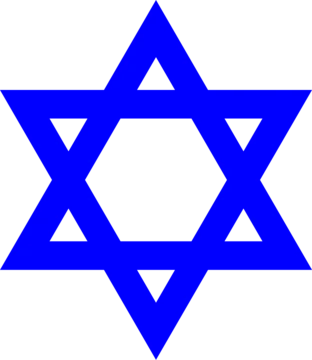
The flag of Israel, officially adopted on 28 October 1948, is a white banner with three blue symbols: two horizontal stripes and a centred Star of David. Its dimensions are defined as 160 cm by 220 cm, giving a ratio of 8:11, though variants with other proportions, such as 2:3, are also common. The Star of David, recalling the legendary Seal of Solomon, has been a widely recognized Jewish symbol since the 17th century and was formally endorsed by the First Zionist Congress in 1897.
Quick Facts
- Nickname
- "Flag of Zion"
- Use
- 111000
- Proportion
- 8:11
- Adoption
- 1885 (as flag of Rishon LeZion)
- 1897 (by the Zionist movement)
- 28 October 1948 (by Israel)
- Relinquished
- 1958 (as flag of Rishon LeZion)
- Designer
- Israel Belkind and Fanny Abramovitch
Facts from the source article.
Origin of the flag
In the Middle Ages, mystical powers were attributed to the pentagram and hexagram, both called the 'Seal of Solomon', but the name eventually became exclusive to the pentagram, while the hexagram became associated with King David and later appeared in Jewish art. In 1648, Ferdinand II of the Holy Roman Empire permitted the Jews of Prague to fly a red flag with a yellow Star of David over their synagogue. The idea that blue and white were the national colours of the Jewish people was voiced early on by Ludwig August von Frankl in 'Judah's Colors'. In 1885, the agricultural village of Rishon LeZion used a blue-and-white flag with a blue Star of David, designed by Israel Belkind and Fanny Abramovitch, in a procession marking its third anniversary. In 1891, Michael Halperin flew a similar flag with a blue hexagram and the text 'נס ציונה' (Nes Ziona). That same year, a blue-and-white flag with a Star of David and the word 'Maccabee' was used by the Bnai Zion Educational Society, and Jacob Baruch Askowith and his son Charles Askowith designed the 'flag of Judah', displayed on 24 July 1891 at the dedication of Zion Hall in Boston, Massachusetts.
Design
The Provisional Council of State Proclamation describes the stripes as a 'dark sky-blue' and the Shield of David as 'sky-blue', though the two elements are almost always the same shade. In Hebrew, the blue is called tḵēleṯ, traditionally a dark sky-blue dye identical to indigo, extracted from a sea creature called a ḥillāzōn (almost certainly the banded dye-murex). Flags with vastly differing shades of blue are commonplace, and Israel's national colours are sometimes said to be kāḥol lāḇān instead of tḵēleṯ lāḇān. In 1950, the standard colour for government-regulated Israeli flags was set as 'Indanthren Calidon (GCDN)', while product labels use CMYK 100/70/0/28. The blue stripes symbolise the stripes on a tallit, the traditional Jewish prayer shawl, and the Star of David is a widely acknowledged symbol of the Jewish people. In Judaism, blue symbolises God's glory, purity and gevura (God's severity), while the white field represents hesed (Divine Benevolence). The biblical commandment to dye one tassel thread with tekhelet is referenced, and after the dye industry collapsed near the end of the Talmudic era, Jews wove blue or purple stripes into tallit cloth in remembrance.
Notable flags
A homemade flag known as the Ink Flag was raised by Israeli soldiers near present-day Eilat during the War of Independence in 1949. A photograph of this event has been likened to the iconic 1945 image of U.S. soldiers raising the flag on Iwo Jima, and it has also been memorialized in replica form. Another notable flag flew continuously over Fort Budapest, the only Bar-Lev Line strongpoint held by Israel throughout the Yom Kippur War siege; it now resides at the Israeli Armored Corps memorial in Latrun. In 2007, a massive flag measuring 660 by 100 meters and weighing 5.2 tonnes was unveiled near Masada. Manufactured in the Philippines by entrepreneur Grace Galindez-Gupana, it was a religious and diplomatic gesture of support for Israel, setting a world record later surpassed.
Criticism
The High Follow-Up Committee for Arab Citizens of Israel claims that the flag reinforces inequality between Arabs and Jews. Rabbi Moses Feinstein called the flag 'a foolish and meaningless object', discouraging its display in synagogues, while the Chazon Ish wrote that praying in a synagogue decorated with it should be avoided. Despite a 1997 legal requirement for government-funded schools to fly it, Haredi Jews generally refrain, though the Ponevezh Yeshiva raises it once a year on Independence Day. Some fringe groups burn it on Independence Day. Yasser Arafat claimed the two blue stripes represent the Nile and Euphrates rivers, alleging expansionist intent; the Hamas Covenant states 'After Palestine, the Zionists aspire to expand from the Nile to the Euphrates'. In 2006, Hamas leader Mahmoud al-Zahar demanded Israel change its flag over this issue. Arab writer Saqr Abu Fakhr has called this a popular misconception about Jews that persists in the Arab world despite being unfounded.
More in Star of David
Spotted an error? Know more?
Reader corrections go straight into our review queue. Suggest an edit · How this site is sourced