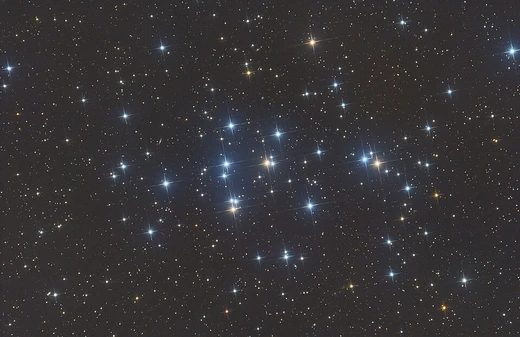
Super star cluster
A massive young open cluster thought to evolve into a globular cluster.

A super star cluster is a young, massive open cluster that will likely evolve into a globular cluster. It earns the "super" label because it shines more brightly and packs more mass than other young clusters, though it does not need to be larger in size. These clusters usually contain many young, massive stars that energize a surrounding HII region—sometimes an ultra-dense HII region—which is itself wrapped in a dust cocoon. Because dust heavily blocks visible light, the youngest super star clusters are most easily seen and photographed using radio and infrared telescopes. Some, like Westerlund 1, exist within the Milky Way, but most are found far beyond it. For example, the Hubble Space Telescope has identified 197 young super star clusters in the galaxy M82 alone.
Super star clusters tend to form where galaxies interact or in areas with intense star formation and high enough pressure to allow cluster formation. Such regions include new galaxies rich in star formation, dwarf starburst galaxies, spiral arms with high star-formation rates, and merging galaxies. A 1996 study in the Astronomical Journal used ultraviolet images from Hubble to examine star-forming rings in five barred galaxies. It found many star clusters clumped within these rings, with masses between about 1,000 and 100,000 solar masses, ages around 100 million years, and radii of roughly 5 parsecs. These clusters are thought to eventually become globular clusters, matching the properties of super star clusters.
Typical properties of a super star cluster include a mass of at least 100,000 solar masses, a radius near 5 parsecs, and an age around 100 million years (though some observed clusters may be up to 1 billion years old). The associated HII region has high electron densities, from 1,000 to 1 million particles per cubic centimeter, and pressures ranging from 10 million to 10 billion Kelvin per cubic centimeter.
Before the Hubble Space Telescope, the small size of super star clusters made them hard to spot due to limited resolution. Hubble’s introduction in the 1990s, with its angular resolution of about one-tenth of an arcsecond, made finding and measuring these clusters—and even individual stars within them—much easier. One notable discovery is the star Westerlund 1-26 in the Milky Way’s Westerlund 1 cluster, whose radius may exceed that of Jupiter’s orbit.
- Mass
- ≳ 10^5 M☉
- Radius
- ≈ 5 pc (≈ 10^19 cm)
- Age
- ≈ 100 Myr (other sources state up to 1 Gyr)
- Electron density
- n_e = 10^3–10^6 cm⁻³ (property of associated HII region)
- Pressure
- P/k_B = 10^7–10^10 K⋅cm⁻³ (property of associated HII region)
Lore & Background
Super star clusters have been observed in the Milky Way, such as Westerlund 1 (Wd1), but most have been found in farther regions of the universe. In the galaxy M82 alone, 197 young SSCs were identified using the Hubble Space Telescope. They generally form in galaxy interactions and regions of high star formation with sufficient pressure, including newer galaxies, dwarf starburst galaxies, spiral arms with high star formation rates, and merging galaxies.
A 1996 Astronomical Journal study using Hubble Space Telescope ultraviolet images of star-forming rings in five barred galaxies found numerous star clusters in clumps within the rings. These clusters had masses of about 10^3 to 10^5 M☉, ages of about 100 Myr, and radii of about 5 pc, matching SSC properties and thought to evolve into globular clusters. The Hubble Space Telescope, with its high resolution, has enabled astronomers to find SSCs and measure their properties, as well as those of individual stars within them, such as the massive star Westerlund 1-26 in Westerlund 1, whose radius is thought to be larger than Jupiter's orbit.
Reader's Guide
The Hubble Space Telescope has been pivotal in the study of super star clusters. Before its introduction in the 1990s, the limited resolution of ground-based and space telescopes made it difficult to find SSCs due to their relatively small size compared to host galaxies. With an angular resolution of about 1/10 arcsecond, the HST allowed astronomers not only to see SSCs but also to measure their properties and those of individual stars within them. The HST searches the night sky, particularly nearby galaxies, for star clusters and dense stellar objects to identify those with properties similar to SSCs or objects that may evolve into globular clusters. The discovery of 197 young SSCs in M82 using the HST exemplifies its contribution. Additionally, the 1996 study of star-forming rings in barred galaxies using HST ultraviolet images provided key data on cluster masses, ages, and radii that match SSC characteristics. These observations have reinforced the understanding that SSCs are precursors to globular clusters, forming in high-pressure star-forming regions such as galaxy mergers and starburst environments.
Did You Know?
- The youngest super star clusters are best observed in radio and infrared due to high extinction in visible light.
- In the galaxy M82, 197 young super star clusters were identified using the Hubble Space Telescope.
- The massive star Westerlund 1-26 in the SSC Westerlund 1 has a radius thought to be larger than Jupiter's orbit around the Sun.
- A 1996 Astronomical Journal study found star clusters in barred galaxies with masses of about 10^3 to 10^5 M☉ and ages of about 100 Myr, matching SSC properties.
Frequently Asked Questions
What is a super star cluster?
It is a young, extraordinarily massive open cluster of stars that astronomers expect will eventually settle into a globular cluster. It sits at the high end of stellar density and luminosity among young cluster populations, with a total mass typically exceeding 100,000 solar masses.
What makes a super star cluster 'super' compared to other young clusters?
The label refers to its exceptional brightness and total mass rather than any particular physical size. Its radius is only around 5 parsecs, comparable to many ordinary young clusters, yet it packs far more stellar mass and shines far more intensely.
How do astronomers observe a super star cluster when dust blocks visible light?
Because the dense dust cocoon surrounding the cluster scatters and absorbs most optical wavelengths, radio and infrared telescopes are the primary tools for detecting and imaging the youngest examples. The ionized gas the cluster energizes also radiates strongly in the radio band, making it a useful tracer.
What role do the massive stars inside a super star cluster play?
The hot, massive members blast their surroundings with ultraviolet radiation, ionizing nearby gas and powering an HII region with electron densities ranging from 1,000 to a million particles per cubic centimeter. This energized gas, compressed by the surrounding dust shell, is sometimes classified as an ultra-dense HII region.
How old is a typical super star cluster?
Most are estimated to be around 100 million years old, though some sources push the upper bound to roughly one billion years. This places them firmly in the 'young' category relative to the multi-billion-year lifespans of mature globular clusters.
More in Star Clusters 1-24
Spotted an error? Know more?
Reader corrections go straight into our review queue. Suggest an edit · How this site is sourced