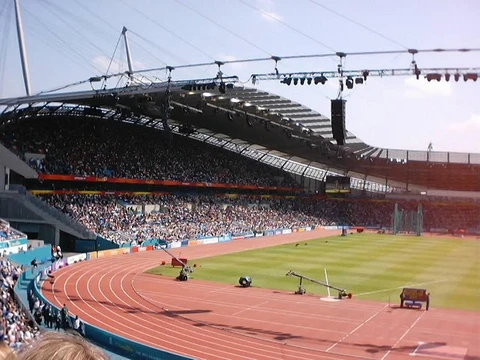
Speed skating

Speed skating is a type of ice skating where competitors race against each other to cover a specific distance. The sport has three main forms: long-track, short-track, and marathon. In the Olympic Games, long-track is typically called "speed skating," while short-track is referred to as "short track." The International Skating Union (ISU), which governs competitive ice sports, uses "speed skating" for long-track and "short track skating" for the other. Long-track races happen on a 400-meter oval, whereas short-track uses a 111-meter oval.
An international federation for the sport was established in 1892, making it the first governing body for any winter sport. Speed skating is especially popular in the Netherlands, Norway, and South Korea. Major international rinks also exist in Canada, the United States, Germany, Italy, Japan, Russia, Kazakhstan, China, Belarus, and Poland. A World Cup circuit takes place in these countries, plus two events at the Thialf ice hall in Heerenveen, Netherlands.
The standard long-track rink is 400 meters, though tracks of 200, 250, and 333⅓ meters are sometimes used. The ISU allows some flexibility in curve size and radius. Short-track skating occurs on a smaller rink, usually the size of an ice hockey rink, with a 111.12-meter oval. Distances are shorter than in long-track; the longest Olympic individual race is 1500 meters, with women’s relays at 3000 meters and men’s at 5000 meters. Events often use a knockout format, where the top two from heats of four or five skaters advance to a final for medals. Disqualifications and falls happen fairly often.
Mass-start races come in several variations. In roller sports regulations, eight types are described, including elimination races (where skaters are removed at set points), simple distance races (which may include preliminaries), endurance races with time limits instead of fixed distances, points races, and individual pursuits. Rules about disqualification for unfairly hindering an opponent vary by discipline. In long-track, almost any interference with a pairmate is penalized, though skaters can switch from the inner to outer lane after the final curve if they cannot hold the inner curve, as long as they don’t interfere. In mass-start races, some physical contact is usually allowed.
Team races also exist. In long-track, the only high-level team event is the team pursuit, though relay races similar to athletics are held for children. Short-track and inline competitions include relays, where exchanges can happen at any time except during the last few laps. Most speed skating races use an oval course, but there are exceptions. Oval sizes vary: short-track requires a 111.12-meter oval, long-track uses a standardized 400-meter rink, and inline skating rinks range from 125 to 400 meters (banked tracks are limited to 250 meters). Inline skating can also take place on closed road courses of 400 to 1000 meters, or on open roads where start and finish lines don’t match—this is also true for outdoor marathons. In the Netherlands, marathon competitions may be held on natural ice in canals, lakes, and rivers, or on artificially frozen 400-meter tracks, with skaters sometimes circling 100 times.
The origins of speed skating go back over a thousand years in northern Europe, especially Scandinavia and the Netherlands, where people strapped bones to their shoes to travel on frozen waterways. In Norway, King Eystein I boasted of his skill racing on bone skates, which he called "ice legs." Skating wasn’t limited to those regions: in 1592, a Scotsman designed a skate with an iron blade, which helped spread the sport. By 1642, the first known skating club, The Skating Club of Edinburgh, was formed. In 1763, the first detailed speed skating race took place from Wisbech to Whittlesey in England, with a prize of 20 guineas, won by John Lamb of Wisbech. In the Netherlands, people began touring the waterways connecting the 11 cities of Friesland, a challenge that eventually led to the Elfstedentocht.
The first known women’s speed skating competition was held in Heerenveen, Netherlands, on February 1–2, 1805. A knockout-style race on a frozen canal drew a crowd of over 10,000, with 130 women competing. The winner was Trijntje Pieters Westra, a twenty-year-old farmer’s daughter from Poppingawier. By 1851, North Americans had embraced the sport, and the all-steel blade was later developed there. In Norway, interest surged after a famous 1885 race at Frognerkilen between Axel Paulsen and Renke van der Zee. The Netherlands returned to prominence in 1889 by organizing the first world championships, and the ISU was founded there in 1892. By the early 20th century, speed skating had become a major popular sporting activity.
Lore & Background
Speed skating is a competitive form of ice skating where participants race each other over a set distance. The sport has three main types: long-track, short-track, and marathon. In the Olympics, long-track is typically called "speed skating," while short-track is known as "short track." The International Skating Union, the sport's governing body, officially refers to long-track as "speed skating" and short-track as "short track skating." Long-track races occur on a 400-meter oval track, whereas short-track uses a smaller 111.12-meter oval, often the size of an ice hockey rink. Short-track distances are shorter, with the longest Olympic individual race being 1500 meters; women’s relays are 3000 meters and men’s 5000 meters. Events often use a knockout format, with the top two from heats of four or five advancing to the final. Disqualifications and falls are common in short-track. Mass-start races have several variations, including elimination races, distance races, endurance races with time limits, points races, and individual pursuits. Rules on disqualification for hindering opponents vary by discipline; in long-track, almost any interference with a pairmate is penalized, though skaters may switch lanes out of the final curve if they cannot hold the inner curve, provided they do not interfere. In mass-start events, some physical contact is usually allowed. The only high-level team race in long-track is the team pursuit, while relay races are held in short-track and inline competitions, where exchanges can occur at any time except during the final laps. Most races are held on oval courses, though outdoor marathons may use natural ice on canals, lakes, or rivers, or artificial 400-meter tracks where skaters may circle 100 times. The sport enjoys great popularity in the Netherlands, Norway, and South Korea, with top international rinks in Canada, the United States, Germany, Italy, Japan, Russia, Kazakhstan, China, Belarus, and Poland. A World Cup circuit includes events in these countries, plus two in Heerenveen, Netherlands. The origins of speed skating date back over a millennium in Northern Europe, where natives attached bones to their shoes to travel on frozen waterways.
Reader's Guide
Speed skating is a competitive form of ice skating where racers travel a set distance on skates, encompassing long-track, short-track, and marathon disciplines. Long-track speed skating occurs on a 400-meter oval, while short-track takes place on a 111-meter track, typically the size of an ice hockey rink. The International Skating Union, founded in 1892 as the first international federation for any winter sport, governs the sport, distinguishing long-track as "speed skating" and short-track as "short track skating." In the Olympics, long-track is simply called speed skating, whereas short-track is known as short track. The sport enjoys significant popularity in the Netherlands, Norway, and South Korea, with top international rinks also located in Canada, the United States, Germany, Italy, Japan, Russia, Kazakhstan, China, Belarus, and Poland. A World Cup circuit includes events in these nations, plus two in Heerenveen, Netherlands. Races vary in format, including mass-start events like elimination races, points races, and individual pursuits. Rules on disqualification differ by discipline; long-track penalizes most infringements on a pairmate, while mass-start races permit some physical contact. Team races include the team pursuit in long-track and relay races in short-track, where exchanges can occur anytime except the final laps. Marathon speed skating in the Netherlands may take place on natural ice on canals or lakes, or on artificially frozen 400-meter tracks with skaters completing many laps. The sport’s history dates back over a millennium in Northern Europe, where natives used bones as skates for travel on frozen waterways. The development of iron-bladed skates in the 16th century, followed by all-steel blades in North America, helped spread the sport globally.
Ancient Roots and the Birth of a Sport
The story of speed skating stretches back more than a thousand years to the frozen waterways of northern Europe, particularly Scandinavia and the Netherlands. Early inhabitants improvised by attaching animal bones to their footwear, allowing them to glide across frozen rivers, canals, and lakes. In Norway, King Eystein Magnusson—later King Eystein I—famously boasted of his racing prowess on what were called "ice legs," bone skates that gave him an edge over rivals. The sport was not confined to those regions, however. In 1592, a Scotsman designed a skate fitted with an iron blade, and it was precisely this iron-bladed innovation that propelled skating and speed skating into wider circulation across Europe. By 1642, the first known skating club, The Skating Club of Edinburgh, had been established, and in 1763 the earliest speed skating race documented in detail was run from Wisbech to Whittlesey across the English Fens, offering a prize of twenty guineas to the victor, John Lamb of Wisbech.
Standardization and the ISU Framework
The International Skating Union, established in the Netherlands in 1892, holds the distinction of being the first international federation created for any winter sport. Under its governance, long-track speed skating is the discipline officially called simply "speed skating," while short-track is designated "short track skating." The ISU sets precise standards for competition venues: long-track events take place on a 400-meter oval, though tracks of 200, 250, and 333⅓ meters appear occasionally, and the rules permit some flexibility in curve size and radius. Short-track racing is confined to a much tighter 111.12-meter oval, roughly the dimensions of an ice hockey rink. In long-track pair races, nearly any infringement on a rival skater results in disqualification, yet competitors may shift from the inner to the outer lane out of the final curve if they cannot hold the inside, provided they do not impede their opponent. Team competition at the highest level in long track is limited to the team pursuit, while short track features relay events where exchanges can occur at any point during the race, though they may be prohibited in the final laps.
A Global Sport with Deep Regional Roots
Speed skating commands passionate followings in a handful of nations above all others. The Netherlands, Norway, and South Korea are the countries where the sport enjoys the deepest grassroots popularity, and each has produced generations of elite competitors. Beyond those three, top-tier international rinks operate in Canada, the United States, Germany, Italy, Japan, Russia, Kazakhstan, China, Belarus, and Poland. The annual World Cup circuit threads through many of these countries, with two dedicated events staged at the Thialf ice hall in Heerenveen, Netherlands—a venue that sits in the heart of the country's skating tradition. The sport's geographic spread is no accident. In the Netherlands, marathon competitions can be held on the natural ice of canals, lakes, and rivers, or on artificially frozen 400-meter tracks where skaters complete a hundred laps. In Scandinavia, the tradition of touring the waterways connecting the eleven cities of Friesland eventually gave rise to the legendary Elfstedentocht. Meanwhile, by 1851 North Americans had embraced the sport, and the all-steel skate blade was later developed there, further diversifying the global skating landscape.
Race Formats and the Spectacle of Competition
The variety of race formats in speed skating creates a rich competitive landscape. In short track, events typically follow a knockout structure: heats of four or five skaters are run, and the two fastest advance to the final, where medals are decided. Falls and disqualifications are common features of these tight, high-speed races on the 111.12-meter oval. The longest individual Olympic distance in short track is 1,500 meters, while relay events extend to 3,000 meters for women and 5,000 meters for men. Long-track speed skating, by contrast, emphasizes head-to-head pair racing over set distances on the 400-meter oval. Mass-start events introduce yet another dimension, with regulations describing eight distinct types, including elimination races where competitors are dropped at fixed intervals, points races, endurance races governed by time limits rather than distance, and individual pursuits. In mass-start formats, a degree of physical contact between skaters is generally tolerated, a stark contrast to the strict non-interference rules of long-track pair events. This diversity of formats ensures that speed skating offers something distinct for every style of competitor and spectator.
Frequently Asked Questions
What is speed skating?
Speed skating is a competitive ice sport in which athletes race one another over a fixed distance on specialized skates. The discipline is overseen internationally by the ISU and splits into several distinct formats.
What are the main disciplines within speed skating?
The sport is broken into long-track, short-track, and marathon skating. Long-track is the oldest Olympic format, while short-track and marathon each run their own separate competitive circuits.
Where is speed skating most popular?
The Netherlands, Norway, and South Korea consistently produce the largest fan bases and the strongest national teams. In those countries the sport enjoys a cultural following far beyond typical Olympic-event interest.
More in Sports & Games 1-23
Spotted an error? Know more?
This is a living reference — every entry is fact-audited, and reader corrections feed straight into our audit queue. Suggest an edit · See this site's audit record