Goalball
Last updated
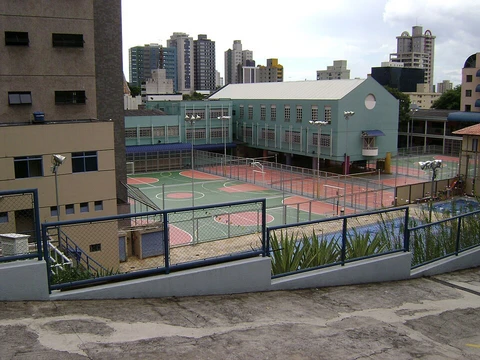
Vision-impaired athletes compete in an indoor team sport on a court measuring 18 meters in length and 9 meters in width.[1][2] Three-player teams attempt to score by manually throwing a ball containing bells into the opposing team's goal.[1][3] Competitors rely on the ball's auditory cues to track its location and are required to wear eyeshades to guarantee fair play.[1]
Life and work
Goalball was invented in 1946 by Austrian Hans Lorenzen and German Sepp Reindle to rehabilitate visually impaired World War II veterans.[4][5] Goalball became a full Paralympic sport at the 1976 Summer Paralympics in Toronto.[6][5] A mercy rule declares the leading team the winner if a ten-point goal difference is reached.[7] During the 1950s and 1960s, the sport transitioned into a more competitive form.[6]
Goalball was first presented as a demonstration event at the 1972 Summer Paralympics held in Heidelberg, West Germany.[6] Each match is composed of two twelve-minute periods, separated by a five-minute intermission.[1][8] When the score remains equal after standard play, a single six-minute overtime period is played where the first goal wins.[7][8] Should the overtime period end without a goal, the match is decided by penalty throws.[7]
What the cited sources add
The Österreichisches Paralympisches Committee states that each team consists of three players with up to three substitutes.[5] The IBSA rules page also states that team staff can now coach after any whistled stoppage in play.[8] The IBSA rules page explains that half-time was changed from three to five minutes in 2025.[8] According to the IBSA regulations, a player has ten seconds after contacting the ball to send it back toward the opponent's goal.[8]
A 2014 rule change mandated that the ball must also cross the center line to speed up play.[8] To minimize the possibility of cheating, eye patches were introduced to be worn beneath the eyeshades.[8]
References
- Wikipedia, "Goalball" (CC BY-SA 4.0), which cites: "Goalball – Paralympic Athletes, Photos & Events", Paralympic.org (original not read by us) en.wikipedia.org
- Wikipedia, "Goalball" (CC BY-SA 4.0), which cites: "授乳後のバストアップ", Ibsa-sports.org; (original not read by us) en.wikipedia.org
- Wikipedia, "Goalball" (CC BY-SA 4.0) en.wikipedia.org
- Wikipedia, "Goalball" (CC BY-SA 4.0), which cites: INNENMOSER, "Behindertensport 1951-2011: Historische und aktuelle Aspekte im nationalen und internationalen Dialog", Meyer & Meyer Sportverlag, 2015, p. 116; "Goalball", Österreichisches Paralympisches Committee, 9 May 2019 (we also read that source) en.wikipedia.org
- "Goalball", Österreichisches Paralympisches Committee, 9 May 2019. oepc.at
- Wikipedia, "Goalball" (CC BY-SA 4.0), which cites: "Goalball – General information", International Blind Sports Association; "Goalball", Österreichisches Paralympisches Committee, 9 May 2019 (we also read that source) en.wikipedia.org
- Wikipedia, "Goalball" (CC BY-SA 4.0), which cites: "Paralympics Rules of the Game: Goalball", cbs8.com, 25 August 2021 (original not read by us) en.wikipedia.org
- Wikipedia, "Goalball" (CC BY-SA 4.0), which cites: "Goalball. Rules and downloads", International Blind Sports Federation (IBSA) (we also read that source) en.wikipedia.org
Each numbered sentence above was checked against the source it cites before publication. Sentences citing Wikipedia adapt text from the English Wikipedia article Goalball (contributors), used under CC BY-SA 4.0; this entry is available under the same licence. Other sources were used for facts only.
Also in the Codexery
More in Sports & Athletics
Sources
Compiled from Wikipedia and the sources listed below. Text from Wikipedia is available under CC BY-SA 4.0; this entry is adapted from it.
- Wikipedia: Goalball (CC BY-SA 4.0).
Spotted an error? Know more?
Reader corrections go straight into our review queue. Suggest an edit · How this site is sourced