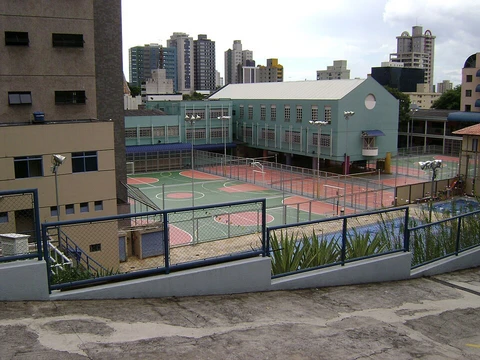
Handball
Team sport with seven players per side, aiming to throw a ball into the opponent's goal.

Handball, also known as team handball, European handball, Olympic handball, or indoor handball, is a fast-paced team sport played by two sides of seven players each, comprising six outcourt players and one goalkeeper. The objective is to pass the ball using the hands and throw it into the opposing team’s goal. A standard match consists of two 30-minute periods, with the team scoring more goals declared the winner. The modern game is typically played indoors on a court with a goal centered at each end, surrounded by a zone where only the defending goalkeeper is permitted. Goals must be thrown from outside this zone or by diving into it. The sport is high-scoring; professional teams now commonly score between 20 and 35 goals each, though lower scores were more frequent in earlier decades. Defenders may use body contact to hinder attackers, and while no protective gear is mandatory, players often wear soft bands, pads, and mouth guards.
The modern rules were established in 1917 by Karl Schelenz, Max Heiser, and Erich Konigh in Berlin, a date considered the sport’s birth. The first official match took place that same year in Germany, with Schelenz revising the rules in 1919. International play began in 1925 for men (Germany vs. Belgium) and in 1930 for women (Germany vs. Austria). Handball debuted at the Olympics in 1936 as an outdoor event, then returned as an indoor sport in 1972; women’s handball was added in 1976. The International Handball Federation, formed in 1946, now includes 197 member federations. The sport is most popular in Europe, where countries have won nearly all men’s world championship medals since 1938. Only two non-European nations, South Korea and Brazil, have claimed women’s world titles. Handball also enjoys followings in East Asia, North Africa, and parts of South America.
Origins trace back to ancient Greece, depicted on amphorae, and ancient Roman women played a similar game. Medieval France and Inuit in Greenland also had handball-like games. By the 19th century, variants existed in Denmark, the Czech Republic, Ukraine, and Germany. The first written rules were published in 1906 by Danish gym teacher Holger Nielsen. Field handball was played at the 1936 Olympics, but indoor handball evolved in Scandinavia and returned to the Olympics in 1972. The IHF organized the first men’s world championship in 1938, held every few years until 19
Lore & Background
Games resembling handball were played in Ancient Greece, as depicted on amphorae and stone carvings, though detailed written accounts are scarce. Descriptions exist of ball games where players threw the ball to one another, often to avoid interception by an opponent, serving as both exercise and social activity. Evidence also shows ancient Roman women playing a version called *expulsim ludere*. In medieval times, handball-like games were recorded in France and among the Inuit in Greenland. By the 19th century, similar games had developed under various names: *håndbold* in Denmark, *házená* in the Czech Republic, *handbol* in Ukraine, and *torball* in Germany. The modern team handball game was codified in northern Europe—primarily Denmark, Germany, Norway, and Sweden—at the end of the 19th century. The first written rules were published in 1906 by Danish gym teacher Holger Nielsen. The modern set of rules, published in Berlin on 29 October 1917 by Max Heiser, Karl Schelenz, and Erich Konigh, is considered the sport’s birth date. The first official match was played in Germany that year, with Schelenz modifying the rules in 1919. International play began in 1925 for men and 1930 for women. The sport is fast and high-scoring, with professional teams typically scoring 20 to 35 goals each. It is played indoors on a court with goals surrounded by a zone reserved for the goalkeeper; goals are scored by throwing from outside or diving into this zone. Body contact is permitted for defenders, and no protective equipment is mandated.
Reader's Guide
Handball is a team sport played by two sides of seven players each, with the objective of throwing the ball into the opponent’s goal. A standard match consists of two 30-minute halves, and the team with more goals wins. The game is played on a court with a goal at each end, surrounded by a zone where only the defending goalkeeper is permitted; attackers must shoot from outside this area or while diving into it. Body contact is allowed for defenders attempting to block attackers, and no protective gear is required, though soft bands, pads, and mouth guards are permitted. The sport is fast and high-scoring, with professional teams now typically scoring between 20 and 35 goals per side. Modern rules were codified in 1917 by Karl Schelenz, Max Heiser, and Erich Konigh in Berlin, with the first official match played that year in Germany. International play began in 1925 for men and 1930 for women. Handball debuted at the Olympics in 1936 as an outdoor event, then returned as an indoor sport in 1972 for men and 1976 for women. The International Handball Federation, founded in 1946, now has 197 member federations. The sport is most popular in Europe, which has dominated world championships, though it also enjoys popularity in East Asia, North Africa, and parts of South America.
A Regional Sporting Milestone
The competition ran over a compact seven-day window, from the sixteenth to the twenty-second of June, concentrating a full programme of events into a single week. This tight scheduling reflected the biennial nature of the gathering, where athletes from across the ECOWAS region converged on a single city to contest medals across multiple disciplines. The event's placement within the broader ECOWAS framework gave it a distinctly regional character, distinguishing it from continental or global multi-sport events while still serving as a meaningful showcase of West African sporting talent and national pride.
Five Disciplines, Two Venues
This relatively compact selection of disciplines was spread across two primary competition sites within the city of Accra. The Accra Sports Stadium Complex served as the central hub for four of the five sports, hosting matches and bouts in boxing, handball, volleyball, and wrestling. Athletics, the one discipline requiring a dedicated track and field facility, was staged at the El-Wak Sports Stadium. This division of venues allowed the organisers to concentrate the team and combat sports in one location while giving the track and field events their own specialised setting. The handball competition, in particular, benefited from being part of a multi-sport complex where athletes from other disciplines could also be present, creating a shared atmosphere of regional competition. The five-sport programme represented a deliberate choice to keep the event manageable within a one-week timeframe while still offering a diverse range of athletic expression across individual and team-based formats.
The Host Nation's Triumph
Ghana's sporting contingent went on to claim the highest number of medals of any participating nation, topping the overall medal table and cementing the games as a homecoming success. As the host, Ghana was responsible for welcoming athletes from across the ECOWAS member states to Accra, managing logistics across two distinct venue sites, and ensuring that the seven-day competition ran smoothly from the sixteenth to the twenty-second of June. The host-nation status also meant that Ghana bore the primary organisational and financial burden of staging the event, a responsibility that was supported by a slate of corporate sponsors. The medal-table dominance of the Ghanaian team underscored the significance of the games as a regional showcase, where the host could leverage local support, familiar conditions, and home crowds to push its athletes to their peak performance across the five contested sports.
Corporate Sponsors and Organizational Support
The sponsorship lineup included Rlg Communications, the Ghana National Petroleum Corporation, the Ghana Oil Company, Ghallywood, and Zoomlion. The Ghana National Petroleum Corporation is listed among the sponsors, highlighting the involvement of the petroleum and energy sector in financing the competition. The breadth of the sponsor roster, spanning a communications company, petroleum and oil entities, and other commercial brands, illustrates the multi-sector economic support that underpinned the games. This corporate backing was essential for a regional biennial competition that, unlike larger continental or global sporting events, operated with a more limited financial framework.
Frequently Asked Questions
What is handball as a sport?
Handball is a fast-paced team game where two sides of seven players each use their hands to pass and shoot a ball into the opponent's net. It is played indoors and is sometimes called European handball or Olympic handball to distinguish it from other handball variants.
How many players are on the court in a handball match?
Each team fields seven players at a time, including the goalkeeper. Substitutions are unlimited, which keeps the tempo high throughout the game.
Where is handball most popular in the world?
The sport enjoys its strongest following across Europe, where national leagues and international competitions draw large audiences. Countries such as Denmark, Germany, France, and Spain are particularly well known for their handball traditions.
More in Sports And Athletics 1-24
Spotted an error? Know more?
This is a living reference — every entry is fact-audited, and reader corrections feed straight into our audit queue. Suggest an edit · See this site's audit record