Frequently Asked Questions
The most-asked questions about spiral galaxies.
What exactly is a spiral galaxy?
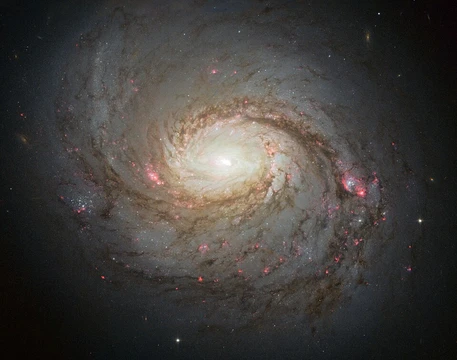
A spiral galaxy is a flat, rotating disk of stars, gas, and dust organized into curving arms that wind outward from a central bulge. It represents roughly half of all galaxy types catalogued in the observable universe.
How do the spiral arms actually form and stay in place?
The leading explanation is density-wave theory: a gravitational pattern rotates through the disk slightly slower than the stars themselves, periodically compressing gas and igniting star formation along the arms. The arms are therefore standing patterns in the disk rather than fixed clumps of material.
What makes a barred spiral different from a regular spiral?
In a barred spiral the central bulge is stretched into an elongated bar of stars, and the arms spring from the bar's ends instead of emerging directly from the core. The Milky Way is classified as a barred spiral.
How large are spiral galaxies typically?
Diameters usually range from about 30,000 to 200,000 light-years, with the Milky Way sitting near the 100,000-light-year mark. The central bulge alone can span several thousand light-years across.
What do you actually see in the spiral arms?
Arms are packed with young, hot blue stars, glowing hydrogen nebulae, and dense molecular clouds where new stars are actively forming. Interspersed among them are older red stars and dark dust lanes that trace the arm structure.
How do spirals differ from elliptical galaxies?
Spirals possess a thin rotating disk with abundant cold gas that fuels ongoing star formation, whereas ellipticals are rounder, contain mostly ancient stars, and have very little remaining gas to birth new ones.
How many spiral galaxies are out there?
Current surveys suggest that on the order of hundreds of billions of galaxies in the observable universe are spiral or barred-spiral types, making them one of the two most common morphological classes.
What is the Andromeda Galaxy's spiral structure like?
M31 is a barred spiral with four major arms and a diameter near 220,000 light-years, roughly twice the Milky Way's span. It is the most distant object resolvable by the unaided human eye.
How did spiral galaxies come into existence?
They are thought to arise when a rotating cloud of gas and dark matter gravitationally collapses, with angular momentum flattening the material into a disk over hundreds of millions of years. The arms are then sustained by the ongoing gravitational dynamics of the disk rather than by a one-time event.
Which spiral galaxy is a great first target for amateur stargazing?
The Whirlpool Galaxy (M51) is a grand-design spiral with two crisp, well-separated arms and a small interacting companion, making its structure visible even in modest telescopes. It is one of the most frequently photographed deep-sky objects by hobbyists.