Frequently Asked Questions
The most-asked questions about spiral galaxies, part 2.
What does Part 2 of the fan encyclopedia focus on compared to Part 1?
Part 1 introduced the basics of spiral classification and famous examples, while Part 2 dives into the dynamic processes inside spirals: how arms form and dissolve, where new stars are born, and how galaxies collide and reshape each other over billions of years.
Who are the main 'characters' featured in Part 2?
The encyclopedia spotlights a handful of iconic spiral systems—M51 (the Whirlpool), M81, the Sombrero Galaxy, and NGC 4631—as recurring case studies, alongside the astronomers whose observations (from Hubble to ALMA) shaped our modern understanding of spiral structure.
Where should a newcomer start reading Part 2?
Begin with the 'Spiral Arms 101' chapter, which explains density-wave theory versus self-organizing arm models, then move to the barred-spiral section before tackling the more advanced interaction-and-merger entries.
What is the single most important fact about spiral arms that Part 2 emphasizes?
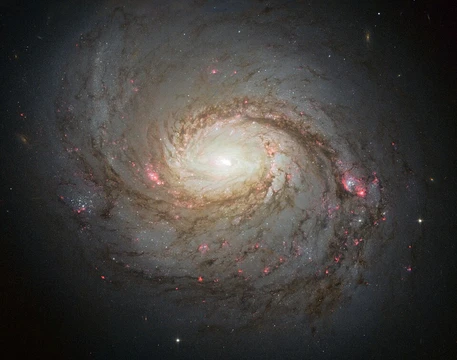
Spiral arms are not rigid structures made of the same stars circling the center; they are traffic-jam-like density waves through which gas and stars flow, meaning the arms are continually being replenished and reformed.
Why does Part 2 give barred spirals their own dedicated section?
Roughly two-thirds of nearby spirals have a central bar, and Part 2 explains how bars funnel gas inward, trigger central starbursts, and can even feed the supermassive black hole at the galaxy's core—making them a key driver of galactic evolution.
What is a 'grand design' spiral and why do fans love them?
A grand design spiral has two clean, well-defined arms (like M51 or M81), and Part 2 notes that their striking symmetry makes them favorites in both public photography and theoretical modeling, even though they represent only a minority of all spirals.
Which notable discovery or moment does Part 2 highlight as a turning point?
The 1940s work by Oort and the later 1960s density-wave papers by Lin, Shu, and others are presented as the pivotal shift from viewing arms as material structures to understanding them as wave phenomena, a reframing the encyclopedia calls the field's 'big bang moment.'
How does Part 2 explain what happens when two spiral galaxies collide?
It walks through the multi-stage process—first a tidal tail, then a chaotic 'merger remnant' with a central elliptical core, and finally the possible re-growth of a new disk—using the Antennae Galaxies and NGC 4676 as running examples.
What does Part 2 say about where new stars actually form in a spiral?
Star formation is concentrated in the dense molecular clumps along the inner edges of spiral arms, and the encyclopedia points out that the bright blue patches visible in images mark those active birth regions rather than the arms as a whole.
How does Part 2 connect back to Part 1 for readers who already finished the first volume?
It assumes you already know the Hubble sequence labels (Sa, Sb, Sc) and can recognize a lenticular galaxy, then builds on that foundation to explore *why* those types exist, how a galaxy can transition between them, and what future observations will test next.