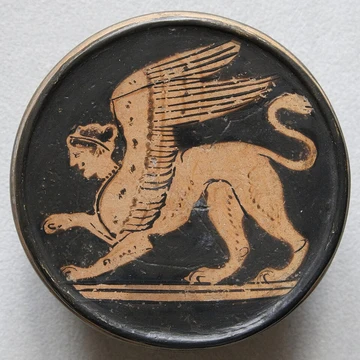
Sphinx of Naxos
Marble sphinx votive offering from Naxos at Delphi.
Last updated
The Sphinx of Naxos, also known as the Sphinx of the Naxians, is a 2.22-meter-tall marble statue of a mythical sphinx, with the head of a woman, the chest and wings of a prey bird, and the body of a lioness. It stood on a 10-meter column topped with one of the first Ionic capitals, erected next to the Temple of Apollo in Delphi around 560 BCE as a votive offering by the island of Naxos. The monument, now housed in the Archaeological Museum of Delphi, is a notable example of early Greek sculpture in-the-round.
Quick Facts
- Material
- Marble (Naxian marble)
- Height
- 2.22 meters (statue); overall with column and base over 12.5 meters
- Location
- Delphi, Greece (originally next to Temple of Apollo; now in Archaeological Museum of Delphi)
- Culture
- Ancient Greek (Naxian)
- Type
- Votive offering, architectural sculpture
Facts from the source article.
Lore & Background
The Sphinx of Naxos was erected around 560 BCE by the wealthy Cycladic island of Naxos as a votive offering to the Temple of Apollo at Delphi, the religious center of ancient Greece. It stood on a tall Ionic column near the Halos, the most sacred spot where Apollo was said to have killed the python. The statue combines a woman's face with an enigmatic smile, prey bird wings, and a lioness's body, carved from a single large piece of Naxian marble. Its solid construction and detailed hair, chest, and wings give it a sense of motion and vitality, and it is an early example of carving in-the-round rather than relief.
Reader's Guide
The Sphinx of Naxos is significant as a major votive monument from the Archaic period, reflecting the wealth and artistic skill of Naxos in the 6th century BCE. Its placement at Delphi, the pan-Hellenic religious center, underscores its role as a guardian figure, a common function of sphinxes in Greek architecture. The monument's height—over 12.5 meters including column and base—would have inspired awe in visitors. The column's Ionic capital is among the earliest known, marking an important development in Greek architectural orders.
Fragments were first excavated in 1860, with the remainder found in 1893. A later inscription from 328–327 BCE records Delphi renewing the Naxians' right of promanteia (priority in consulting the oracle). The Sphinx of Naxos also belongs to a broader tradition of sphinx-topped columns in ancient Greece, and some scholars suggest it may have influenced the later pillars of Ashoka in India following Alexander the Great's contacts.
Frequently Asked Questions
What are the Sphinx of Naxos's dimensions and materials?
The statue itself stands 2.22 meters tall and is carved from Naxian marble. When mounted on its 10-meter column topped with an Ionic capital, the full monument exceeded 12.5 meters in overall height.
What is the Sphinx of Naxos's role or purpose?
It served as a votive offering from the island of Naxos, placed at Delphi to honor the gods and display the island's wealth and devotion. As an architectural sculpture, it functioned as a prominent landmark next to the Temple of Apollo.
More in Sphinxes
Sources
Compiled from Wikipedia and the sources listed below. Text from Wikipedia is available under CC BY-SA 4.0; this entry is adapted from it.
- Wikipedia: Sphinx of Naxos (CC BY-SA 4.0).
Spotted an error? Know more?
Reader corrections go straight into our review queue. Suggest an edit · How this site is sourced