Jaguar round crab (Xantho poressa)
Source-cited species reference: taxonomy from WoRMS, biology from SeaLifeBase, occurrence map from GBIF, description from Wikipedia.
Last updated

George Chernilevsky · via Wikipedia: Xantho poressa · CC BY-SA 3.0
Xantho poressa, the jaguar round crab, is a species of crab from the eastern Atlantic Ocean. It is one of four species in the genus Xantho.
Scientific classification
- KingdomAnimalia
- PhylumArthropoda
- CladePancrustacea
- ClassMalacostraca
- OrderDecapoda
- SuborderPleocyemata
- InfraorderBrachyura
- FamilyXanthidae
- GenusXantho
- SpeciesXantho poressa
Named by (Olivi, 1792)
Close relatives
Other species of Xantho with a Codexery entry.
- Xantho hydrophilus Xantho hydrophilus
Sources: Wikipedia taxobox: Xantho poressa (CC BY-SA 4.0) · order, family and genus agree with WoRMS AphiaID 107442 (CC BY 4.0)
How big is it?
Largest length in the source, 0.04 m, next to a 1.8 m person.
Diagram: drawn by Codexery, schematic shapes to scale (not a likeness). Length: SeaLifeBase species summary
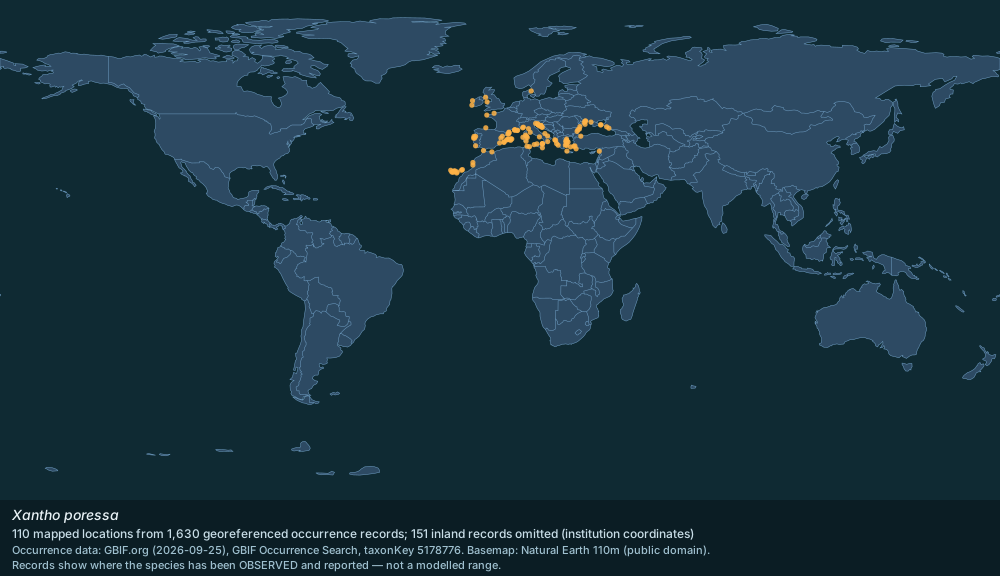
Where the jaguar round crab (xantho poressa) has been recorded
Each dot is a place where the species has been observed and reported (1,630 records, half-degree grid) — not a modelled range. 144 inland records left out (institution coordinates).
Map: drawn by Codexery. Data: GBIF occurrence search (records CC0 / CC BY) · Natural Earth basemap (public domain) · place coordinates: Wikipedia (CC BY-SA 4.0)
Classification (WoRMS)
Full classification as recorded by WoRMS: Kingdom: Animalia · Phylum: Arthropoda · Class: Malacostraca · Order: Decapoda · Family: Xanthidae · Genus: Xantho.
Accepted name: Xantho poressa · Authority: (Olivi, 1792) · Taxonomic status: accepted · AphiaID: 107442.
Synonyms and superseded combinations recorded for this taxon: Cancer levifrons Rafinesque, 1814; Cancer poressa Olivi, 1792; Cancer tinctor Fabricius, 1798; Xantho rivulosa Risso, 1827; Xantho rivulosus Risso, 1827; Xantho zonata O Costa, 1838.
Source: World Register of Marine Species (WoRMS) — https://www.marinespecies.org/aphia.php?p=taxdetails&id=107442 (CC BY 4.0). Accessed 2026-09-25.
Biology and life history (SeaLifeBase)
Measured values published by SeaLifeBase for Xantho poressa. Only fields the database actually holds for this species are shown; these are database values, not aquarium guidance.
Maximum length: 4 cm · Habitat zone: benthic · Vulnerability index: 10 of 100.
Source: SeaLifeBase species summary (SpecCode 9336) — https://www.sealifebase.se/summary/Xantho-poressa.html (CC BY-NC 3.0 — non-commercial use only). Accessed 2026-09-25.
Distribution and occurrence records (GBIF)
1,630 georeferenced occurrence records for Xantho poressa are published through GBIF from 29 countries or marine areas. The map above plots 110 distinct locations from a sample of 1,630 records, omitting 151 inland records that carry an institution's coordinates rather than a collection site; it shows where the species has been observed and reported, not a modelled range.
Most records by country or area: Spain (533); France (208); Croatia (186); Portugal (157); Greece (121).
The full country table, WoRMS marine regions and the sampling notes are on this species' Distribution page.
Source: GBIF Occurrence Search (taxonKey 5178776) — https://www.gbif.org/occurrence/search?taxon_key=5178776&has_coordinate=true (records CC0 / CC BY); WoRMS distribution records (MarineRegions) — https://www.marinespecies.org/aphia.php?p=taxdetails&id=107442 (CC BY 4.0); Natural Earth 110m basemap — https://www.naturalearthdata.com/ (public domain). Accessed 2026-09-25.
Description and natural history (Wikipedia)
The juveniles of X. poressa are cryptically coloured as camouflage among the epibionts on the leaves of Posidonia with a variable carapace colour, which can be yellowish, reddish, brown, or dark grey with patches of another colour, usually white. The pereiopods are usually banded with dark brown or black bands alternating with white or translucent stripes or spots, although the fifth pereiopod is brighter and often unmarked. The adults are uniformly dark grey in colour and they leave the seagrass beds for more open, rocky substrates.
X. poressa is distributed throughout the Black Sea and the Mediterranean Sea and into the warmer parts of the north eastern Atlantic to the Canary Islands.
The larvae of X. poressa go through four zoeal and one megalopal stages, which are typical of most of the related species of crabs in the subfamily Xanthinae. The duration of each zoeal stage is 2–4 days and the megalopa stage lasts an average of 10 days, with the first juvenile crab stage being reached after 23 days. Juveniles live in Posidonia meadows until their last moult, when they migrate to the nearest rocky substrate. In the Black Sea, X. poressa is common near the shoreline at depths less than 1 m; it is mainly found stones on substrates of pebble and crushed rock; it is rare on the other substrates and may occur down to 15 m in depth.
Source: Wikipedia: Xantho poressa — https://en.wikipedia.org/wiki/Xantho_poressa (CC BY-SA 4.0). Accessed 2026-09-25.
Related in Jaguar round crab
Links follow this subject's own source article.
Elsewhere in Jaguar round crab
Sources
Compiled from Wikipedia and the sources listed below. Text from Wikipedia is available under CC BY-SA 4.0; this entry is adapted from it.
- Wikipedia: Xantho poressa (CC BY-SA 4.0).
- Classification: the source article's taxobox; order, family and genus checked against WoRMS, the World Register of Marine Species (CC BY 4.0).
- Occurrence records: GBIF (CC0 / CC BY). Basemap: Natural Earth (public domain).
- Biology values: SeaLifeBase species summary (CC BY-NC 3.0, non-commercial).
- Word definitions: the , each quoted from its Wikipedia article.
Spotted an error? Know more?
Reader corrections go straight into our review queue. Suggest an edit · How this site is sourced