
Crowded sea bell (Turbinaria ornata)
Source-cited species reference: taxonomy from WoRMS, biology from SeaLifeBase, occurrence map from GBIF, description from Wikipedia.

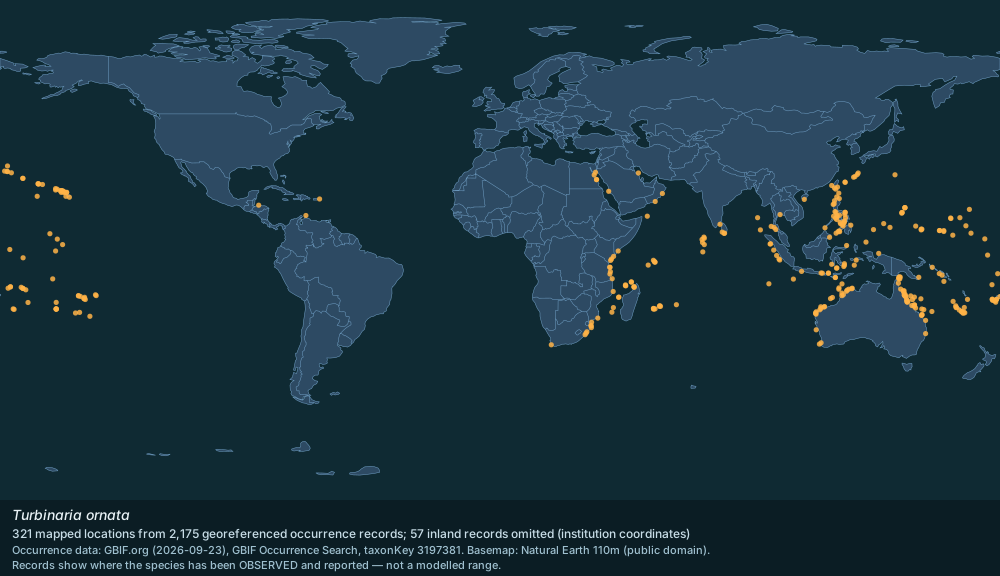
Distribution map plotted from GBIF.org occurrence records; basemap Natural Earth 110m · GBIF records CC0 / CC BY; Natural Earth public domain
Turbinaria ornata is a tropical brown algae of the order Fucales native to coral reef ecosystems of the South Pacific. Turbinaria ornata is more commonly referred to as crowded sea bells in the US and crowned sea bells worldwide. It can quickly colonize these ecosystems due in part to its method of dispersing by detaching older and more buoyant fronds that travel on surface currents, sometimes in large rafts of many individual thalli, or fronds. Some scientists are investigating whether the increase in density of seaweeds, and a decrease in living coral density, on coral reef ecosystems indicates a change in the health of the reef, focusing studies on this particular species of brown alga.
- Scientific name
- Turbinaria ornata
- Authority
- (Turner) J.Agardh, 1848
- Family
- Sargassaceae
- Order
- Fucales
- Depth range
- 0–53 m
- Habitat zone
- sessile
- Gbif occurrence records
- 2,175
Classification (WoRMS)
Full classification as recorded by WoRMS: Kingdom: Chromista · Phylum: Ochrophyta · Class: Phaeophyceae · Order: Fucales · Family: Sargassaceae · Genus: Turbinaria.
Accepted name: Turbinaria ornata · Authority: (Turner) J.Agardh, 1848 · Taxonomic status: accepted · AphiaID: 221490.
Synonyms and superseded combinations recorded for this taxon: Fucus turbinatus var. ornatus Turner, 1807; Sargassum turbinatum var. ornatum (Turner) C.Agardh, 1820.
Source: World Register of Marine Species (WoRMS) — https://www.marinespecies.org/aphia.php?p=taxdetails&id=221490 (CC BY 4.0). Accessed 2026-09-23.
Biology and life history (SeaLifeBase)
Measured values published by SeaLifeBase for Turbinaria ornata. Only fields the database actually holds for this species are shown; these are database values, not aquarium guidance.
Depth range: 0–53 m · Habitat zone: sessile · Fishery importance: commercial.
SeaLifeBase notes: Used for human consumption, as insect repellant and fertilizer; source of algin, tannins and phenols (Ref. 80758). Thrives mostly on rocky reef areas exposed to strong water turbulence, also on coralline rocks in calmer waters, commonly partially exposed during very low tides (Ref. 80758).
Source: SeaLifeBase species summary (SpecCode 108938) — https://www.sealifebase.se/summary/Turbinaria-ornata.html (CC BY-NC 3.0 — non-commercial use only). Accessed 2026-09-23.
Distribution and occurrence records (GBIF)
2,175 georeferenced occurrence records for Turbinaria ornata are published through GBIF from 56 countries or marine areas. The map above plots 321 distinct locations from a sample of 2,175 records, omitting 57 inland records that carry an institution's coordinates rather than a collection site; it shows where the species has been observed and reported, not a modelled range.
Most records by country or area: United States of America (966); Australia (309); Philippines (196); Indonesia (77); French Polynesia (71).
The full country table, WoRMS marine regions and the sampling notes are on this species' Distribution page.
Source: GBIF Occurrence Search (taxonKey 3197381) — https://www.gbif.org/occurrence/search?taxon_key=3197381&has_coordinate=true (records CC0 / CC BY); WoRMS distribution records (MarineRegions) — https://www.marinespecies.org/aphia.php?p=taxdetails&id=221490 (CC BY 4.0); Natural Earth 110m basemap — https://www.naturalearthdata.com/ (public domain). Accessed 2026-09-23.
Description and natural history (Wikipedia)
Yellow in color but can also be dark brown. It can span anywhere from 2-20 CM tall. A good way to describe it would be a club made up of spikey flowers. Turbinaria ornata can alter its morphology and strength of macroalgae in response to hydrodynamic forces.
Widely distributed in the central and western Pacific and Indian oceans. Turbinaria ornata flourishes in tropical areas such as the Hawaiian islands and Tahiti. Very common in rocky interditdal areas. Most of the time they are the most abundant species of algae in the areas where they are found, with massive colonies. Although It is considered an invasive species in some places, Turbinaria Ornata is not considered a problem species in the Hawaiian islands. Turbinaria ornata have had a massive population explosion on the reefs around the globe due to their ability to alter their morphology according to hydrodynamic forces and their ability to produce air bladders that allow them to float to distant locations.
Turbinaria ornata has a wide variety of health benefits and is being researched for pharmaceutical purposes because of its antioxidant, anti-inflammatory, antidiabetic, antiproliferative, and neuroprotective effects on humans. Turbinaria ornata has the proper compounds to be used as a potential source for reducing postprandial hyperglycemia in humans making it an alternative therapeutic approach in treating diabetes. Turbinaria ornata can be grown and used as a natural alternative wastewater treatment that would reduce untreated dangerous chemicals from being dumped into land and water bodies. Compounds found in T. ornata can also be used to restore land and bodies of water that were previously contaminated by toxic and environmentally destructive chemicals.
In Hawaiian, Turbinaria ornata is called Limu Kahili. Limu, or seaweed, and Kāhili, which is a feathered ornament which was a symbol of the royalty amongst Hawaiian families and chiefs.
Source: Wikipedia: Turbinaria ornata — https://en.wikipedia.org/wiki/Turbinaria_ornata (CC BY-SA 4.0). Accessed 2026-09-23.
Gallery
Related in Crowded sea bell
Links follow this subject's own source article.
Elsewhere in Crowded sea bell
Spotted an error? Know more?
Reader corrections go straight into our review queue. Suggest an edit · How this site is sourced