
Thinstripe hermit crab (Clibanarius vittatus)
Source-cited species reference: taxonomy from WoRMS, biology from SeaLifeBase, occurrence map from GBIF, description from Wikipedia.
The thinstripe hermit crab, Clibanarius vittatus, is a species of hermit crab in the family Diogenidae. It is found in the Caribbean Sea, the Gulf of Mexico and the western Atlantic Ocean.
- Scientific name
- Clibanarius vittatus
- Authority
- (Bosc, 1801)
- Family
- Diogenidae
- Order
- Decapoda
- Depth range
- 0–22 m
- Habitat zone
- benthic
- Gbif occurrence records
- 57,459
Classification (WoRMS)
Full classification as recorded by WoRMS: Kingdom: Animalia · Phylum: Arthropoda · Class: Malacostraca · Order: Decapoda · Family: Diogenidae · Genus: Clibanarius.
Accepted name: Clibanarius vittatus · Authority: (Bosc, 1801) · Taxonomic status: accepted · AphiaID: 367528.
Synonyms and superseded combinations recorded for this taxon: Pagurus vittatus Bosc, 1801.
Source: World Register of Marine Species (WoRMS) — https://www.marinespecies.org/aphia.php?p=taxdetails&id=367528 (CC BY 4.0). Accessed 2026-09-23.
Biology and life history (SeaLifeBase)
Measured values published by SeaLifeBase for Clibanarius vittatus. Only fields the database actually holds for this species are shown; these are database values, not aquarium guidance.
Depth range: 0–22 m · Habitat zone: benthic · Fishery importance: commercial.
SeaLifeBase notes: Intertidal, on bay and nearshore (Ref. 97531). Common on beaches and mangroves. Lives in areas associated with deposition of organic matter; susceptible to freshwater exposure (Ref. 118297). Adults mainly feed on detritus (Ref. 118298).
Source: SeaLifeBase species summary (SpecCode 26708) — https://www.sealifebase.se/summary/Clibanarius-vittatus.html (CC BY-NC 3.0 — non-commercial use only). Accessed 2026-09-23.
Distribution and occurrence records (GBIF)
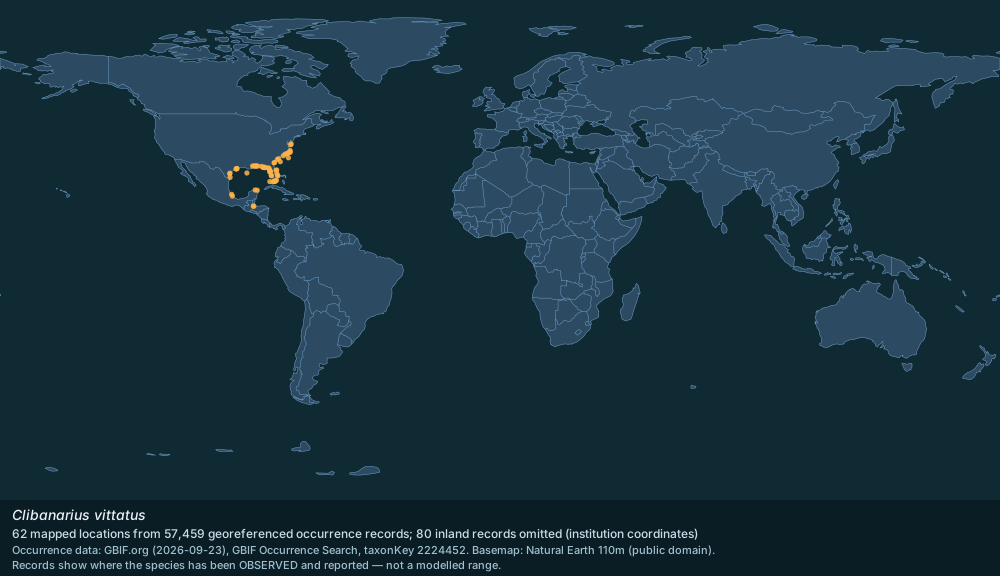
57,459 georeferenced occurrence records for Clibanarius vittatus are published through GBIF from 11 countries or marine areas. The map above plots 62 distinct locations from a sample of 3,000 records, omitting 80 inland records that carry an institution's coordinates rather than a collection site; it shows where the species has been observed and reported, not a modelled range.
Most records by country or area: United States of America (56,996); Mexico (313); Brazil (120); Guatemala (12); Colombia (9).
The full country table, WoRMS marine regions and the sampling notes are on this species' Distribution page.
Source: GBIF Occurrence Search (taxonKey 2224452) — https://www.gbif.org/occurrence/search?taxon_key=2224452&has_coordinate=true (records CC0 / CC BY); WoRMS distribution records (MarineRegions) — https://www.marinespecies.org/aphia.php?p=taxdetails&id=367528 (CC BY 4.0); Natural Earth 110m basemap — https://www.naturalearthdata.com/ (public domain). Accessed 2026-09-23.
Description and natural history (Wikipedia)
Like other hermit crabs, Clibanarius vittatus lives inside the empty shell of a gastropod mollusc. This protects its soft abdomen and normally only its head and limbs project through the aperture of the shell. The chelipeds (claw-bearing legs) and claws of Clibanarius vittatus are small, both the same size, and covered in short bristles. When threatened, the animal retreats into the shell and the chelipeds block the aperture. The outside of the claws bear small blue tubercles. The body and legs are dark green or brown; the body is faintly streaked with white and the legs have more distinct white or grey stripes. Adult crabs often occupy shells of over 10 cm in length.
Clibanarius vittatus is found in shallow parts of the Caribbean Sea, the Gulf of Mexico and the western Atlantic Ocean. Its range extends from Virginia in the eastern United States southwards as far as Brazil. It is plentiful in the Indian River Lagoon in Florida. It is more resistant to desiccation than many hermit crabs and is found in the intertidal zone as well as at depths down to about 22 m. It can be found on sand or mud, in seagrass meadows, on rock jetties, in oyster beds and in other inshore habitats.
Clibanarius vittatus is a scavenger and mostly feeds on detritus that it finds on the seabed.
Reproduction in Clibanarius vittatus is initiated by the passing of spermatophores from a male crab to a female. The egg mass of several thousand eggs is brooded by the female on her abdomen. After a few weeks the eggs hatch and the larvae are released into the water column and become planktonic. They pass through four or five zoeal stages and one post-larval, glaucothoe stage before sinking to the bottom and metamorphosing into juveniles. The free-living glaucothoe larvae sometimes finds a suitable sized shell before metamorphosis; otherwise, the juveniles need to find suitable new homes before they are consumed by predators. An adult female has several broods each year and may produce 180,000 eggs during the reproductive season.
As it grows, Clibanarius vittatus periodically needs to change the shell in which it lives. At this stage it is at its most vulnerable to predators. If a suitable vacant shell cannot be found, crabs may fight each other for shells or even kill living molluscs. The shells chosen by Clibanarius vittatus are usually whelks or conches. Species selected include the lightning whelk (Sinistrofulgur sp.), the knobbed whelk (Busycon carica), the giant triton (Monoplex parthenopeus), the moon snail (Neverita duplicata) and the Florida rocksnail (Stramonita haemastoma).
The sea anemone, Calliactis tricolor, is often found attached to the shell that is occupied by Clibanarius vittatus. This seems to be a mutualistic arrangement in which the crab benefits from the fact that potential predators are deterred by the anemone's stinging cells while the anemone gains a greater access to food as the crab moves around.
Source: Wikipedia: Thinstripe hermit crab — https://en.wikipedia.org/wiki/Thinstripe_hermit_crab (CC BY-SA 4.0). Accessed 2026-09-23.
Gallery
Related in Thinstripe hermit crab
Links follow this subject's own source article.
Elsewhere in Thinstripe hermit crab
Spotted an error? Know more?
Reader corrections go straight into our review queue. Suggest an edit · How this site is sourced