
purple urchin (Strongylocentrotus purpuratus)
Source-cited species reference: taxonomy from WoRMS, biology from SeaLifeBase, occurrence map from GBIF, description from Wikipedia.

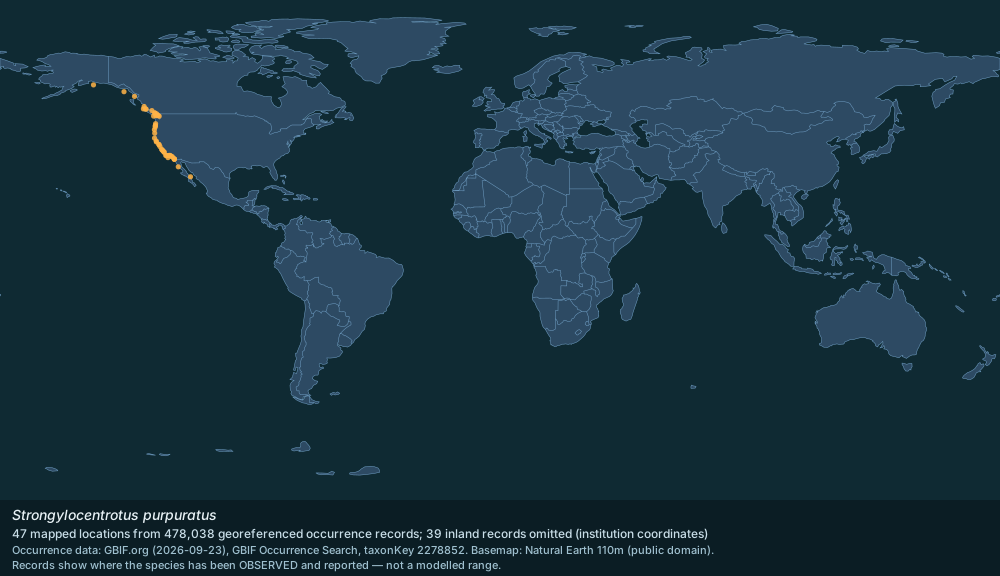
Distribution map plotted from GBIF.org occurrence records; basemap Natural Earth 110m · GBIF records CC0 / CC BY; Natural Earth public domain
Strongylocentrotus purpuratus is a species of sea urchin in the family Strongylocentrotidae, which is commonly known as the purple sea urchin or Pacific purple sea urchin. It lives along the eastern edge of the Pacific Ocean extending from Ensenada, Mexico, to British Columbia, Canada.
- Scientific name
- Strongylocentrotus purpuratus
- Authority
- (Stimpson, 1857)
- Family
- Strongylocentrotidae
- Order
- Camarodonta
- Maximum length
- 8.5 cm
- Depth range
- 0–161 m
- Habitat zone
- benthic
- Gbif occurrence records
- 478,038
Classification (WoRMS)
Full classification as recorded by WoRMS: Kingdom: Animalia · Phylum: Echinodermata · Class: Echinoidea · Order: Camarodonta · Family: Strongylocentrotidae · Genus: Strongylocentrotus.
Accepted name: Strongylocentrotus purpuratus · Authority: (Stimpson, 1857) · Taxonomic status: accepted · AphiaID: 240747.
Synonyms and superseded combinations recorded for this taxon: Echinus purpuratus Stimpson, 1857; Loxechinus purpuratus (Stimpson, 1857); Toxocidaris purpuratus (Stimpson, 1857).
Source: World Register of Marine Species (WoRMS) — https://www.marinespecies.org/aphia.php?p=taxdetails&id=240747 (CC BY 4.0). Accessed 2026-09-23.
Biology and life history (SeaLifeBase)
Measured values published by SeaLifeBase for Strongylocentrotus purpuratus. Only fields the database actually holds for this species are shown; these are database values, not aquarium guidance.
Maximum length: 8.5 cm · Depth range: 0–161 m · Habitat zone: benthic · Vulnerability index: 10 of 100.
SeaLifeBase notes: It is found on rocks from the low intertidal to a depth of 10 meters (Ref. 865).
Source: SeaLifeBase species summary (SpecCode 49326) — https://www.sealifebase.se/summary/Strongylocentrotus-purpuratus.html (CC BY-NC 3.0 — non-commercial use only). Accessed 2026-09-23.
Distribution and occurrence records (GBIF)
478,038 georeferenced occurrence records for Strongylocentrotus purpuratus are published through GBIF from 9 countries or marine areas. The map above plots 47 distinct locations from a sample of 3,000 records, omitting 39 inland records that carry an institution's coordinates rather than a collection site; it shows where the species has been observed and reported, not a modelled range.
Most records by country or area: United States of America (475,938); Canada (1,848); Mexico (209); Sweden (36); Denmark (2).
The full country table, WoRMS marine regions and the sampling notes are on this species' Distribution page.
Source: GBIF Occurrence Search (taxonKey 2278852) — https://www.gbif.org/occurrence/search?taxon_key=2278852&has_coordinate=true (records CC0 / CC BY); WoRMS distribution records (MarineRegions) — https://www.marinespecies.org/aphia.php?p=taxdetails&id=240747 (CC BY 4.0); Natural Earth 110m basemap — https://www.naturalearthdata.com/ (public domain). Accessed 2026-09-23.
Description and natural history (Wikipedia)
After one of its main predators, the sea otter, experienced a population decline, Strongylocentrotus purpuratus became a threat to the health of kelp forests as its own population boomed. The species is also used as a model organism and its genome was the first echinoderm genome to be sequenced.
As the common and specific names suggest, S. purpuratus is deep purple in color. It lives in lower intertidal and nearshore subtidal communities. Its eggs are orange when secreted in water. January, February, and March function as the typical active reproductive months for the species. Sexual maturity is reached around two years. It normally grows to a diameter of about 10 cm, consisting of a form of exoskeleton called a test. They may live as long as 70 years.
The genome of the purple sea urchin was completely sequenced and annotated in 2006 by teams of scientists from over 70 institutions including the Kerckhoff Marine Laboratory at the California Institute of Technology as well as the Human Genome Sequencing Center at the Baylor College of Medicine. A new improved version of the purple sea urchin genome, Strongylocentrotus purpuratus v5.0, is now available on Echinobase. S. purpuratus is one of several biomedical research model organisms in cell and developmental biology. The sea urchin is the first animal with a sequenced genome that (1) is a free-living, motile marine invertebrate; (2) has a bilaterally organized embryo but a radial adult body plan; (3) has the endoskeleton and water vascular system found only in echinoderms; and (4) has a nonadaptive immune system that is unique in the enormous complexity of its receptor repertoire.
The sea urchin genome is estimated to encode about 23,500 genes. The S. purpuratus has 353 protein kinases, containing members of 97% of human kinase subfamilies. Many of these genes were previously thought to be vertebrate innovations or were only known from groups outside the deuterostomes. The team sequencing the species concluded that some genes are not vertebrate specific as thought previously, while other genes still were found in the urchin but not the chordate.
The genome is largely non-redundant, making it very comparable to vertebrates, but without the complexity. For example, 200 to 700 chemosensory genes were found that lacked introns, a feature typical of vertebrates. Thus the sea urchin genome provides a comparison to our own and those of other deuterostomes, the larger group to which both echinoderms and humans belong. Sea urchins are also the closest living relative to chordates. Using the strictest measure, the purple sea urchin and humans share 7,700 genes. Many of these genes are involved in sensing the environment, a fact surprising for an animal lacking a head structure.
The sea urchin also has a chemical defensome that reacts when stress is sensed to eliminate potentially toxic chemicals. S. purpuratuss immune systems contains innate pathogen receptors like Toll-like receptors and genes that encode for LRR. There were genes identified for Biomineralization that were not counterparts of the typical human vertebrate variety (SCCPs), and encode for transmembrane proteins like P16. Many orthologs exist for genes associated with human diseases, such as Reelin (from Norman-Roberts lissencephaly syndrome) and many cytoskeletal proteins of the Usher syndrome network like usherin and VLGR1.
Increasing carbon dioxide concentrations affect the epigenome, gene expression, and phenotype of the purple sea urchin. Carbon dioxide concentration also reduces the size of its larvae, which indicates that fitness of the larvae could be negatively impacted.
The purple sea urchin, along with sea otters and abalones, is a prominent member of the kelp forest community. The purple sea urchin also plays a key role in the disappearance of kelp forests that is currently occurring due to climate change; when urchins completely eliminate kelp from an area, it results in an urchin barren. The purple sea urchin cohabits with the red urchin (Mesocentrotus franciscanus) and the two species exhibit niche partitioning.
Sea urchins like the purple sea urchin have been used for food by the indigenous peoples of California, who ate the yellow egg mass raw.
In California, the peak gonad growth season (and therefore peak of edibility) is September–October. Early in the season, the gonads are still growing and the yield will be smaller. From November onwards the gonads are developed, however harvesting stress can induce spawning, decreasing quality.
Three distinct eukaryotic DNA-dependent RNA polymerases were found within the model organism S. purpuratus. Alongside the investigation of embryonic development, orthologs to human diseases have led scientists to investigate potential therapeutic uses for sequences found in Strongylocentrotus purpuratus. In 2012, scientists at the University of St Andrews began investigating the "2A" viral region in the S. purpuratus genome which may be useful for Alzheimer's disease and cancer research. The study identified a sequence that can return cells to a 'stem-cell' like state. This trait has made the species a candidate in longevity studies, particularly because of its ability to regenerate damaged or aging tissue, which was found to be upheld in older specimens as they suffered no significant disadvantages compared to younger ones.
Source: Wikipedia: Strongylocentrotus purpuratus — https://en.wikipedia.org/wiki/Strongylocentrotus_purpuratus (CC BY-SA 4.0). Accessed 2026-09-23.
Gallery
Related in purple urchin
Links follow this subject's own source article.
Elsewhere in purple urchin
Spotted an error? Know more?
Reader corrections go straight into our review queue. Suggest an edit · How this site is sourced