Tasselled anglerfish (Rhycherus filamentosus)
Source-cited species reference: taxonomy from WoRMS, biology from FishBase, occurrence map from GBIF, conservation from IUCN Red List, description from Wikipedia.
Last updated

Scubagirl85 · via Wikipedia: Rhycherus filamentosus · CC BY-SA 3.0
Rhycherus filamentosus, commonly known as the tasselled anglerfish, is a species of frogfish endemic to southern Australia in the southwestern Pacific Ocean and southeastern Indian Ocean. It is a well-camouflaged predator and lies in wait on the seabed for unwary prey to approach too close.
Scientific classification
- KingdomAnimalia
- PhylumChordata
- ClassActinopterygii
- DivisionTeleostei
- OrderLophiiformes
- FamilyAntennariidae
- GenusRhycherus
- SpeciesRhycherus filamentosus
Named by (Castelnau, 1872)
Sources: Wikipedia taxobox: Rhycherus filamentosus (CC BY-SA 4.0) · differs from this box at family: WoRMS AphiaID 282605 (CC BY 4.0)
Conservation status
Least Concern (LC)
- LC▲ this species
- NT
- VU
- EN
- CR
- EW
- EX
Source: IUCN Red List assessment · GBIF copy of the Red List category
How big is it?
Largest length in the source, 0.23 m, next to a 1.8 m person.
Diagram: drawn by Codexery, schematic shapes to scale (not a likeness). Length: Wikipedia: Rhycherus filamentosus
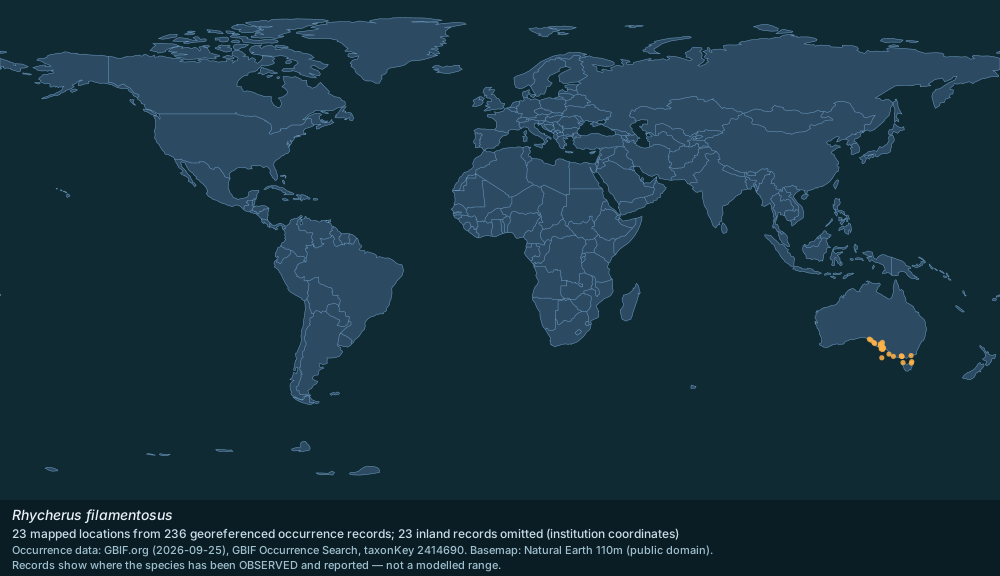
Where the tasselled anglerfish (rhycherus filamentosus) has been recorded
Each dot is a place where the species has been observed and reported (236 records, half-degree grid) — not a modelled range. 23 inland records left out (institution coordinates).
Map: drawn by Codexery. Data: GBIF occurrence search (records CC0 / CC BY) · Natural Earth basemap (public domain) · place coordinates: Wikipedia (CC BY-SA 4.0)
Classification (WoRMS)
Full classification as recorded by WoRMS: Kingdom: Animalia · Phylum: Chordata · Class: Teleostei · Order: Lophiiformes · Family: Rhycheridae · Genus: Rhycherus.
Accepted name: Rhycherus filamentosus · Authority: (Castelnau, 1872) · Taxonomic status: accepted · AphiaID: 282605.
Synonyms and superseded combinations recorded for this taxon: Chironectes bifurcatus McCoy, 1886; Chironectes filamentosus Castelnau, 1872; Rhycherus wildii Ogilby, 1907; Rycherus wildii Ogilby, 1907.
Source: World Register of Marine Species (WoRMS) — https://www.marinespecies.org/aphia.php?p=taxdetails&id=282605 (CC BY 4.0). Accessed 2026-09-25.
Biology and life history (FishBase)
Measured values published by FishBase for Rhycherus filamentosus. Only fields the database actually holds for this species are shown; these are database values, not aquarium guidance.
Maximum length: 23 cm · Depth range: 0–60 m · Habitat zone: reef-associated · Body shape: other · Vulnerability index: 13 of 100 · Aquarium trade: never/rarely.
FishBase notes: A temperate species found inshore on reefs (Ref. 7300) to at least a depth of 45 m (Ref. 9563). Minimum depth reported taken from Ref. 57178.
Source: FishBase species summary (SpecCode 14048) — https://www.fishbase.se/summary/Rhycherus-filamentosus.html (CC BY-NC 3.0 — non-commercial use only). Accessed 2026-09-25.
Distribution and occurrence records (GBIF)
236 georeferenced occurrence records for Rhycherus filamentosus are published through GBIF from 1 countries or marine areas. The map above plots 23 distinct locations from a sample of 236 records, omitting 23 inland records that carry an institution's coordinates rather than a collection site; it shows where the species has been observed and reported, not a modelled range.
Most records by country or area: Australia (236).
Source: GBIF Occurrence Search (taxonKey 2414690) — https://www.gbif.org/occurrence/search?taxon_key=2414690&has_coordinate=true (records CC0 / CC BY); WoRMS distribution records (MarineRegions) — https://www.marinespecies.org/aphia.php?p=taxdetails&id=282605 (CC BY 4.0); Natural Earth 110m basemap — https://www.naturalearthdata.com/ (public domain). Accessed 2026-09-25.
Conservation status (IUCN Red List)
The IUCN Red List assesses Rhycherus filamentosus (Castelnau 1872) as Least Concern (code LC). No trend, population estimate or threat analysis is given here, because none is available from this source without the Red List API; follow the source link for the full assessment, including its date.
Source: IUCN Red List of Threatened Species (taxon 207614261) — https://www.iucnredlist.org/species/207614261/0; GBIF IUCN Red List category endpoint (taxonKey 2414690) — https://api.gbif.org/v1/species/2414690/iucnRedListCategory. Accessed 2026-09-25.
Description and natural history (Wikipedia)
This fish was one of a number of species of fish trawled up from Gulf St Vincent in Southern Australia by Frederick George Waterhouse, the curator of the South Australian Museum. He sent these specimens to the French naturalist Francis de Laporte de Castelnau who was the French consul in Melbourne. de Castelnau formally described this fish in 1872, giving it the name Chironectes filamentosus, but it was later transferred to the genus Rhycherus, making it Rhycherus filamentosus.
Frogfish in this family have compressed, globose bodies, laterally-placed eyes and large, obliquely-slanting mouths. The first dorsal spine is modified into an elongated, slender illicium which is tipped by an esca, a whitish, worm-like lure.
Rhycherus filamentosus can grow to a total length of about 23 cm. The skin is copiously decorated with threads and filaments that resemble fronds of red algae. The basic colour of this well-camouflaged fish is reddish-brown, with vertical bars and patches of dark and pale brown, and whitish underparts.
Rhycherus filamentosus is endemic to Australia and occurs in the southeastern Indian Ocean as well as the southwestern Pacific Ocean. Its range extends from Spencer Gulf in South Australia at 130°E to the eastern end of the Bass Strait at 149°E. It is associated with reefs and can be found down to about 60 m.
A benthic fish, R. filamentosus lives on the seabed and rarely swims, instead moving around with its pectoral and pelvic fins in a kind of "walk". It is a well-camouflaged ambush predator; it rests on the seabed and when a potential prey approaches, it starts to waggle its esca. If the prey comes closer, the fish positions itself for action, and then strikes with great rapidity by opening its mouth and drawing in the prey by suction.
Source: Wikipedia: Rhycherus filamentosus — https://en.wikipedia.org/wiki/Rhycherus_filamentosus (CC BY-SA 4.0). Accessed 2026-09-25.
Sources
Compiled from Wikipedia and the sources listed below. Text from Wikipedia is available under CC BY-SA 4.0; this entry is adapted from it.
- Wikipedia: Rhycherus filamentosus (CC BY-SA 4.0).
- Classification: the source article's taxobox; compare WoRMS, the World Register of Marine Species (CC BY 4.0).
- Conservation status: IUCN Red List assessment.
- Occurrence records: GBIF (CC0 / CC BY). Basemap: Natural Earth (public domain).
- Biology values: FishBase species summary (CC BY-NC 3.0, non-commercial).
- Word definitions: the , each quoted from its Wikipedia article.
Spotted an error? Know more?
Reader corrections go straight into our review queue. Suggest an edit · How this site is sourced