
Red sea urchin (Mesocentrotus franciscanus)
Source-cited species reference: taxonomy from WoRMS, biology from SeaLifeBase, occurrence map from GBIF, description from Wikipedia.

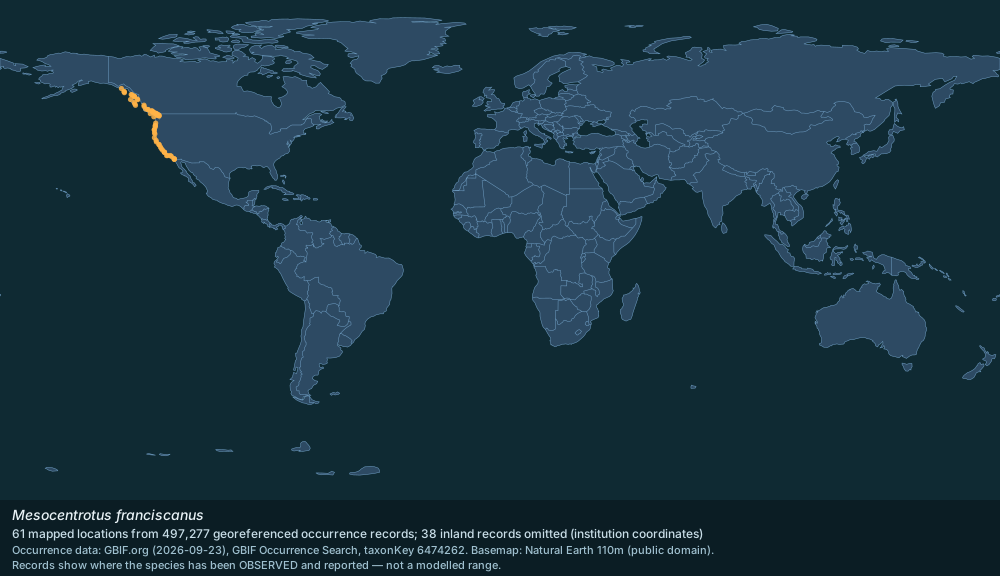
Distribution map plotted from GBIF.org occurrence records; basemap Natural Earth 110m · GBIF records CC0 / CC BY; Natural Earth public domain
The red sea urchin (Mesocentrotus franciscanus) is a sea urchin found in the northeastern Pacific Ocean from Alaska to Baja California. It lives in shallow waters from the low-tide line to greater than 280 m deep, and is typically found on rocky shores sheltered from extreme wave action in areas where kelp is available.
- Scientific name
- Mesocentrotus franciscanus
- Authority
- (A. Agassiz, 1863)
- Family
- Strongylocentrotidae
- Order
- Camarodonta
- Maximum length
- 19 cm
- Depth range
- 0–125 m
- Habitat zone
- benthic
- Gbif occurrence records
- 497,277
Classification (WoRMS)
Full classification as recorded by WoRMS: Kingdom: Animalia · Phylum: Echinodermata · Class: Echinoidea · Order: Camarodonta · Family: Strongylocentrotidae · Genus: Mesocentrotus.
Accepted name: Mesocentrotus franciscanus · Authority: (A. Agassiz, 1863) · Taxonomic status: accepted · AphiaID: 591102.
Synonyms and superseded combinations recorded for this taxon: Strongylocentrotus franciscanus (A. Agassiz, 1863); Toxocidaris franciscana A. Agassiz, 1863; Toxocidaris franciscanus A. Agassiz, 1863.
Source: World Register of Marine Species (WoRMS) — https://www.marinespecies.org/aphia.php?p=taxdetails&id=591102 (CC BY 4.0). Accessed 2026-09-23.
Biology and life history (SeaLifeBase)
Measured values published by SeaLifeBase for Mesocentrotus franciscanus. Only fields the database actually holds for this species are shown; these are database values, not aquarium guidance.
Maximum length: 19 cm · Depth range: 0–125 m · Habitat zone: benthic · Vulnerability index: 39.8 of 100 · Fishery importance: commercial.
SeaLifeBase notes: Harvestable size is around 9-10 cm test diameter (4-5 years in age) (Ref. 121955). Found in relatively high energy environments on open rocky intertidal and subtidal shores (Ref. 121802). Herbivorous grazer in nearshore habitats (Ref. 121801). Kelp forest species (Ref. 121804). Found in concentrated amount at the apex of the holdfast of the giant kelp Macrocystis pyrifera (Ref. 121803).
Source: SeaLifeBase species summary (SpecCode 49324) — https://www.sealifebase.se/summary/Mesocentrotus-franciscanus.html (CC BY-NC 3.0 — non-commercial use only). Accessed 2026-09-23.
Distribution and occurrence records (GBIF)
497,277 georeferenced occurrence records for Mesocentrotus franciscanus are published through GBIF from 4 countries or marine areas. The map above plots 61 distinct locations from a sample of 3,000 records, omitting 38 inland records that carry an institution's coordinates rather than a collection site; it shows where the species has been observed and reported, not a modelled range.
Most records by country or area: United States of America (495,502); Canada (1,705); Mexico (66); Russian Federation (1).
The full country table, WoRMS marine regions and the sampling notes are on this species' Distribution page.
Source: GBIF Occurrence Search (taxonKey 6474262) — https://www.gbif.org/occurrence/search?taxon_key=6474262&has_coordinate=true (records CC0 / CC BY); WoRMS distribution records (MarineRegions) — https://www.marinespecies.org/aphia.php?p=taxdetails&id=591102 (CC BY 4.0); Natural Earth 110m basemap — https://www.naturalearthdata.com/ (public domain). Accessed 2026-09-23.
Description and natural history (Wikipedia)
A sea urchin's spherical body is completely covered by sharp spines. These spines grow on a hard shell called the "test", which encloses the animal. It can vary in color from red to dark burgundy. Rarely, albino specimens are found. It has a mouth located on its underside, which is surrounded by five teeth. During larval development, the body of a sea urchin transitions from bilateral to radial symmetry.
This bilaterally symmetrical larva, called an echinopluteus, subsequently develops a type of pentaradiate symmetry that characterizes echinoderms. It crawls very slowly over the sea bottom using its spines as stilts, with the help of its tube feet. Scattered among its spines are rows of tiny tube feet with suckers that help it to move and stick to the sea floor.
This animal has a mouth with special jaws (Aristotle's lantern) located on the bottom (oral) surface. Its preferred diet is seaweeds and algae, including giant kelp (Macrocystis pyrifera) and bull kelp (Nereocystis luetkeana), which it scrapes off and tears up from the sea floor. Adults may consume plankton (particularly Lithothamnion sp. and Bossiella sp.) if other food sources are not available. During larval development, urchins use bands of cilia to capture food (namely zooplankton) from the water column. Red sea urchins found in the channel adjacent to San Juan Island have been found to live a uniquely sedentary lifestyle with the heavy currents bringing an abundance of food.
Sea urchins are often found living in groups of five to ten individuals. They can regenerate lost spines. Their lifespan frequently exceeds 30 years, and marine biologists have discovered some species with dramatically longer lifespans; certain individuals have been estimated to live for more than 200 years. Red sea urchins are notoriously ravenous kelp-eaters and are implicated in devastating kelp beds by forming grazing fronts. The intense grazing pressure exerted by urchins is an important link in a trophic cascade often observed along the west coast of North America in which sea otter predation influences urchin abundance, which in turn influences kelp devastation. In contrast to their negatively perceived impact on community structure in open coastal kelp beds, the sedentary behavior and capture of detrital seaweed in the San Juan Islands is hypothesized to create an important habitat and energy source below the photic zone. These diverse ecosystem effects of red urchins highlight their importance as ecosystem engineers in temperate rocky reef ecosystems.
Spawning peaks between June and September. Eggs are fertilized externally while they float in the ocean, and planktonic larvae remain in the water column for about a month before settling on the bottom of the sea floor, where they undergo metamorphosis into juvenile urchins. These juveniles use chemical cues to locate adults. Although juveniles are found almost exclusively under aggregated adults, the adults and juveniles are not directly related.
Source: Wikipedia: Red sea urchin — https://en.wikipedia.org/wiki/Red_sea_urchin (CC BY-SA 4.0). Accessed 2026-09-23.
Gallery
Related in Red sea urchin
Links follow this subject's own source article.
Elsewhere in Red sea urchin
Spotted an error? Know more?
Reader corrections go straight into our review queue. Suggest an edit · How this site is sourced