Where Queen angelfish has been recorded
GBIF occurrence records for Holacanthus ciliaris, mapped and tabulated by country.

40,077 georeferenced occurrence records with coordinates are published for Holacanthus ciliaris through GBIF, from 46 countries or marine areas. This page maps those records and lists where they come from. Occurrence records reflect where people have looked as well as where the species lives, so well-surveyed coastlines are over-represented.
- Georeferenced records
- 40,077
- Countries / areas
- 46
- Mapped locations
- 125
- Records sampled for the map
- 3,000
- Inland records omitted
- 15
- Gbif taxonkey
- 5211452
Evolutionary Roots & Taxonomic Journey
The queen angelfish's scientific story stretches back to 1758, when Carl Linnaeus catalogued the species as Chaetodon ciliaris in the tenth edition of his Systema Naturae, anchoring its type locality to the Western Atlantic and Caribbean. Nearly half a century later, French naturalist Bernard Germain de Lacépède reassigned it to the genus Holacanthus, a name drawn from two Ancient Greek roots meaning "full" and "spine." The specific epithet ciliaris, meaning "fringed," nods to the fish's ciliate scales. Molecular evidence suggests the Holacanthus genus first diverged between 10.2 and 7.6 million years ago, with the Guinean angelfish of West Africa sitting as the sister lineage to every other member—pointing to an original colonization of the Atlantic from the Indian Ocean. The later closure of the Isthmus of Panama, roughly 3.5 to 3.1 million years ago, carved off the Tropical Eastern Pacific species. The queen angelfish's closest living relative is the Bermuda blue angelfish, its sister species, from which it split approximately 1.5 million years ago. Remarkably, the two can still interbreed, producing the fertile Townsend angelfish, a hybrid that carries blended traits of both parents and can itself mate with either species.
A Crown of Blue: Form & Colour Variation
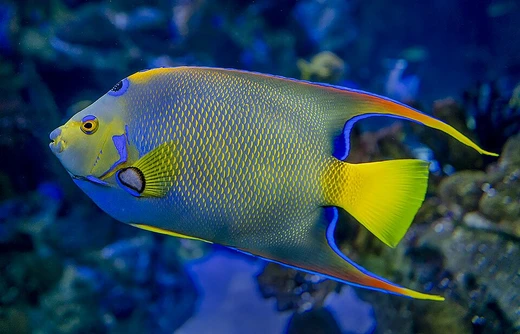
The adult queen angelfish presents a broad, laterally compressed oval body with a triangular caudal fin, a reduced snout, and a small mouth bearing bristle-like teeth. Its dorsal fin carries fourteen spines and nineteen to twenty-one soft rays; the anal fin has three spines and twenty to twenty-one soft rays, both trailing behind the body. The species reaches a maximum of forty-five centimetres and 1,600 grams, with males tending to outsize females. The most striking feature is the forehead "crown"—a cobalt-blue ocellus ringed in electric blue and speckled with electric-blue dots—that separates it from the look-alike Bermuda blue angelfish. The body is sheathed in blue-green scales tipped with yellow, while the tail, pectoral, and pelvic fins blaze bright yellow. Juveniles look entirely different: dark blue with vivid vertical stripes and a yellow pectoral patch. Beyond the standard palette, seven additional colour morphs have been documented off the Saint Peter and Saint Paul Archipelago in Brazil, ranging from a dominant gold-orange form to all-white individuals. A further cobalt-blue-and-white morph was recorded near Dry Tortugas, Florida, in 2009. At least two wild fish at the archipelago also display a "pughead" skeletal deformity.
Harem Life, Courtship & the Cleaner-Fish Years
The social world of the queen angelfish revolves around a male who holds a large territory and tends a harem of two to four females. The species is presumed to be protogynous—individuals likely begin life as females, and the largest harem female can transform into a male if the dominant one vanishes. During the day, each female forages independently at a different spot while the male shuttles between them, rushing at her, circling, and feeding alongside her. Spawning happens year-round but is timed around a full moon. Courtship involves the male displaying his flank to the female and flicking his pectoral fins, after which the pair release transparent eggs that drift in the water column until they hatch. A fascinating early-life role belongs to the juveniles: before developing their adult colouration, young queen angelfish serve as cleaner fish, establishing stations where they pick ectoparasites off the bodies of larger species. As they grow, they pass through transitional patterns before settling into the familiar blue-and-yellow adult livery.
Range, Selective Feeding & Conservation Outlook
The queen angelfish inhabits tropical and subtropical waters of the Western Atlantic, stretching from Florida along the Gulf of Mexico and through the Caribbean down to Brazil, with its range extending eastward to Bermuda and the remote Saint Peter and Saint Paul Archipelago. As a benthic species, it ranges from shallow coastal waters to depths of seventy metres, favouring coral reefs—particularly those dominated by soft corals—and swims either solo or in pairs. Adults are notably selective feeders. Their menu includes sponges, tunicates, jellyfish, corals, plankton, and algae, but the proportion of each in their diet does not simply mirror local abundance. Off St. Thomas and Salvador, Bahia, sponges make up roughly ninety percent of adult intake, while at the Saint Peter and Saint Paul Archipelago the fish consume over thirty prey species, with sponges at sixty-eight percent, algae at twenty-five, and bryozoans at five. They specifically target rarer sponge species such as Geodia neptuni and Erylus latens. In the aquarium trade, the queen angelfish is a popular export, particularly from Brazil. A 2010 IUCN assessment rated the species as least concern, noting that wild populations appeared stable.
Related in Queen angelfish
Links follow this subject's own source article.
Elsewhere in Queen angelfish
Spotted an error? Know more?
Reader corrections go straight into our review queue. Suggest an edit · How this site is sourced