
Tuberculate pear crab (Pyromaia tuberculata)
Source-cited species reference: taxonomy from WoRMS, biology from SeaLifeBase, occurrence map from GBIF, description from Wikipedia.
Pyromaia tuberculata is a species of crab in the family Inachoididae.
- Scientific name
- Pyromaia tuberculata
- Authority
- (Lockington, 1877)
- Family
- Inachoididae
- Order
- Decapoda
- Maximum length
- 1.58 cm
- Habitat zone
- benthic
- Gbif occurrence records
- 888
Classification (WoRMS)
Full classification as recorded by WoRMS: Kingdom: Animalia · Phylum: Arthropoda · Class: Malacostraca · Order: Decapoda · Family: Inachoididae · Genus: Pyromaia.
Accepted name: Pyromaia tuberculata · Authority: (Lockington, 1877) · Taxonomic status: accepted · AphiaID: 395036.
Synonyms and superseded combinations recorded for this taxon: Inachus tuberculatus Lockington, 1877; Neorhynchus mexicanus Rathbun, 1894; Pyromaia mexicana (Rathbun, 1894).
Source: World Register of Marine Species (WoRMS) — https://www.marinespecies.org/aphia.php?p=taxdetails&id=395036 (CC BY 4.0). Accessed 2026-09-23.
Biology and life history (SeaLifeBase)
Measured values published by SeaLifeBase for Pyromaia tuberculata. Only fields the database actually holds for this species are shown; these are database values, not aquarium guidance.
Maximum length: 1.58 cm · Habitat zone: benthic · Vulnerability index: 10 of 100.
SeaLifeBase notes: Carapace width range: 0.37 to 1.58 cm (Ref. 93549).
Source: SeaLifeBase species summary (SpecCode 27038) — https://www.sealifebase.se/summary/Pyromaia-tuberculata.html (CC BY-NC 3.0 — non-commercial use only). Accessed 2026-09-23.
Distribution and occurrence records (GBIF)
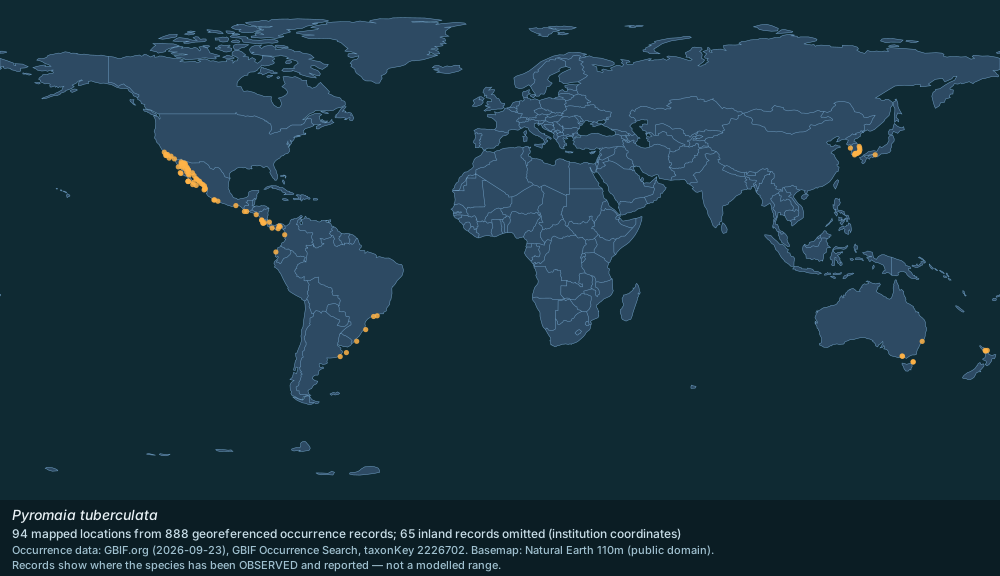
888 georeferenced occurrence records for Pyromaia tuberculata are published through GBIF from 14 countries or marine areas. The map above plots 94 distinct locations from a sample of 888 records, omitting 65 inland records that carry an institution's coordinates rather than a collection site; it shows where the species has been observed and reported, not a modelled range.
Most records by country or area: United States of America (327); Japan (162); Mexico (145); Korea, Republic of (103); Brazil (55); Australia (33); New Zealand (28); Costa Rica (12); Argentina (10); Panama (6); Colombia (3); Guatemala (2); Ecuador (1); Nicaragua (1).
Marine regions with a valid WoRMS distribution record: New Zealand Exclusive Economic Zone; Rio de la Plata; Japanese part of the Philippine Sea; Brazilian part of the South Atlantic Ocean; Australian part of the Indian Ocean; New Zealand part of the South Pacific Ocean; Australian part of the Tasman Sea; Australian Exclusive Economic Zone; Japanese part of the North Pacific Ocean; Cubagua Island; Lesser Antilles; Argentinean part of the South Atlantic Ocean; Uruguayan part of the South Atlantic Ocean; Colombian part of the North Pacific Ocean.
Source: GBIF Occurrence Search (taxonKey 2226702) — https://www.gbif.org/occurrence/search?taxon_key=2226702&has_coordinate=true (records CC0 / CC BY); WoRMS distribution records (MarineRegions) — https://www.marinespecies.org/aphia.php?p=taxdetails&id=395036 (CC BY 4.0); Natural Earth 110m basemap — https://www.naturalearthdata.com/ (public domain). Accessed 2026-09-23.
Description and natural history (Wikipedia)
Pyromaia tuberculata, also known as the fire crab, was first described by Lockington in 1877 off the coast of San Diego, California. The familial classification of pyromaia is currently still controversial. It was originally known as the Inachus tuberculata, and has also been referred to as Neorhynchus mexicanus. It is a member of the superfamily majoidea, also called “spider crabs”.
P. tuberculata is a benthic dwelling crab species, with adults often inhabiting continental shelves. Individuals of P. tuberculata have a granulate and tuberculate carapace, with a short, backwards facing spine on the first abdominal segment. The species undergoes nine post-larval stages each separated by brief periods of molting. Beginning at the third crab stage, mature females can be differentiated from males by the large rounded sodomites which make up their abdominal plates and form a cavity to hold eggs. The carapace length of adult specimens in the ninth crab stage can reach up to 20 mm while the carapace width can reach approximately 18 mm.
The life cycle of P. tuberculata is made up of three main stages: the egg, larval, and crab. The incubation time of P. tuberculata eggs has an inverse relationship to the temperature in which the ovigerous females live, with eggs hatching after 7 days at 26 °C, and 80 days at 8 °C. Larvae are free floating and feed on brine shrimp and small plankton, undergoing regular intervals of molting. There are two zoeal and one megalopa stage for larval tuberculata, which can be distinguished through analysis of carapace spines and relative width. In the first zoeal stage the carapace has a singular dorsal spine and the eyes are sessile, whereas in the second zoeal stage there are multiple small dorsal spines and eyes are slightly stalked. In the megalopa stage, the carapace lacks spines but is larger and more prominently lobed. After reaching the initial crab stage, it takes approximately 3 months for P. tuberculata to reach adulthood. There is no clear difference in body size or weight between adult males and females. Males can begin to reproduce after 47–81 days, while female can reproduce after 62–79 days.
P. tuberculata is characterized by a low number of post-larval stages which results in a shorter life span than other benthic crab species. This species also has a shorter larval phase, which is common in the Majidae family, and represents a greater degree of ecological specialization. It has a relatively short developmental stage and can reproduce year round. The ability of female crabs to carry fertilized eggs days after the puberty molt aids in shorter generation times. In combination with strategies leading to maximum offspring survival, such as a high larval dispersal area to areas of high oxygen, the year round reproduction of P. Tuberculata makes it so three generation cycles may take place each year. Females of the first generation lay eggs in early spring which reach maturity in late summer. This second generation releases eggs more quickly due to the warmer average water temperature, allowing for the third generation to settle and release eggs until early winter.
P. tuberculata is native to the pacific coast of North America from San Francisco Bay to Panama, but has spread to coastal waters of Argentina, Australia, Brazil, Japan, and New Zealand. Larvae float freely in coastal and estuarial waters up to 18 meters of depth. Adults live hidden among stones or on mud to sandy-mud bottoms up to depths of 412 meters. Adults and larvae were reported on the Atlantic Argentine continental shelf after previously only being observed in the Atlantic in the coastal waters of Brazil. P. tuberculata has now also spread to the western Pacific, as specimens of P. tuberculata have been found along the southeast coast of Australia in Port Phillip Bay and Newcastle, and along the western coast in Cockburn Sound. In the northwest pacific, populations of P. tuberculata have been established in the waters of China and Japan mostly due to naval shipping after World War II.
P. tuberculata is considered an invasive species due to its spreading to the southeast Atlantic and western Pacific. After arriving in Japanese waters, P. tuberculata has thrived due to its ability to quickly recolonize waters following instances of summer hypoxia. Smaller, native crabs have limited breeding seasons which restrict their ability to compete with the invasive P. tuberculata. In eutrophic waters such as Tokyo Bay, P. tuberculata is abundant from the intertidal zone up to 80 meters of depth, with inner-bay populations being replenished each fall with larvae from crabs in the outer-bay, which do not experience the hypoxic die offs. Populations of P. tuberculata are limited in the shallow waters of Port Phillip Bay Australia due to predation by globefish.
Source: Wikipedia: Pyromaia tuberculata — https://en.wikipedia.org/wiki/Pyromaia_tuberculata (CC BY-SA 4.0). Accessed 2026-09-23.
Gallery
Spotted an error? Know more?
Reader corrections go straight into our review queue. Suggest an edit · How this site is sourced