
Horned sea star (Protoreaster nodosus)
Source-cited species reference: taxonomy from WoRMS, biology from SeaLifeBase, occurrence map from GBIF, description from Wikipedia.

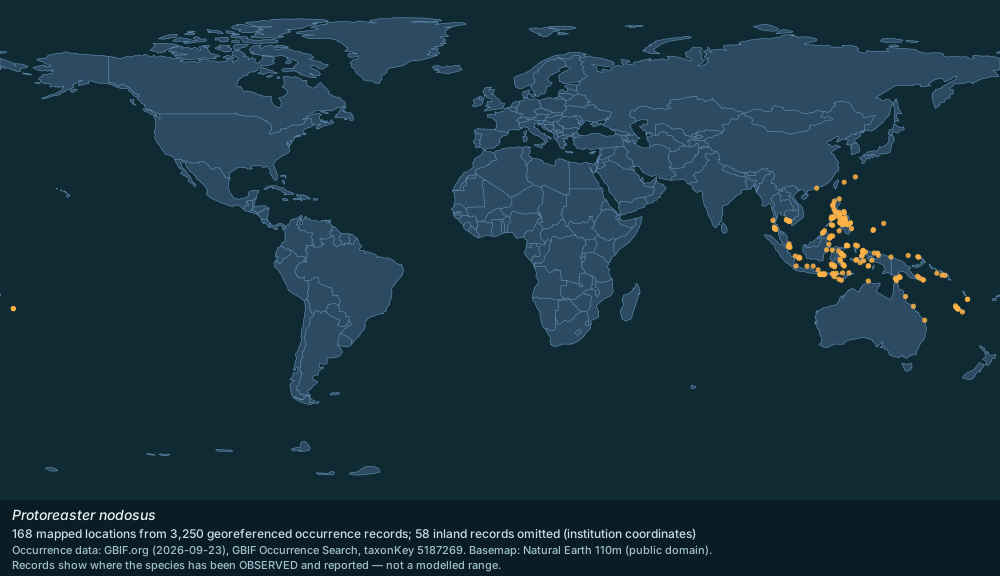
Distribution map plotted from GBIF.org occurrence records; basemap Natural Earth 110m · GBIF records CC0 / CC BY; Natural Earth public domain
Protoreaster nodosus, commonly known as the horned starfish or chocolate chip starfish, is a species of sea star found in the warm, shallow waters of the Indo-Pacific region. They are sometimes seen in the marine aquarium trade or dried and sold as curios.
- Scientific name
- Protoreaster nodosus
- Authority
- (Linnaeus, 1758)
- Family
- Oreasteridae
- Order
- Valvatida
- Maximum length
- 30 cm
- Depth range
- 0–37 m
- Habitat zone
- reef-associated
- Gbif occurrence records
- 3,250
Classification (WoRMS)
Full classification as recorded by WoRMS: Kingdom: Animalia · Phylum: Echinodermata · Class: Asteroidea · Order: Valvatida · Family: Oreasteridae · Genus: Protoreaster.
Accepted name: Protoreaster nodosus · Authority: (Linnaeus, 1758) · Taxonomic status: accepted · AphiaID: 213285.
Synonyms and superseded combinations recorded for this taxon: Asterias dorsatus Linnaeus, 1753; Asterias nodosa Linnaeus, 1758; Oreaster clouei Perrier, 1869; Oreaster franklini (Gray, 1840); Oreaster hiulcus (Gray, 1840); Oreaster hondurae Domantay & Roxas, 1938; Oreaster intermedia von Martens, 1866; Oreaster mammosus Valenciennes (MS) in Perrier, 1869; Oreaster modestus (Gray, 1866); Oreaster mutica von Martens, 1866; Oreaster nahensis Goto, 1914; Oreaster nodosus (Linnaeus, 1758); Oreaster nodosus var. hondurae Domantay & Roxas, 1938; Oreaster turritus (Gray, 1840); Pentaceros clouei (Perrier, 1869); Pentaceros franklini Gray, 1840; Pentaceros hiulcus Gray, 1840; Pentaceros modestus Gray, 1866; Pentaceros nodosus (Linnaeus, 1758); Pentaceros turritus Gray, 1840; Protoreaster gotoi Döderlein, 1936.
Source: World Register of Marine Species (WoRMS) — https://www.marinespecies.org/aphia.php?p=taxdetails&id=213285 (CC BY 4.0). Accessed 2026-09-23.
Biology and life history (SeaLifeBase)
Measured values published by SeaLifeBase for Protoreaster nodosus. Only fields the database actually holds for this species are shown; these are database values, not aquarium guidance.
Maximum length: 30 cm · Depth range: 0–37 m · Habitat zone: reef-associated · Vulnerability index: 20 of 100 · Aquarium trade: never/rarely.
SeaLifeBase notes: It is known as a good bioindicator species for monitoring reef health (Ref. 85384) and has been harvested extensively as an ornament (Ref. 98606). Occurs on seagrass beds and seaweed areas (Refs. 82802, 89727), particularly on reef flats (Ref. 85384). It is known to be an extra-oral feeder (Ref. 85384) or microphagous feeder (Ref. 98606). Feeds on microbial and microalgal films, both living and decomposing seagrass blades, and filamentous green algae (Ref. 98606).
Source: SeaLifeBase species summary (SpecCode 86714) — https://www.sealifebase.se/summary/Protoreaster-nodosus.html (CC BY-NC 3.0 — non-commercial use only). Accessed 2026-09-23.
Distribution and occurrence records (GBIF)
3,250 georeferenced occurrence records for Protoreaster nodosus are published through GBIF from 24 countries or marine areas. The map above plots 168 distinct locations from a sample of 3,000 records, omitting 58 inland records that carry an institution's coordinates rather than a collection site; it shows where the species has been observed and reported, not a modelled range.
Most records by country or area: Singapore (866); Indonesia (815); Philippines (601); New Caledonia (254); Papua New Guinea (148).
The full country table, WoRMS marine regions and the sampling notes are on this species' Distribution page.
Source: GBIF Occurrence Search (taxonKey 5187269) — https://www.gbif.org/occurrence/search?taxon_key=5187269&has_coordinate=true (records CC0 / CC BY); WoRMS distribution records (MarineRegions) — https://www.marinespecies.org/aphia.php?p=taxdetails&id=213285 (CC BY 4.0); Natural Earth 110m basemap — https://www.naturalearthdata.com/ (public domain). Accessed 2026-09-23.
Description and natural history (Wikipedia)
P. nodosus possess rows of spines or "horns"; black conical points arranged in a single row, radially on the dorsal side, which may erode and become blunt. These dark protrusions can intimidate possible predators by looking frightening or dangerous. On the ventral side, tube feet, purple in color (or pale, transparent pink), are arranged in rows on each arm. Most horned sea stars found are a roughly rigid five-pointed star-shape with tapering arms to the end, although there are anomalies like four or six-armed specimens; they may grow up to 30 cm in diameter. The sea stars are usually colored in shades of red or brown, but can be light tan, resembling the color of cookie dough. This coloration, combined with the small horns on its dorsal side, give the sea star an appearance similar to a chocolate chip cookie.
Horned sea stars prefer sheltered, sandy or slightly muddy bottoms to hard substrata such as coral reefs, or areas of vegetation (like mangrove forests), and are frequently sighted conspicuously between the leaves of seagrasses on sea grass meadows or on blank stretches of coral sand. Field studies suggest the species could be restricted to the western Pacific Ocean (Thailand to Samoa and Japan to New Caledonia). In shallow water, this species can be seen intertidally, occasionally exposed to the low tide. They do not withstand rapid changes well, and usually keep themselves underwater. Many individuals of this species can be seen gathering on soft ocean bottoms. While the cause is mostly unknown, it is thought to likely increase the chance of fertilization when spawning, or is simply a suitable feeding ground.
Horned sea stars are opportunistic carnivores; adults are known to prey on most sessile life forms including hard corals and sponges in an aquarium. In this same environment, they will hunt down snails for food. An individual horned sea star has been observed eating a sea urchin in their natural habitat.
As with other tropical echinoderms, commensal animals like shrimps (of genus Periclimenes), tiny brittle stars and even juvenile filefish can be found on the surface of a horned sea star. This may be attributed to its protective nature, as the horned sea star has few predators.
In many tropical Asian and Pacific countries, where horned sea stars are collected for sea shell trade, overharvesting has a severe impact on the population of the echinoderms. A related species, the Atlantic Oreaster reticulatus, commonly known as Bahama Sea Star, is similarly a once-abundant species reduced in number due to continuous harvesting by both industry and tourists alike.
Source: Wikipedia: Protoreaster nodosus — https://en.wikipedia.org/wiki/Protoreaster_nodosus (CC BY-SA 4.0). Accessed 2026-09-23.
Gallery
Related in Horned sea star
Links follow this subject's own source article.
Elsewhere in Horned sea star
Spotted an error? Know more?
Reader corrections go straight into our review queue. Suggest an edit · How this site is sourced