
Pinjalo (Pinjalo pinjalo)
Source-cited species reference: taxonomy from WoRMS, biology from FishBase, occurrence map from GBIF, conservation from IUCN Red List, description from Wikipedia.

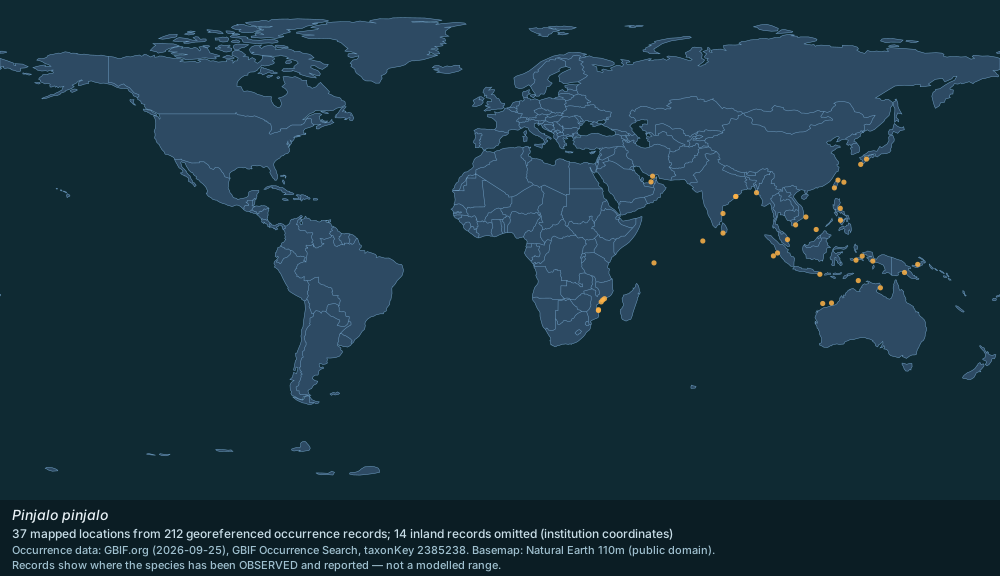
Distribution map plotted from GBIF.org occurrence records; basemap Natural Earth 110m · GBIF records CC0 / CC BY; Natural Earth public domain
Pinjalo pinjalo, the pinjalo, is a species of marine ray-finned fish, a snapper belonging to the family Lutjanidae. It is found in the Indian and Western Pacific Oceans.
- Scientific name
- Pinjalo pinjalo
- Authority
- (Bleeker, 1850)
- Family
- Lutjanidae
- Order
- Eupercaria incertae sedis
- Maximum length
- 80 cm
- Depth range
- 15–100 m
- Habitat zone
- reef-associated
- Iucn red list
- Least Concern
- Gbif occurrence records
- 212
Classification (WoRMS)
Full classification as recorded by WoRMS: Kingdom: Animalia · Phylum: Chordata · Class: Teleostei · Order: Eupercaria incertae sedis · Family: Lutjanidae · Genus: Pinjalo.
Accepted name: Pinjalo pinjalo · Authority: (Bleeker, 1850) · Taxonomic status: accepted · AphiaID: 218506.
Synonyms and superseded combinations recorded for this taxon: Caesio pinjalo Bleeker, 1850; Mesoprion mitchelli Günther, 1867; Odontonectes pinjalo (Bleeker, 1850); Pinjalo microphthalmus Lee, 1987; Pinjalo typus Bleeker, 1845.
Source: World Register of Marine Species (WoRMS) — https://www.marinespecies.org/aphia.php?p=taxdetails&id=218506 (CC BY 4.0). Accessed 2026-09-25.
Biology and life history (FishBase)
Measured values published by FishBase for Pinjalo pinjalo. Only fields the database actually holds for this species are shown; these are database values, not aquarium guidance.
Maximum length: 80 cm · Common length: 30 cm · Depth range: 15–100 m · Habitat zone: reef-associated · Body shape: fusiform / normal · Vulnerability index: 52 of 100 · Fishery importance: minor commercial · Aquarium trade: never/rarely.
FishBase notes: Adults inhabit reefs and rocky bottoms (Ref. 30573). They are found in schools over shallow depths of a few meters in open ocean reefs. In most areas they are found in deep waters and are usually trawled to 100 m depth (Ref. 48635). They feed on benthic and planktonic invertebrates (Ref. 30573), and possibly small fishes. Marketed fresh or dried-salted.
Source: FishBase species summary (SpecCode 196) — https://www.fishbase.se/summary/Pinjalo-pinjalo.html (CC BY-NC 3.0 — non-commercial use only). Accessed 2026-09-25.
Distribution and occurrence records (GBIF)
212 georeferenced occurrence records for Pinjalo pinjalo are published through GBIF from 16 countries or marine areas. The map above plots 37 distinct locations from a sample of 212 records, omitting 14 inland records that carry an institution's coordinates rather than a collection site; it shows where the species has been observed and reported, not a modelled range.
Most records by country or area: Mozambique (134); Philippines (19); Indonesia (16); India (6); Chinese Taipei (6); Malaysia (5); United Arab Emirates (4); Australia (4); Bangladesh (4); Japan (4); Papua New Guinea (4); Viet Nam (2); Iran (Islamic Republic of) (1); Sri Lanka (1); Maldives (1).
Marine regions with a valid WoRMS distribution record: Mozambican Exclusive Economic Zone; Tanzanian Exclusive Economic Zone; Somali Exclusive Economic Zone; Kenyan Exclusive Economic Zone; Comoran Exclusive Economic Zone; Eritrean Exclusive Economic Zone; Red Sea; Djiboutian Exclusive Economic Zone; Mtwapa; Ungama Bay.
Source: GBIF Occurrence Search (taxonKey 2385238) — https://www.gbif.org/occurrence/search?taxon_key=2385238&has_coordinate=true (records CC0 / CC BY); WoRMS distribution records (MarineRegions) — https://www.marinespecies.org/aphia.php?p=taxdetails&id=218506 (CC BY 4.0); Natural Earth 110m basemap — https://www.naturalearthdata.com/ (public domain). Accessed 2026-09-25.
Conservation status (IUCN Red List)
The IUCN Red List assesses Pinjalo pinjalo (Bleeker, 1850) as Least Concern (code LC). No trend, population estimate or threat analysis is given here, because none is available from this source without the Red List API; follow the source link for the full assessment, including its date.
Source: IUCN Red List of Threatened Species (taxon 194403) — https://www.iucnredlist.org/species/194403/0; GBIF IUCN Red List category endpoint (taxonKey 2385238) — https://api.gbif.org/v1/species/2385238/iucnRedListCategory. Accessed 2026-09-25.
Description and natural history (Wikipedia)
Pinjalo pinjalo was first formally described in 1850 as Caesio pinjalo by the Dutch physician, herpetologist and ichthyologist Pieter Bleeker with the type locality given as Batavia on Java. The specific name derives from the Malay ikan Pinjalo, a local name for this fish around the type locality. When Bleeker created the genus Pinjalo he used the name Pinjalo typus for the type species but this proved to be a nomen nudum and Caesio pinjalo was designated as the type species by tautonymy.
Pinjalo pinjalo has a body which is moderately deep with a steep dorsal profile on the head and a convex space between the eyes. it has a comparatively large eye which has a diameter roughly equal or greater than the length of the snout. The eye has an adipose eyelid. The snout is relatively short and pointed, the mouth is small only extending to the front of the eye. There is a single row of small, conical teeth in jaws, these are enlarged in the front and an inner band of bristle-like teeth. The dorsal fin has 10 spines and 13-15 soft rays while the anal fin has 3 rays and 8-10 soft rays. The dorsal and anal fins both have scaly sheaths at their bases. The pectoral fins are long, extending as far as the level of the anus and containing 18 fin rays. The caudal fin is emarginate. This species is greyish to pinkish-grey on the upper body becoming silvery pink to silvery-white on the lower body. The dorsal and caudal fins arepinkish to pinkish-yellow with darker margins, while the pelvic and anal fins are yellowish. These colours may either quickly fade or get deeper. The pinjalo attains a maximum total length of 80 cm, although of 30 cm is more typical.
Pinjalo pinjalo has a wide Indo-Pacific distribution. It is found from the Red Sea south to Mozambique, Socotra, the Comoros and the Seychelles. It is also found in the Gulf of Aden, the Persian Gulf east into the Pacific Ocean where it occurs as far east as Papua New Guinea, north to Taiwan and the Philippines. In Australia larvae have been recorded at Port Hedland in Western Australia. This species occurs at depths of 15 to 100 m where it can be found on coral and rocky reefs, both coastal and offshore, as well as outer reef slopes.
Pinjalo pinjalo is a schooling species which feeds largely on benthic and planktonic invertebrates. its biology is otherwise little known.
Pinjalo pinjalo is taken a by artisanal fisheries in many parts of its range, particularly in Asia. It is fished for using gill nets, handlines, traps and bottom trawls. It is sold as fresh fish or preserved as salted fish.
Source: Wikipedia: Pinjalo pinjalo — https://en.wikipedia.org/wiki/Pinjalo_pinjalo (CC BY-SA 4.0). Accessed 2026-09-25.
Gallery
Spotted an error? Know more?
Reader corrections go straight into our review queue. Suggest an edit · How this site is sourced