
Chilean bat star (Patiria chilensis)
Source-cited species reference: taxonomy from WoRMS, biology from SeaLifeBase, occurrence map from GBIF, description from Wikipedia.
Patiria chilensis is a species of starfish in the family Asterinidae. It is found in the southeastern Pacific Ocean along the coasts of South America. It is a broadly pentagonal, cushion-like starfish with five short arms.
- Scientific name
- Patiria chilensis
- Authority
- (Lutken, 1859)
- Family
- Asterinidae
- Order
- Valvatida
- Depth range
- 0–20 m
- Habitat zone
- benthic
- Gbif occurrence records
- 2,953
Classification (WoRMS)
Full classification as recorded by WoRMS: Kingdom: Animalia · Phylum: Echinodermata · Class: Asteroidea · Order: Valvatida · Family: Asterinidae · Genus: Patiria.
Accepted name: Patiria chilensis · Authority: (Lutken, 1859) · Taxonomic status: accepted · AphiaID: 382124.
Synonyms and superseded combinations recorded for this taxon: Asterina chilensis Lutken, 1859; Asterina gayi Perrier, 1876; Asteriscus chilensis Lutken, 1859; Patiria gayi (Perrier, 1876).
Source: World Register of Marine Species (WoRMS) — https://www.marinespecies.org/aphia.php?p=taxdetails&id=382124 (CC BY 4.0). Accessed 2026-09-23.
Biology and life history (SeaLifeBase)
Measured values published by SeaLifeBase for Patiria chilensis. Only fields the database actually holds for this species are shown; these are database values, not aquarium guidance.
Depth range: 0–20 m · Habitat zone: benthic · Aquarium trade: never/rarely.
SeaLifeBase notes: This is an epibiotic species found on hard bottoms and holdfasts of Lessonia nigrescens in intertidal areas to 20 meters in depth. It feeds on mollusks and detritus (Ref. 87801).
Source: SeaLifeBase species summary (SpecCode 154278) — https://www.sealifebase.se/summary/Patiria-chilensis.html (CC BY-NC 3.0 — non-commercial use only). Accessed 2026-09-23.
Distribution and occurrence records (GBIF)
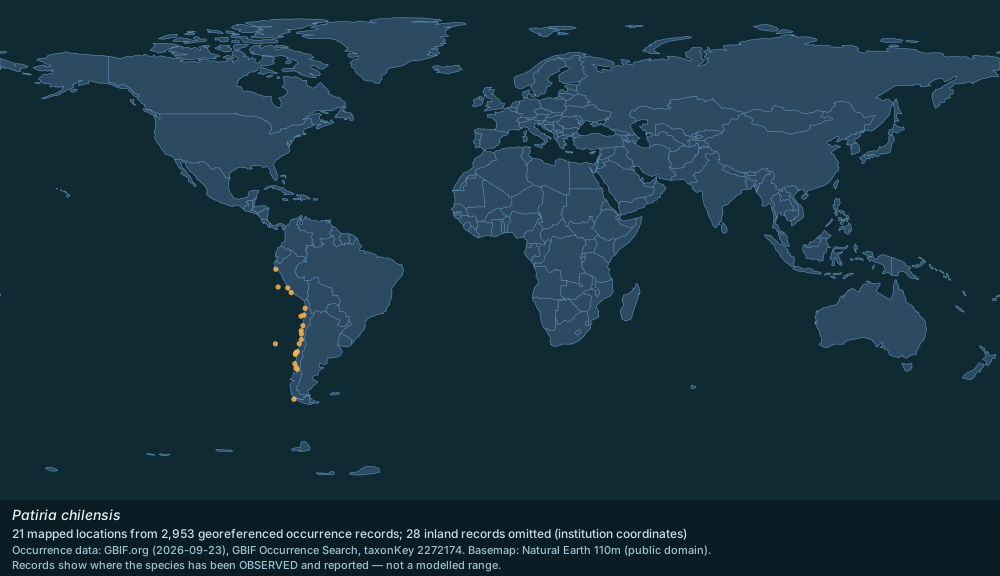
2,953 georeferenced occurrence records for Patiria chilensis are published through GBIF from 2 countries or marine areas. The map above plots 21 distinct locations from a sample of 2,953 records, omitting 28 inland records that carry an institution's coordinates rather than a collection site; it shows where the species has been observed and reported, not a modelled range.
Most records by country or area: Chile (2,919); Peru (34).
The full country table, WoRMS marine regions and the sampling notes are on this species' Distribution page.
Source: GBIF Occurrence Search (taxonKey 2272174) — https://www.gbif.org/occurrence/search?taxon_key=2272174&has_coordinate=true (records CC0 / CC BY); WoRMS distribution records (MarineRegions) — https://www.marinespecies.org/aphia.php?p=taxdetails&id=382124 (CC BY 4.0); Natural Earth 110m basemap — https://www.naturalearthdata.com/ (public domain). Accessed 2026-09-23.
Description and natural history (Wikipedia)
P. chilensis occurs in the rocky intertidal zone in temperate seas off the coast of Chile. It is mainly present in the lower algal zone, dominated by the kelps Lessonia nigrescens and Durvillaea antarctica and various encrusting coralline algae. Echinoids occurring in this zone include Loxechinus albus and Tetrapygus niger, and starfish include Stichaster striatus, Meyenaster gelatinosus and the dominant Heliaster helianthus. These starfish are the dominant carnivores in this zone and seem to play an important role in maintaining the community structure. Besides being a predator of sessile organisms, P. chilensis is an opportunistic feeder, scavenging for dead animal matter and detritus. It is a small species, and avoids being preyed on by the larger starfish by tending to remain in concealed locations. It is not known to shed its arms, as do many of the other starfish species in the locality, but the arms sometimes get amputated, perhaps eaten by fish. When that happens, the arms do not regenerate, but the thick skin closes over the wound to heal it.
Like other echinoids, pollution can affect this species. The opening of a new sea outlet from a copper mine at Caleta Palito in Chile in 1975 caused mass mortality of the starfish Stichaster striatus, Meyenaster gelatinosus and Patiria chilensis and the sea urchin Tetrapygus niger, which disappeared completely from the area.
Source: Wikipedia: Patiria chilensis — https://en.wikipedia.org/wiki/Patiria_chilensis (CC BY-SA 4.0). Accessed 2026-09-23.
Gallery
Related in Chilean bat star
Links follow this subject's own source article.
Elsewhere in Chilean bat star
Spotted an error? Know more?
Reader corrections go straight into our review queue. Suggest an edit · How this site is sourced