Vieja (Paralabrax dewegeri)
Source-cited species reference: taxonomy from WoRMS, biology from FishBase, occurrence map from GBIF, conservation from IUCN Red List, description from Wikipedia.
Last updated

Distribution map plotted from GBIF.org occurrence records; basemap Natural Earth 110m · GBIF records CC0 / CC BY; Natural Earth public domain
Paralabrax dewegeri, the vieja, vieja parrot rock-bass or meo viejo, is a species of marine ray-finned fish, a sea bass from the subfamily Serraninae, classified as part of the family Serranidae which includes the groupers and anthias. It is found in the western Atlantic along the northern coast of South America.
Scientific classification
- KingdomAnimalia
- PhylumChordata
- ClassActinopterygii
- DivisionTeleostei
- OrderPerciformes
- FamilySerranidae
- GenusParalabrax
- SpeciesParalabrax dewegeri
Named by (Metzelaar, 1919)
Close relatives
Other species of Paralabrax with a Codexery entry.
- Barred sand bass Paralabrax nebulifer
- Paralabrax clathratus Paralabrax clathratus
- Spotted sand bass Paralabrax maculatofasciatus
Sources: Wikipedia taxobox: Paralabrax dewegeri (CC BY-SA 4.0) · order, family and genus agree with WoRMS AphiaID 282055 (CC BY 4.0)
Conservation status
Least Concern (LC)
- LC▲ this species
- NT
- VU
- EN
- CR
- EW
- EX
Source: IUCN Red List assessment · GBIF copy of the Red List category
How big is it?
Largest length in the source, 0.43 m, next to a 1.8 m person.
Diagram: drawn by Codexery, schematic shapes to scale (not a likeness). Length: Wikipedia: Paralabrax dewegeri
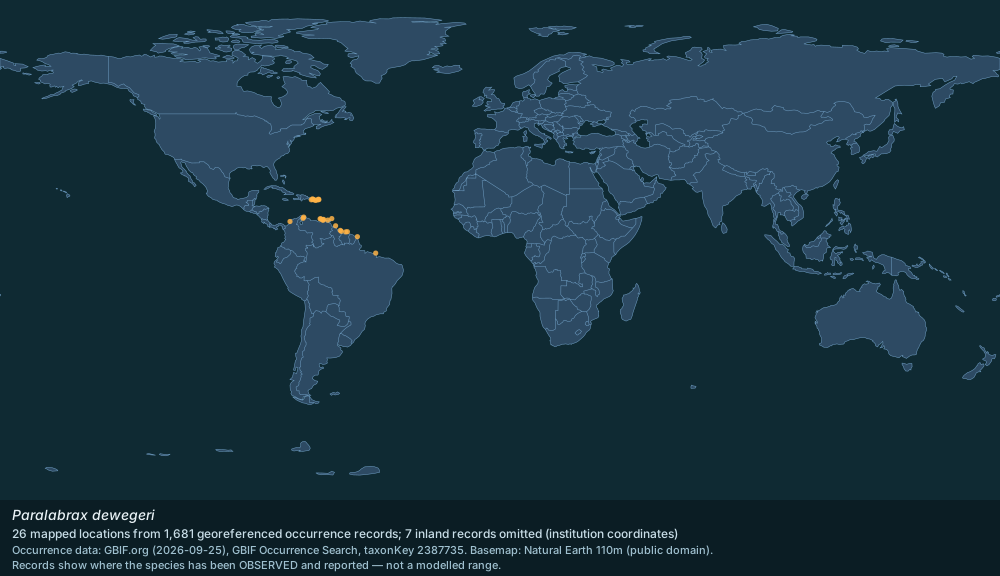
Where the vieja (paralabrax dewegeri) has been recorded
Each dot is a place where the species has been observed and reported (1,681 records, half-degree grid) — not a modelled range. 2 inland records left out (institution coordinates).
Map: drawn by Codexery. Data: GBIF occurrence search (records CC0 / CC BY) · Natural Earth basemap (public domain) · place coordinates: Wikipedia (CC BY-SA 4.0)
Classification (WoRMS)
Full classification as recorded by WoRMS: Kingdom: Animalia · Phylum: Chordata · Class: Teleostei · Order: Perciformes · Family: Serranidae · Genus: Paralabrax.
Accepted name: Paralabrax dewegeri · Authority: (Metzelaar, 1919) · Taxonomic status: accepted · AphiaID: 282055.
Synonyms and superseded combinations recorded for this taxon: Prionodes dewegeri (Metzelaar, 1919); Serranus dewegeri Metzelaar, 1919.
Source: World Register of Marine Species (WoRMS) — https://www.marinespecies.org/aphia.php?p=taxdetails&id=282055 (CC BY 4.0). Accessed 2026-09-25.
Biology and life history (FishBase)
Measured values published by FishBase for Paralabrax dewegeri. Only fields the database actually holds for this species are shown; these are database values, not aquarium guidance.
Maximum length: 43 cm · Common length: 35 cm · Habitat zone: reef-associated · Body shape: fusiform / normal · Vulnerability index: 33 of 100 · Fishery importance: commercial · Aquarium trade: never/rarely.
FishBase notes: Found on semi-hard or soft bottoms. Juveniles are often in association with Thalassia . Synchronously hermaphroditic (Ref. 7251).
Source: FishBase species summary (SpecCode 1218) — https://www.fishbase.se/summary/Paralabrax-dewegeri.html (CC BY-NC 3.0 — non-commercial use only). Accessed 2026-09-25.
Distribution and occurrence records (GBIF)
1,681 georeferenced occurrence records for Paralabrax dewegeri are published through GBIF from 8 countries or marine areas. The map above plots 26 distinct locations from a sample of 1,681 records, omitting 7 inland records that carry an institution's coordinates rather than a collection site; it shows where the species has been observed and reported, not a modelled range.
Most records by country or area: Puerto Rico (1,642); Venezuela (Bolivarian Republic of) (17); Brazil (5); French Guiana (5); Guyana (5).
The full country table, WoRMS marine regions and the sampling notes are on this species' Distribution page.
Source: GBIF Occurrence Search (taxonKey 2387735) — https://www.gbif.org/occurrence/search?taxon_key=2387735&has_coordinate=true (records CC0 / CC BY); WoRMS distribution records (MarineRegions) — https://www.marinespecies.org/aphia.php?p=taxdetails&id=282055 (CC BY 4.0); Natural Earth 110m basemap — https://www.naturalearthdata.com/ (public domain). Accessed 2026-09-25.
Conservation status (IUCN Red List)
The IUCN Red List assesses Paralabrax dewegeri (Metzelaar, 1919) as Least Concern (code LC). No trend, population estimate or threat analysis is given here, because none is available from this source without the Red List API; follow the source link for the full assessment, including its date.
Source: IUCN Red List of Threatened Species (taxon 190365) — https://www.iucnredlist.org/species/190365/0; GBIF IUCN Red List category endpoint (taxonKey 2387735) — https://api.gbif.org/v1/species/2387735/iucnRedListCategory. Accessed 2026-09-25.
Description and natural history (Wikipedia)
Paralabrax dewegeri has an elongate compressed body with a pointed head. The preoperculum is smoothly rounded and has fine serrations along its edge. There are three spines on the gill cover, the topmost spine is blunt and rather small while the other two are sharp.
The dorsal fin has 10 spines and 14 soft rays while the anal fin has three spines and seven soft rays, with the ends of the soft rayed parts of these fins being rounded. The caudal fin is truncate. The body is brown in colour, fading to yellowish brown on its lower part with seven vertical dark brown bars on the lower part of the body.
There is a large dark brown spot at the base of the pectoral fins which has a pale yellowish brown line running behind it. The paired fins are dark brown. This species attains a maximum published total length of 43 cm, although 35 cm is more common, and it has a maximum weight of 1.3 kg.
Distribution
Paralabrax dewegeri is found in the western Atlantic Ocean, where it is found along the northern coast of South America from the Gulf of Venezuela eastwards to Fortaleza in Brazil. It also occurs in Curaçao and Trinidad and Tobago.
Habitat and biology
Paralabrax dewegeri is found in water with depths of between 10 and 25 m over semi-hard or soft substrates and among soft corals. Juveniles are found in beds of the sea grass Thalassia. It is a carnivorous species which has a diet largely made up of crustaceans but it also feeds on fishes, molluscs, worms and brittle stars. Females attain sexual maturity at about 11 cm and this species is a protogynous hermaphrodite.
Taxonomy
Paralabrax dewegeri was first formally described as Prionodes dewegeri in 1919 by the Dutch ichthyologist Jan Metzelaar (1891-1929) with the type locality given as Guanta in Venezuela. It is the sister taxon to P. callaensis of the eastern Pacific Ocean and, in turn, these two species hare a common ancestor with the Galapagos endemic P. albomaculatus.
Utilisation
Paralabrax dewegeri is said to have palatable flesh but it is of little commercial importance to fisheries because of its relatively small size.
Source: Wikipedia: Paralabrax dewegeri — https://en.wikipedia.org/wiki/Paralabrax_dewegeri (CC BY-SA 4.0). Accessed 2026-09-25.
Elsewhere in Vieja
Sources
Compiled from Wikipedia and the sources listed below. Text from Wikipedia is available under CC BY-SA 4.0; this entry is adapted from it.
- Wikipedia: Paralabrax dewegeri (CC BY-SA 4.0).
- Classification: the source article's taxobox; order, family and genus checked against WoRMS, the World Register of Marine Species (CC BY 4.0).
- Conservation status: IUCN Red List assessment.
- Occurrence records: GBIF (CC0 / CC BY). Basemap: Natural Earth (public domain).
- Biology values: FishBase species summary (CC BY-NC 3.0, non-commercial).
- Word definitions: the , each quoted from its Wikipedia article.
Spotted an error? Know more?
Reader corrections go straight into our review queue. Suggest an edit · How this site is sourced