Graceful decorator crab (Oregonia gracilis)
Source-cited species reference: taxonomy from WoRMS, biology from SeaLifeBase, occurrence map from GBIF, description from Wikipedia.
Last updated

1855 · via Wikipedia: Oregonia gracilis · Public domain
Oregonia gracilis, commonly known as the graceful decorator crab, is a species of crab belonging to the family Oregoniidae. Like other decorator crabs it habitually attaches other organisms to its back. The sessile organisms are attached to hooked setae that act as a sort of velcro attachment. This decoration provides visual and chemical camouflage thus reducing predation risk.
Pacific halibut are a major predator of O. gracilis. Other predators include octopus and sea otters. The main food source of O. gracilis is floating kelp and algae that they capture utilizing a waiting strategy in order to maintain cryptosis.
Scientific classification
- KingdomAnimalia
- PhylumArthropoda
- CladePancrustacea
- ClassMalacostraca
- OrderDecapoda
- SuborderPleocyemata
- InfraorderBrachyura
- FamilyOregoniidae
- GenusOregonia
- SpeciesOregonia gracilis
Named by Dana, 1851
Close relatives
Other species of Oregonia with a Codexery entry.
- Oregonia bifurca Oregonia bifurca
Sources: Wikipedia taxobox: Oregonia gracilis (CC BY-SA 4.0) · order, family and genus agree with WoRMS AphiaID 442171 (CC BY 4.0)
How big is it?
Largest length in the source, 0.07 m, next to a 1.8 m person.
Diagram: drawn by Codexery, schematic shapes to scale (not a likeness). Length: SeaLifeBase species summary
Where the graceful decorator crab (oregonia gracilis) has been recorded
Each dot is a place where the species has been observed and reported (3,957 records, half-degree grid) — not a modelled range. 45 inland records left out (institution coordinates).
Map: drawn by Codexery. Data: GBIF occurrence search (records CC0 / CC BY) · Natural Earth basemap (public domain)
Classification (WoRMS)
Full classification as recorded by WoRMS: Kingdom: Animalia · Phylum: Arthropoda · Class: Malacostraca · Order: Decapoda · Family: Oregoniidae · Genus: Oregonia.
Accepted name: Oregonia gracilis · Authority: Dana, 1851 · Taxonomic status: accepted · AphiaID: 442171.
Synonyms and superseded combinations recorded for this taxon: Oregonia hirta Dana, 1851; Oregonia longimana Spence Bate, 1865; Oregonia mutsuensis Yokoya, 1928.
Source: World Register of Marine Species (WoRMS) — https://www.marinespecies.org/aphia.php?p=taxdetails&id=442171 (CC BY 4.0). Accessed 2026-09-25.
Biology and life history (SeaLifeBase)
Measured values published by SeaLifeBase for Oregonia gracilis. Only fields the database actually holds for this species are shown; these are database values, not aquarium guidance.
Maximum length: 7.5 cm · Depth range: 0–400 m · Habitat zone: benthic · Vulnerability index: 10 of 100.
SeaLifeBase notes: It is found on rocky bottoms from the intertidal to a depth of 400 meters (Ref. 865).
Source: SeaLifeBase species summary (SpecCode 26929) — https://www.sealifebase.se/summary/Oregonia-gracilis.html (CC BY-NC 3.0 — non-commercial use only). Accessed 2026-09-25.
Distribution and occurrence records (GBIF)
3,957 georeferenced occurrence records for Oregonia gracilis are published through GBIF from 9 countries or marine areas. The map above plots 183 distinct locations from a sample of 3,000 records, omitting 61 inland records that carry an institution's coordinates rather than a collection site; it shows where the species has been observed and reported, not a modelled range.
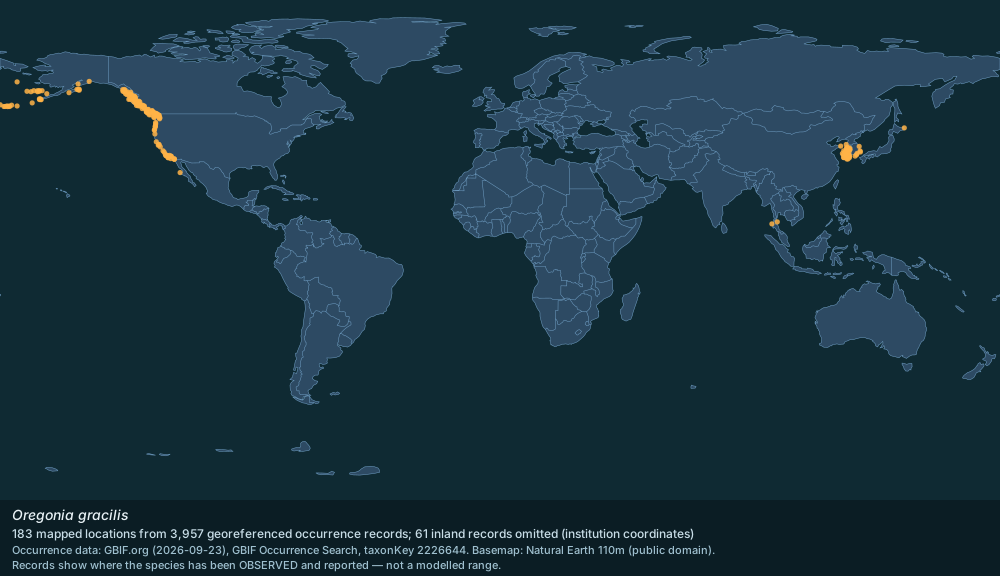
Most records by country or area: United States of America (2,017); Canada (1,494); Korea, Republic of (238); China (158); Japan (17).
The full country table, WoRMS marine regions and the sampling notes are on this species' Distribution page.
Source: GBIF Occurrence Search (taxonKey 2226644) — https://www.gbif.org/occurrence/search?taxon_key=2226644&has_coordinate=true (records CC0 / CC BY); WoRMS distribution records (MarineRegions) — https://www.marinespecies.org/aphia.php?p=taxdetails&id=442171 (CC BY 4.0); Natural Earth 110m basemap — https://www.naturalearthdata.com/ (public domain). Accessed 2026-09-25.
Description and natural history (Wikipedia)
Oregonia gracilis have three body segments: head, thorax and abdomen. Like many crustaceans, the head and thorax combine into a cephalothorax and are completely covered in a continuous exoskeleton called a carapace.
The carapace is heart shaped, a brown, tan or grey color and 5 cm in length with four pairs of long thin walking legs (pereiopods). A fifth pair of the pereiopods have pincers attached and are called chelipeds. The chelipeds are used for feeding, defense, and to decorate their bodies. The chelipeds are longer than the walking legs in males and shorter than the walking legs in females.
The mouth has three pairs of feeding appendages called maxillipeds. Two long stalked compound eyes protrude from the cephalothorax. Behind each eye is a large and curved postorbital spine.
Using fine hooked setae found on the carapace, the crab liberally decorates itself with algae, sponges, bryozoans and hydroids. Its shell covered in sessile organisms makes the crab camouflaged to its environment. Juveniles and adult females decorate heavily whereas adult males are sparse in their decoration.
Range and habitat
Oregonia gracilis live in the intertidal zone up to 436 meters deep. They can be found in the Bering Sea, the North Pacific Coast and Japan.
Reproduction
For the majority of their lives, O. gracilis live by themselves except during mating season. Mates are found using chemical cues.
During the mating process the male uses the first and second abdominal appendages to transfer sperm packets called spermatophores to the female. The sperm fertilizes the egg which the females produce and carry on their setae. Recently hatched eggs are orange-red; eggs nearly ready to hatch are reddish-brown.
The O. gracilia hatch in an advanced larval stage called zoea. Having developed compound eyes and a spiny carapace the zoea drift towards the surface. After the zoea phase, the larvae advance to the megalopa phase until finally reaching their adult form.
Source: Wikipedia: Oregonia gracilis — https://en.wikipedia.org/wiki/Oregonia_gracilis (CC BY-SA 4.0). Accessed 2026-09-25.
Related in Graceful decorator crab
Links follow this subject's own source article.
Elsewhere in Graceful decorator crab
Sources
Compiled from Wikipedia and the sources listed below. Text from Wikipedia is available under CC BY-SA 4.0; this entry is adapted from it.
- Wikipedia: Oregonia gracilis (CC BY-SA 4.0).
- Classification: the source article's taxobox; order, family and genus checked against WoRMS, the World Register of Marine Species (CC BY 4.0).
- Occurrence records: GBIF (CC0 / CC BY). Basemap: Natural Earth (public domain).
- Biology values: SeaLifeBase species summary (CC BY-NC 3.0, non-commercial).
- Word definitions: the , each quoted from its Wikipedia article.
Spotted an error? Know more?
Reader corrections go straight into our review queue. Suggest an edit · How this site is sourced