
Daisy brittle star (Ophiopholis aculeata)
Source-cited species reference: taxonomy from WoRMS, biology from SeaLifeBase, occurrence map from GBIF, description from Wikipedia.
Ophiopholis aculeata, the crevice brittle star or daisy brittle star, is a species of brittle star in the family Ophiactidae. It has a circum-polar distribution and is found in the Arctic Ocean, the northern Atlantic Ocean and the northern Pacific.
- Scientific name
- Ophiopholis aculeata
- Authority
- (Linnaeus, 1767)
- Family
- Ophiopholidae
- Order
- Amphilepidida
- Depth range
- 0–2000 m
- Habitat zone
- benthic
- Gbif occurrence records
- 27,761
Classification (WoRMS)
Full classification as recorded by WoRMS: Kingdom: Animalia · Phylum: Echinodermata · Class: Ophiuroidea · Order: Amphilepidida · Family: Ophiopholidae · Genus: Ophiopholis.
Accepted name: Ophiopholis aculeata · Authority: (Linnaeus, 1767) · Taxonomic status: accepted · AphiaID: 125125.
Synonyms and superseded combinations recorded for this taxon: Asterias aculeata Linnaeus, 1767; Ophiocoma bellis (Fleming, 1828); Ophiolepis scolopendrica Müller & Troschel, 1842; Ophiopholis aculeata typica H.L. Clark, 1911; Ophiopholis bellis (Forbes, 1828); Ophiopholis scolopendrica (Müller & Troschel, 1842); Ophiura bellis Fleming, 1828; Polypholis echinata Duncan, 1880.
Source: World Register of Marine Species (WoRMS) — https://www.marinespecies.org/aphia.php?p=taxdetails&id=125125 (CC BY 4.0). Accessed 2026-09-23.
Biology and life history (SeaLifeBase)
Measured values published by SeaLifeBase for Ophiopholis aculeata. Only fields the database actually holds for this species are shown; these are database values, not aquarium guidance.
Depth range: 0–2000 m · Habitat zone: benthic.
SeaLifeBase notes: Maximum depth range from Ref. 125373. Free-living (Ref. 3123).
Source: SeaLifeBase species summary (SpecCode 49064) — https://www.sealifebase.se/summary/Ophiopholis-aculeata.html (CC BY-NC 3.0 — non-commercial use only). Accessed 2026-09-23.
Distribution and occurrence records (GBIF)
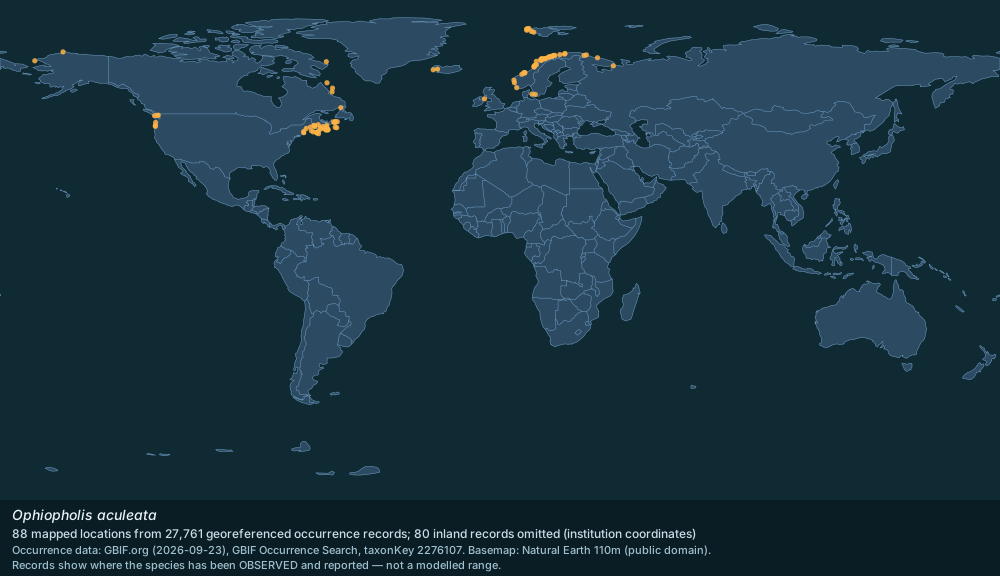
27,761 georeferenced occurrence records for Ophiopholis aculeata are published through GBIF from 27 countries or marine areas. The map above plots 88 distinct locations from a sample of 3,000 records, omitting 80 inland records that carry an institution's coordinates rather than a collection site; it shows where the species has been observed and reported, not a modelled range.
Most records by country or area: Canada (18,602); Norway (3,445); United Kingdom of Great Britain and Northern Ireland (2,041); United States of America (1,209); Russian Federation (832).
The full country table, WoRMS marine regions and the sampling notes are on this species' Distribution page.
Source: GBIF Occurrence Search (taxonKey 2276107) — https://www.gbif.org/occurrence/search?taxon_key=2276107&has_coordinate=true (records CC0 / CC BY); WoRMS distribution records (MarineRegions) — https://www.marinespecies.org/aphia.php?p=taxdetails&id=125125 (CC BY 4.0); Natural Earth 110m basemap — https://www.naturalearthdata.com/ (public domain). Accessed 2026-09-23.
Description and natural history (Wikipedia)
Ophiopholis aculeata has a central pentagonal disc up to 2 cm in diameter; this is clearly set off from the five robust, twisted arms, which are four times as long as the disc is wide. The mouth is on the oral or underside of the disc and is surrounded by five toothed jaws. The aboral or upper side of the disc is granular, and a pair of large scales, the radial shield, covers the base of each arm. The radial shield is covered with small spines which conceal the scales. The many-jointed arms are covered with more scales both on the oral and aboral surfaces; on the aboral surface there is a regular series of oval scales each surrounded by smaller scales. There are six or seven stout spines per segment, with one short spine being hooked. The colour varies, being often reddish or variegated, and sometimes purplish; the central scales on the disc often form a ten-pointed star and there are often darker bands on the arms.
This brittle star has a circum-boreal distribution. In the northern Atlantic Ocean it is common around Iceland, Spitzbergen and Norway southwards to the North Sea. On the eastern coast of North America its range extends from Greenland southwards to Long Island, and in the Pacific Ocean, its range stretches from Japan and the Bering Sea southwards to California. It is generally found on rocky substrates where it has a tendency to hide inside shells, in hollows and crevices. It generally occurs at depths less than 300 m but has been found as deep as 1880 m.
Ophiopholis aculeata feeds on detritus and small organisms that it traps with its tube feet and with mucus secreted by glands on its arms. It is preyed on by fish and birds.
The sexes are separate in this species, and fertilisation is external. Mass spawning events have been seen, with all the individuals of this species in a locality releasing their spawn at the same time in response to some environmental cue. This has been observed in Jamaica at night, during the period 20:00 hours to 22:00 hours, and in both morning and afternoon in the Gulf of Saint Lawrence, Canada. The cue that triggers a spawning event may be a change in the temperature of the water. Spawning tends to occur at 6.5 to 7 °C in Alaska, and about a degree cooler than this further north in the White Sea. Several spawning events have occurred when warmer surface waters have down-welled into deep, colder water layers. The larvae of brittle stars are known as ophiopluteus larvae and form part of the plankton. When they are fully developed, they settle on the seabed and undergo metamorphosis into juvenile brittle stars.
Source: Wikipedia: Ophiopholis aculeata — https://en.wikipedia.org/wiki/Ophiopholis_aculeata (CC BY-SA 4.0). Accessed 2026-09-23.
Gallery
Related in Daisy brittle star
Links follow this subject's own source article.
Elsewhere in Daisy brittle star
Spotted an error? Know more?
Reader corrections go straight into our review queue. Suggest an edit · How this site is sourced