
Ophionereis schayeri
Source-cited species reference: taxonomy from WoRMS, biology from SeaLifeBase, occurrence map from GBIF, description from Wikipedia.
Ophionereis schayeri, Schayer's brittle star, is a brittle star in the family Ophionereididae.
- Scientific name
- Ophionereis schayeri
- Authority
- (Müller & Troschel, 1844)
- Family
- Ophionereididae
- Order
- Amphilepidida
- Habitat zone
- benthic
- Gbif occurrence records
- 983
Classification (WoRMS)
Full classification as recorded by WoRMS: Kingdom: Animalia · Phylum: Echinodermata · Class: Ophiuroidea · Order: Amphilepidida · Family: Ophionereididae · Genus: Ophionereis.
Accepted name: Ophionereis schayeri · Authority: (Müller & Troschel, 1844) · Taxonomic status: accepted · AphiaID: 243889.
Synonyms and superseded combinations recorded for this taxon: Ophiolepis schayeri Müller & Troschel, 1844.
Source: World Register of Marine Species (WoRMS) — https://www.marinespecies.org/aphia.php?p=taxdetails&id=243889 (CC BY 4.0). Accessed 2026-09-23.
Biology and life history (SeaLifeBase)
Measured values published by SeaLifeBase for Ophionereis schayeri. Only fields the database actually holds for this species are shown; these are database values, not aquarium guidance.
Habitat zone: benthic · Aquarium trade: never/rarely.
Source: SeaLifeBase species summary (SpecCode 152858) — https://www.sealifebase.se/summary/Ophionereis-schayeri.html (CC BY-NC 3.0 — non-commercial use only). Accessed 2026-09-23.
Distribution and occurrence records (GBIF)
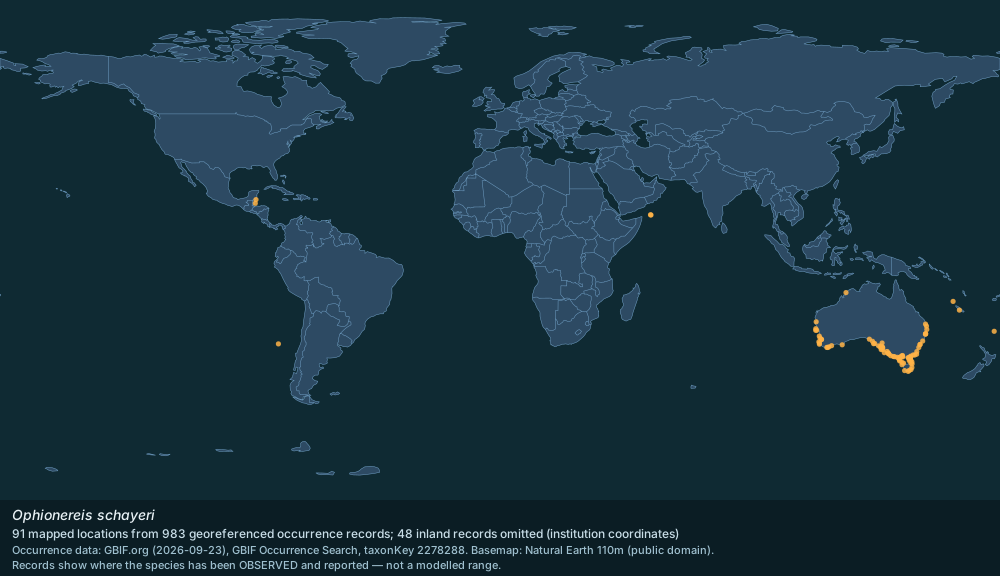
983 georeferenced occurrence records for Ophionereis schayeri are published through GBIF from 7 countries or marine areas. The map above plots 91 distinct locations from a sample of 983 records, omitting 48 inland records that carry an institution's coordinates rather than a collection site; it shows where the species has been observed and reported, not a modelled range.
Most records by country or area: Australia (953); United States of America (13); Belize (6); New Caledonia (6); New Zealand (2); Yemen (2); Chile (1).
Source: GBIF Occurrence Search (taxonKey 2278288) — https://www.gbif.org/occurrence/search?taxon_key=2278288&has_coordinate=true (records CC0 / CC BY); WoRMS distribution records (MarineRegions) — https://www.marinespecies.org/aphia.php?p=taxdetails&id=243889 (CC BY 4.0); Natural Earth 110m basemap — https://www.naturalearthdata.com/ (public domain). Accessed 2026-09-23.
Description and natural history (Wikipedia)
The central disk is up to 2.5 centimetres wide, with arms to 15 centimetres long. The species is a filter-feeder that sifts sand and mud from the ocean floor for detritus and plankton.
Schayer's Brittle Star is found off the coast of Australia. Areas include New South Wales, Victoria, South Australia, Western Australia and Tasmania. It is the largest and most common brittle star found near Sydney.
The species occurs from the inter-tidal zone to 180 metres below sea level. This brittle star may be found under boulders in tidal areas. It moves quickly away from light when exposed. To reduce exposure to high temperatures, O. schayeri will form clusters under boulders in rocky reef habitats. Under these boulders, they scavenge for food by extending their arms out at night. Like many species inhabiting tide pools, O. schayeri may be particularly susceptible to the increased temperatures and ocean acidification engendered by climate change.
As all brittle stars, Schayer’s brittle star undergoes a process of metamorphoses throughout their life cycle, starting from planktotrophy and moving to brooded lecithotrophy. The larva of a Schayer’s brittle star is bilaterally symmetrical, with a ciliated band around the body. The next developmental form is a vitellaria larva, bordered by ciliary ridges. The vitellaria larva soon develops juvenile tube feet and ventral skeletal plates. This metamorphosis results in a full body transformation from bilateral to radial symmetrical form, the last of which resembles other members of the Echinodermata phylum. (Selvakumaraswamy & Byrne, 2004). This evolutionary adaptation from planktotrophic to lecithotrophic development can be associated with an increased maternal reliance. The lecithotrophic development evolved along with a larger egg. Both of these evolutionary adaptations led to an increase in triglyceride present in the eggs. The effect of this increase in triglyceride levels on the eggs is still currently undergoing research (Inke et al, 2006).
Similar to the related species O. fasciata, Schayer's brittle star is capable of bioluminescence, which may function as a warning to predators. It is hypothesized that this behavioral phenomenon requires extra-cellular calcium, associating with the radial nerve chord in order to trigger the luminescence. The fluorescent cells are photocytes, which can be found under the ventral, dorsal, and lateral arm plates. The true functional purpose of this bioluminescence has yet to be studied.
Source: Wikipedia: Ophionereis schayeri — https://en.wikipedia.org/wiki/Ophionereis_schayeri (CC BY-SA 4.0). Accessed 2026-09-23.
Gallery
Spotted an error? Know more?
Reader corrections go straight into our review queue. Suggest an edit · How this site is sourced