Where Savigny's brittle star has been recorded
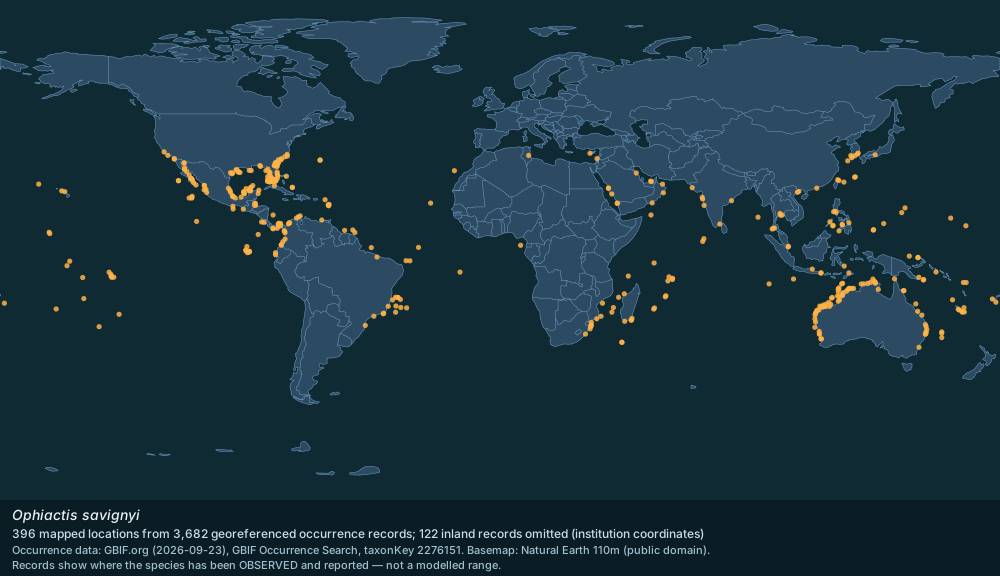
GBIF occurrence records for Ophiactis savignyi, mapped and tabulated by country.
Last updated

Distribution map plotted from GBIF.org occurrence records; basemap Natural Earth 110m · GBIF records CC0 / CC BY; Natural Earth public domain
3,682 georeferenced occurrence records with coordinates are published for Ophiactis savignyi through GBIF, from 87 countries or marine areas. This page maps those records and lists where they come from. Occurrence records reflect where people have looked as well as where the species lives, so well-surveyed coastlines are over-represented.
Quick Facts
- Georeferenced records
- 3,682
- Mapped locations
- 396
- Inland records omitted
- 122
- Gbif taxonkey
- 2276151
Facts from the source article.
Countries and areas with the most records (GBIF)
Mexico — 941 records; Australia — 613 records; United States of America — 552 records; Brazil — 328 records; Colombia — 150 records; Japan — 142 records; Panama — 98 records; Belize — 59 records; Philippines — 57 records; Saudi Arabia — 46 records; French Polynesia — 45 records; Korea, Republic of — 44 records; Papua New Guinea — 43 records; Ecuador — 32 records; Guadeloupe — 26 records.
Source: GBIF Occurrence Search (taxonKey 2276151) — https://www.gbif.org/occurrence/search?taxon_key=2276151&has_coordinate=true (records CC0 / CC BY). Accessed 2026-09-25.
Marine regions with a WoRMS distribution record
European waters (ERMS scope); West Indian Ocean; Mascarene Basin; Eastern Africa & Madagascar; Red Sea; Kenyan Exclusive Economic Zone; Tanzanian Exclusive Economic Zone; Somali Exclusive Economic Zone; Seychellois Exclusive Economic Zone; Mozambican Exclusive Economic Zone; South Africa (country); Madagascar; Comoran Exclusive Economic Zone; Aldabra; Chagos; Mediterranean Sea - Eastern Basin; Greek Exclusive Economic Zone; Gulf of Mexico; Puerto Rican Exclusive Economic Zone; Panamanian part of the Caribbean Sea; Dominican Republic Exclusive Economic Zone; Venezuelan Exclusive Economic Zone; Colombian part of the Caribbean Sea; Honduras; Mexico; Cuban Exclusive Economic Zone; Costa Rican part of the Caribbean Sea; Belizean Exclusive Economic Zone; Caribbean Sea; Haitian Exclusive Economic Zone.
Source: WoRMS distribution records (MarineRegions) — https://www.marinespecies.org/aphia.php?p=taxdetails&id=125122 (CC BY 4.0). Accessed 2026-09-25.
How to read this map
The map plots a sample of 3,000 of the 3,682 records, deduplicated to a half-degree grid, so dense areas do not merge into one blob. The sample covers 70 of the 87 countries or areas with records; the areas absent from the sample hold 61 records in total (Egypt, Virgin Islands (U.S.), Jamaica, Congo, Democratic Republic of the, Puerto Rico, Mayotte, Barbados, Saint Barthélemy).
122 records plotting inland were omitted: for a marine species those are almost always the holding institution's coordinates rather than a collection site.
Records show where the species has been observed and reported, not a modelled range.
Source: GBIF Occurrence Search (taxonKey 2276151) — https://www.gbif.org/occurrence/search?taxon_key=2276151&has_coordinate=true (records CC0 / CC BY); WoRMS distribution records (MarineRegions) — https://www.marinespecies.org/aphia.php?p=taxdetails&id=125122 (CC BY 4.0); Natural Earth 110m basemap — https://www.naturalearthdata.com/ (public domain). Accessed 2026-09-25.
Related in Savigny's brittle star
Links follow this subject's own source article.
Elsewhere in Savigny's brittle star
Spotted an error? Know more?
Reader corrections go straight into our review queue. Suggest an edit · How this site is sourced