
Gloomy octopus (Octopus tetricus)
Source-cited species reference: taxonomy from WoRMS, biology from SeaLifeBase, occurrence map from GBIF, conservation from IUCN Red List, description from Wikipedia.

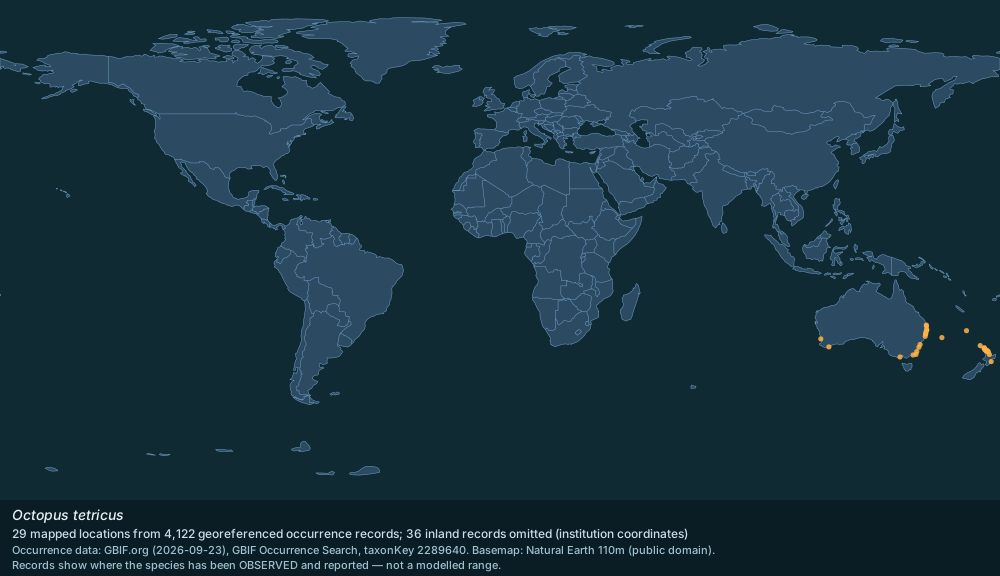
Distribution map plotted from GBIF.org occurrence records; basemap Natural Earth 110m · GBIF records CC0 / CC BY; Natural Earth public domain
Octopus tetricus, the gloomy octopus, the common Sydney octopus, or the peachy octopus, is a species of octopus from the subtropical waters of eastern Australia and northern New Zealand. O. tetricus belongs to the Octopus vulgaris species group. All species within the O. vulgaris group are similar in morphology, behaviour, and physiology. The English translation of O. tetricus (Latin) is 'the gloomy octopus'. It is a significant species in the fishing industry in Australia. They play an important role in energy flux between trophic levels in the marine environment.
- Scientific name
- Octopus tetricus
- Authority
- A. A. Gould, 1852
- Family
- Octopodidae
- Order
- Octopoda
- Maximum length
- 80 cm
- Depth range
- 0–60 m
- Habitat zone
- benthic
- Iucn red list
- Least Concern
- Gbif occurrence records
- 4,122
Classification (WoRMS)
Full classification as recorded by WoRMS: Kingdom: Animalia · Phylum: Mollusca · Class: Cephalopoda · Order: Octopoda · Family: Octopodidae · Genus: Octopus.
Accepted name: Octopus tetricus · Authority: A. A. Gould, 1852 · Taxonomic status: accepted · AphiaID: 342036.
Synonyms and superseded combinations recorded for this taxon: Octopus gibbsi O'Shea, 1999.
Source: World Register of Marine Species (WoRMS) — https://www.marinespecies.org/aphia.php?p=taxdetails&id=342036 (CC BY 4.0). Accessed 2026-09-23.
Biology and life history (SeaLifeBase)
Measured values published by SeaLifeBase for Octopus tetricus. Only fields the database actually holds for this species are shown; these are database values, not aquarium guidance.
Maximum length: 80 cm · Depth range: 0–60 m · Habitat zone: benthic · Vulnerability index: 52 of 100 · Fishery importance: commercial.
SeaLifeBase notes: Mantle length is 14 cm (Ref. 96968). Data for maximum weight for males/unsexed is from Ref. 96968. It lives in subtidal areas, adjacent to rocky reefs (Ref. 96968).
Source: SeaLifeBase species summary (SpecCode 57249) — https://www.sealifebase.se/summary/Octopus-tetricus.html (CC BY-NC 3.0 — non-commercial use only). Accessed 2026-09-23.
Distribution and occurrence records (GBIF)
4,122 georeferenced occurrence records for Octopus tetricus are published through GBIF from 5 countries or marine areas. The map above plots 29 distinct locations from a sample of 3,000 records, omitting 36 inland records that carry an institution's coordinates rather than a collection site; it shows where the species has been observed and reported, not a modelled range.
Most records by country or area: Australia (3,509); New Zealand (559); Norfolk Island (51); France (1); United States of America (1).
The full country table, WoRMS marine regions and the sampling notes are on this species' Distribution page.
Source: GBIF Occurrence Search (taxonKey 2289640) — https://www.gbif.org/occurrence/search?taxon_key=2289640&has_coordinate=true (records CC0 / CC BY); WoRMS distribution records (MarineRegions) — https://www.marinespecies.org/aphia.php?p=taxdetails&id=342036 (CC BY 4.0); Natural Earth 110m basemap — https://www.naturalearthdata.com/ (public domain). Accessed 2026-09-23.
Conservation status (IUCN Red List)
The IUCN Red List assesses Octopus tetricus Gould, 1852 as Least Concern (code LC). No trend, population estimate or threat analysis is given here, because none is available from this source without the Red List API; follow the source link for the full assessment, including its date.
Source: IUCN Red List of Threatened Species (taxon 163280) — https://www.iucnredlist.org/species/163280/0; GBIF IUCN Red List category endpoint (taxonKey 2289640) — https://api.gbif.org/v1/species/2289640/iucnRedListCategory. Accessed 2026-09-23.
Description and natural history (Wikipedia)
O. tetricus was originally discovered in New South Wales and was also found along the eastern Australian coastline. It occurs from Lakes Entrance in Victoria to Moreton Bay in southern Queensland. O. tetricus is distributed in the subtropical seas of eastern Australia and northern New Zealand, including Lord Howe Island. A close relative, Octopus djinda, occurs at similar latitudes in Western Australia, from Shark Bay to Cape Le Grand, and was considered to be conspecific with O. tetricus until 2021.The first sighting of O. tetricus in New Zealand was not until 1997, and has since become one of the most common species of octopus found in New Zealand, alongside Pinnoctopus cordiformis and Macroctopus maorum. O. tetricus populations in New Zealand are found along the North-East coast of the North Island, between the Bay of Plenty and Northland.
Gene squencing confirms that O. tetricus from Australia and New Zealand come from the same original population. It is proposed that the mechanism for gene flow across the Tasman Sea is through planktonic larvae and/or adults using floating wood or algae as transport. It is hypothesised that warmer waters spreading south of Australia are influencing populations to O. tetricus to disperse further south in response to climate change.
Octopus tetricus is normally coloured grey to mottled brown with rufous arm faces that taper towards the tip. They have orange colouration of arms, funnel, and mantle opening. Their eyes are typically white in colour. The skin is granular, and has many small irregularly shaped patches and large warty structures used to make it appear spiky when the octopus camouflages itself as seaweed. The adults typically have an arm span of 2 m and a mantle length of up to 20 cm. The maximum weight recorded for O. tetricus is 2.6 kg.
The second and third arms of O. tetricus are longer than the first and fourth arms, typical of all species in the Octopoda order. The brain, optic lobes, and the highly developed arm nervous system are the three main components of the octopus nervous system. Each arm of the octopus has been described as having its own brain, where individual processing, motor systems, and sensory exploration can occur. This is where the concept that octopus have many brains comes from. The arm nervous system of the octopus contains three-fifths of the octopus's total number of neurons – 350 million neurons distributed equally throughout each of its eight arms.
Octopus tetricus Gould, 1852 was described by American conchologist Augustus Addison Gould in the 1852 publication, Mollusca of the United States Exploring Expedition under Captain Charles Wilkes. An illustration of O. tetricus was also published a few years later (plate 47).
The type specimen is listed as being from Sydney, New South Wales, Australia. The type was one of many thousands of specimens collected by the Wilkes Expedition, however this particular specimen of O. tetricus is thought to be lost.
The New Zealand species O. gibbsi is considered to be a synonym of O. tetricus.
The species epithet tetricus means 'forbidding' or 'gloomy'.
The reproductive cycle of females is tied to seasonal changes, similar to many other species. Females reach maturity around Australia's spring and summer seasons in order to mate and lay eggs. During the mating process the male O. tetricus passes spermatophores to the female in two different ways. The male either wraps his arms and web around the female's mantle or reaches his mating arm from a distance and inserts it into the female's mantle. The males third right arm is the specialised mating arm, and the sperm is moved down a groove on this arm which has a sucker-less tip. Spermatophores are released from the male's "terminal organ", moved by the male's oral suckers, and then the spermatophores are inserted into the female's oviduct.
O. tetricus start out as eggs that are laid in large numbers in the octopus's nest, approximately 270,000 eggs per female. The eggs are normally glued to the rock or substrate at the top of the den created by the female octopus. The female usually lays her eggs over several nights in a string formation. The size and number of strings of eggs usually depends on how large the female is and can have between 60 and 200 egg strings. The female then guards the eggs until they hatch. Female O. tetricus have also been known to store viable spermatozoa for up to 114 days. The amount of time embryonic development takes varies with water temperature, and newly hatched O. tetricus larvae are about 2.5 mm long and 1.1 mm wide, approximately the size of a grain of rice. These larvae go through a stage called the paralarval stage where they are considered planktonic, or free floating, organisms before they settle to the bottom and grow large enough to hunt for their food. This stage may last around 35–60 days. The females of O. tetricus have been known to cannibalise the males following mating.
Temperature plays a key role in growth of this octopus species. With a good food supply, octopuses that reside in areas with a cooler water temperature tend to grow slower during the key growth phase and when they reach maturity they are generally larger than octopuses that are found in warmer water temperatures.
Adult O. tetricus is observed to have a relatively small body size and a lifespan of approximately 11 months, although there is evidence that they can live up to 2 years. They have a very fast growth rate, reaching adult size after approximately 100 days. Female O. tetricus rarely eat or sleep during the protection of the nest, devoting all resources to nourishing its offspring, and die shortly after the eggs hatch. Females are found to mature at a slower rate and become larger than male O. tetricus. This is a semelparous species, meaning each female reproduces once in her lifetime.
Octopus tetricus occurs in the intertidal zone along rocky shores and seagrass beds and in the ocean at depths of up to 70 m. It has been suggested that this species is associated more commonly with rocky reefs during the breeding season, although they frequent areas of the sea bed with soft-sediments for much of their life. O. tetricus alter their habitats by digging out dens and using remains from prey, including but not limited to shells. It is very common for scallop beds to be found in close proximity to the excavated dens. The scallops serve as a food source and their shells are part of the shell beds built. One O. tetricus den in Sydney has been observed being continuously used by different individuals since at least 2009. O. tetricus has been observed shifting and transporting sediment and shells to maintain their dens. They tend to have a preference for materials that are free from barnacles and encrustations, although the scale on which this is the case is dependent on foraging success.
Source: Wikipedia: Octopus tetricus — https://en.wikipedia.org/wiki/Octopus_tetricus (CC BY-SA 4.0). Accessed 2026-09-23.
Gallery
Related in Gloomy octopus
Links follow this subject's own source article.
Elsewhere in Gloomy octopus
Spotted an error? Know more?
Reader corrections go straight into our review queue. Suggest an edit · How this site is sourced