Meridiastra calcar
Source-cited species reference: taxonomy from WoRMS, biology from SeaLifeBase, occurrence map from GBIF, description from Wikipedia.
Last updated

MAVRIC Staff · via Wikipedia: Meridiastra calcar · CC BY 4.0
Meridiastra calcar, formerly classified as Patiriella calcar, is a species of sea star in the family Asterinidae. It is endemic to Australia. It is commonly known as carpet sea star, cushion sea star, or eight-armed sea star.
Scientific classification
- KingdomAnimalia
- PhylumEchinodermata
- ClassAsteroidea
- OrderValvatida
- FamilyAsterinidae
- GenusMeridiastra
- SpeciesMeridiastra calcar
Named by (Lamarck, 1816)
Sources: Wikipedia taxobox: Meridiastra calcar (CC BY-SA 4.0) · order, family and genus agree with WoRMS AphiaID 459547 (CC BY 4.0)
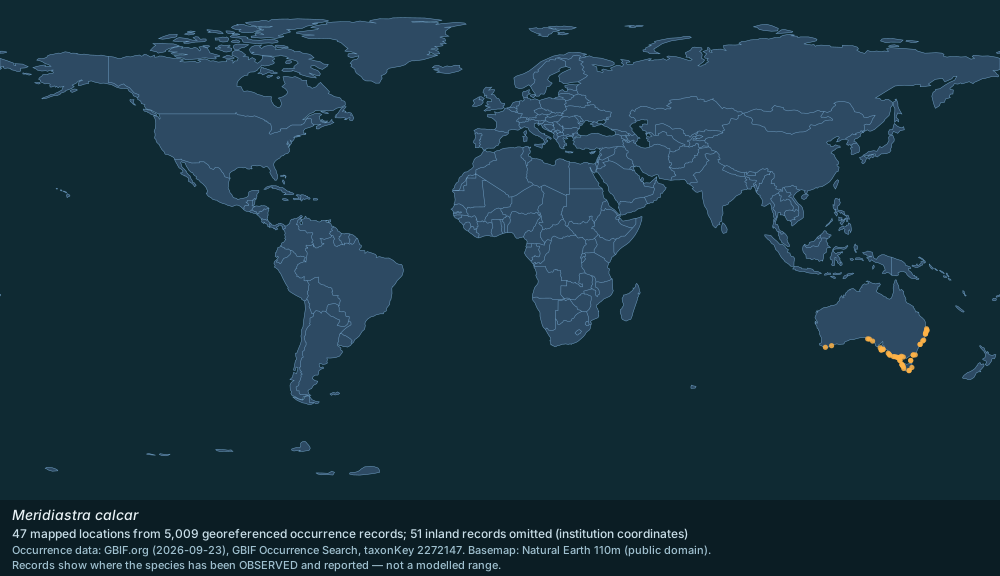
Where the meridiastra calcar has been recorded
Each dot is a place where the species has been observed and reported (5,009 records, half-degree grid) — not a modelled range. 40 inland records left out (institution coordinates).
Map: drawn by Codexery. Data: GBIF occurrence search (records CC0 / CC BY) · Natural Earth basemap (public domain) · place coordinates: Wikipedia (CC BY-SA 4.0)
Quick Facts
- Authority
- (Lamarck, 1816)
- Family
- Asterinidae
- Order
- Valvatida
- Habitat zone
- benthic
- Gbif occurrence records
- 5,009
Facts from the source article.
Classification (WoRMS)
Full classification as recorded by WoRMS: Kingdom: Animalia · Phylum: Echinodermata · Class: Asteroidea · Order: Valvatida · Family: Asterinidae · Genus: Meridiastra.
Accepted name: Meridiastra calcar · Authority: (Lamarck, 1816) · Taxonomic status: accepted · AphiaID: 459547.
Synonyms and superseded combinations recorded for this taxon: Asterias calcar Lamarck, 1816; Asterias calcar var. octagona Lamarck, 1816; Asterias octagona Lamarck, 1816; Asteriscus calcar (Lamarck, 1816); Patiriella calcar (Lamarck, 1816).
Source: World Register of Marine Species (WoRMS) — https://www.marinespecies.org/aphia.php?p=taxdetails&id=459547 (CC BY 4.0). Accessed 2026-09-25.
Biology and life history (SeaLifeBase)
Measured values published by SeaLifeBase for Meridiastra calcar. Only fields the database actually holds for this species are shown; these are database values, not aquarium guidance.
Habitat zone: benthic · Aquarium trade: never/rarely.
Source: SeaLifeBase species summary (SpecCode 167969) — https://www.sealifebase.se/summary/Meridiastra-calcar.html (CC BY-NC 3.0 — non-commercial use only). Accessed 2026-09-25.
Distribution and occurrence records (GBIF)
5,009 georeferenced occurrence records for Meridiastra calcar are published through GBIF from 2 countries or marine areas. The map above plots 47 distinct locations from a sample of 3,000 records, omitting 51 inland records that carry an institution's coordinates rather than a collection site; it shows where the species has been observed and reported, not a modelled range.
Most records by country or area: Australia (5,007); Japan (1).
The full country table, WoRMS marine regions and the sampling notes are on this species' Distribution page.
Source: GBIF Occurrence Search (taxonKey 2272147) — https://www.gbif.org/occurrence/search?taxon_key=2272147&has_coordinate=true (records CC0 / CC BY); WoRMS distribution records (MarineRegions) — https://www.marinespecies.org/aphia.php?p=taxdetails&id=459547 (CC BY 4.0); Natural Earth 110m basemap — https://www.naturalearthdata.com/ (public domain). Accessed 2026-09-25.
Description and natural history (Wikipedia)
The cushion sea star typically has eight short, distinct, triangular "arms", though 7- or 9-armed individuals can be found. These "arms" are laterally fused together for some of their length, leaving ray-like tips of varying length to jut from the disk-like body. This species aboral surface can be any colour or combination of colours, while the oral side is uniformly pale. This sea star attains a maximum diameter from arm tip to arm tip of 5 cm–10 cm.
The cushion sea star is found in the intertidal zone of Australian coasts from Western Australia's south coast to Queensland's coast off Currumbin, while including Tasmania, South Australia, Victoria and New South Wales. This sea star species favours rocky coasts abiding both in tide pools and to a maximum depth of 3 meters below sea level.
Like other sea stars, the cushion sea star is a slow-moving animal using its tube feet to move about, collecting or subduing the food items that constitute this omnivorous species diet, namely, algae, detritus, mussels and other invertebrates. This species is viviparous like a few others classified in the genus Patiriella, brooding its young within the body.
Source: Wikipedia: Meridiastra calcar — https://en.wikipedia.org/wiki/Meridiastra_calcar (CC BY-SA 4.0). Accessed 2026-09-25.
Related in Meridiastra calcar
Links follow this subject's own source article.
Elsewhere in Meridiastra calcar
Sources
Compiled from Wikipedia and the sources listed below. Text from Wikipedia is available under CC BY-SA 4.0; this entry is adapted from it.
- Wikipedia: Meridiastra calcar (CC BY-SA 4.0).
- Classification: the source article's taxobox; order, family and genus checked against WoRMS, the World Register of Marine Species (CC BY 4.0).
- Occurrence records: GBIF (CC0 / CC BY). Basemap: Natural Earth (public domain).
- Biology values: SeaLifeBase species summary (CC BY-NC 3.0, non-commercial).
- Word definitions: the , each quoted from its Wikipedia article.
Spotted an error? Know more?
Reader corrections go straight into our review queue. Suggest an edit · How this site is sourced