
Spinous spider crab (Maja squinado)
Source-cited species reference: taxonomy from WoRMS, biology from SeaLifeBase, occurrence map from GBIF, description from Wikipedia.
Maja squinado (the European spider crab, spiny spider crab or spinous spider crab) is a species of migratory crab found in the Mediterranean Sea. The appearance of the European spider crab is similar to the much larger Japanese spider crab, although the European spider crab belongs to the family Majidae, and the Japanese spider crab belongs to a different family of crabs, the Macrocheiridae.
- Scientific name
- Maja squinado
- Authority
- (Herbst, 1788)
- Family
- Majidae
- Order
- Decapoda
- Maximum length
- 22 cm
- Depth range
- 0–150 m
- Habitat zone
- benthic
- Gbif occurrence records
- 24,192
Classification (WoRMS)
Full classification as recorded by WoRMS: Kingdom: Animalia · Phylum: Arthropoda · Class: Malacostraca · Order: Decapoda · Family: Majidae · Genus: Maja.
Accepted name: Maja squinado · Authority: (Herbst, 1788) · Taxonomic status: accepted · AphiaID: 107350.
Synonyms and superseded combinations recorded for this taxon: Cancer squinado Herbst, 1788; Maia squinado (Herbst, 1788); Maja tuberculata De Haan, 1839.
Source: World Register of Marine Species (WoRMS) — https://www.marinespecies.org/aphia.php?p=taxdetails&id=107350 (CC BY 4.0). Accessed 2026-09-23.
Biology and life history (SeaLifeBase)
Measured values published by SeaLifeBase for Maja squinado. Only fields the database actually holds for this species are shown; these are database values, not aquarium guidance.
Maximum length: 22 cm · Depth range: 0–150 m · Habitat zone: benthic · Vulnerability index: 12 of 100 · Fishery importance: commercial.
SeaLifeBase notes: Maximum carapace width: 18.0 cm. Maximum depth from Ref. 114133. Occurs from the sublittoral area (Refs. 435, 106904) to depths of about 90 m (Ref. 106904), on rocky bottoms with algae (Ref. 435). Juveniles are predominantly found in shallow waters with mixed hard-and-soft bottoms. Adults live in deeper areas (Ref. 106904).
Source: SeaLifeBase species summary (SpecCode 9325) — https://www.sealifebase.se/summary/Maja-squinado.html (CC BY-NC 3.0 — non-commercial use only). Accessed 2026-09-23.
Distribution and occurrence records (GBIF)
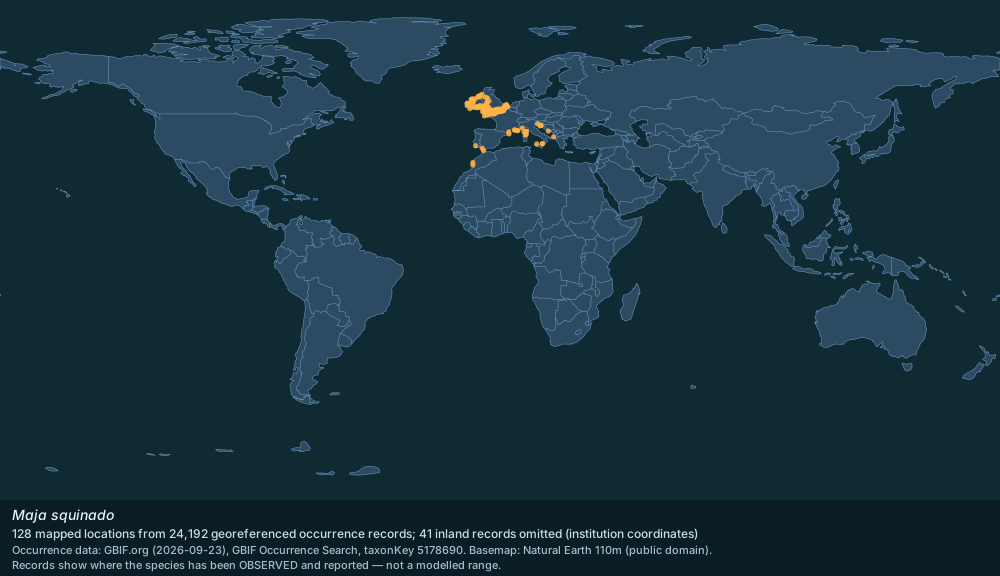
24,192 georeferenced occurrence records for Maja squinado are published through GBIF from 29 countries or marine areas. The map above plots 128 distinct locations from a sample of 3,000 records, omitting 41 inland records that carry an institution's coordinates rather than a collection site; it shows where the species has been observed and reported, not a modelled range.
Most records by country or area: United Kingdom of Great Britain and Northern Ireland (13,002); France (7,855); Jersey (1,115); Guernsey (1,066); Ireland (497).
The full country table, WoRMS marine regions and the sampling notes are on this species' Distribution page.
Source: GBIF Occurrence Search (taxonKey 5178690) — https://www.gbif.org/occurrence/search?taxon_key=5178690&has_coordinate=true (records CC0 / CC BY); WoRMS distribution records (MarineRegions) — https://www.marinespecies.org/aphia.php?p=taxdetails&id=107350 (CC BY 4.0); Natural Earth 110m basemap — https://www.naturalearthdata.com/ (public domain). Accessed 2026-09-23.
Description and natural history (Wikipedia)
A review of the species complex around M. squinado was able to differentiate between specimens from the Mediterranean Sea and those from the Atlantic, and concluded that the Atlantic specimens were a separate species, called Maja brachydactyla Balss, 1922. The specific epithet squinado derives from the Provençal name for the species –,, or — recorded by Rondelet as early as 1554.
The young of M. squinado are slightly longer than 1mm after hatching, and weigh approximately 0.12 mg at this time. Within 4–8 days, the larva molts numerous times, finally ending with morphological changes that presumably include the further development and increase in size of the cephalothorax. In a second phase, the Carapace grows to a length of approx. 2mm, and weighs approx. 0.3 mg.
The larva then undergoes metamorphosis to the first juvenile instar, and changes its planktonic life to a benthic one (living on the sea floor). Its appearance is also similar to that of the adult animal. From this stage only growth and the formation of sexual maturity follows. In observations under laboratory conditions, approx. 10.5% of the hatched zoea made it to this stage. The same conditions in terms of food, temperature and the like cannot be created in a laboratory. Animals in the first juvenile stage perform their first molt about 21 days after hatching, and therefore enter the second juvenile stage.
Here there is a considerable increase in the length of the carapace to approx. 4.51 mm. The second molt marks the beginning of the third juvenile stage, the animal now has the appearance of the adult, with a carapace length of approx. 5.63 mm, but is not sexually mature.
Juvenile animals spend another 2 years moulting and growing in size. The juvenile animals live in shallow water in winter, between rocks in coastal kelp forests. They spend the summer on small rocky reefs at a depth of only about 4 m. After this time, they reach a carapace length between 6–13 cm, with no noticeable sex-specific differences. During this time they are not yet sexually mature.
There are two main periods for the critical molts that follow the approximately two-year period of growth leading to sexual maturity: the first, the prepubertal, in April, and the second, the pubertal, from July to October. However, in captive animals it has been noticed that in very large individuals that are in the phase before one of the two molts, one molt may be lost entirely, or be very late. Likewise, three molts have been observed on some individual specimens. The average time interval between the two critical molts is 104 days. Typically, the carapace length in animals that are already comparatively large increases less after molting, relative to the initial size, than that of smaller animals. This also explains why there is a smaller increase in length (approx. 27%) in the pubescent molt than in the prepubertal (approx. 36%).
As with many species, M. squinado's behavior is dependent on many things. Some of the factors include size, life history, and age. Migrations generally take place in autumn, with some crabs covering over 100 mi in 8 months. All crabs are vulnerable to predation when moulting, and M. squinado becomes gregarious around that time, presumably for defense against predators. Females can produce up to four broods per year. M. squinado has been documented to feed on macroalgae and benthic invertebrates. From a 1992 study done in Galicia, seaweeds from the Laminariaceae, Corallina spp., molluscs, the gastropods Bittium spp., Trochiidae, the bivalve Mytilus spp., echinoderms, and others were observed as part of the diet of this particular species.
M. squinado is the subject of commercial fishery, with over 5,000 tonnes caught annually. More than 70% off the coast of France, over 10% off the coast of the United Kingdom, 6% from the Channel Islands, 3% from each of Spain and Ireland, 2% from Croatia, 1% from Portugal, and the remainder coming from Montenegro, Denmark, and Morocco, although official production figures are open to doubt. The European Union imposes a minimum landing size of 120 mm for M. squinado, and some individual countries have other regulations, such as a ban on landing egg-bearing females in Spain and a closed season in France and the Channel Islands. However, fisheries can fall due to bad management and environmental degradation. Another notable consideration is that M. squinado is currently endangered, meaning that it is harder for fishermen to catch.
Source: Wikipedia: Maja squinado — https://en.wikipedia.org/wiki/Maja_squinado (CC BY-SA 4.0). Accessed 2026-09-23.
Gallery
Related in Spinous spider crab
Links follow this subject's own source article.
Elsewhere in Spinous spider crab
Spotted an error? Know more?
Reader corrections go straight into our review queue. Suggest an edit · How this site is sourced