
Lemon shark (Negaprion brevirostris)
Source-cited species reference: taxonomy from WoRMS, biology from FishBase, occurrence map from GBIF, conservation from IUCN Red List, description from Wikipedia.
The lemon shark (Negaprion brevirostris) is a species of requiem shark from the family Carcharhinidae, known for its yellowish skin, which inspires its common name.
- Scientific name
- Negaprion brevirostris
- Authority
- (Poey, 1868)
- Family
- Carcharhinidae
- Order
- Carcharhiniformes
- Maximum length
- 340 cm
- Depth range
- 0–92 m
- Habitat zone
- reef-associated
- Iucn red list
- Vulnerable
- Gbif occurrence records
- 23,292
Classification (WoRMS)
Full classification as recorded by WoRMS: Kingdom: Animalia · Phylum: Chordata · Class: Elasmobranchii · Order: Carcharhiniformes · Family: Carcharhinidae · Genus: Negaprion.
Accepted name: Negaprion brevirostris · Authority: (Poey, 1868) · Taxonomic status: accepted · AphiaID: 105800.
Synonyms and superseded combinations recorded for this taxon: Carcharias fronto Jordan & Gilbert, 1882; Hypoprion brevirostris Poey, 1868.
Source: World Register of Marine Species (WoRMS) — https://www.marinespecies.org/aphia.php?p=taxdetails&id=105800 (CC BY 4.0). Accessed 2026-09-23.
Biology and life history (FishBase)
Measured values published by FishBase for Negaprion brevirostris. Only fields the database actually holds for this species are shown; these are database values, not aquarium guidance.
Maximum length: 340 cm · Common length: 240 cm · Depth range: 0–92 m · Habitat zone: reef-associated · Body shape: fusiform / normal · Vulnerability index: 72.9 of 100 · Fishery importance: commercial · Aquarium trade: never/rarely.
FishBase notes: Occurs on continental and insular shelves, frequenting mangrove fringes, coral keys, docks, sand or coral mud bottoms, saline creeks, enclosed bays or sounds, and river mouths. May enter fresh water. Occasionally moves into the open ocean, near or at the surface, apparently for purposes of migration. May rest motionless on the bottom (Ref. 9710). May occur singly or in small groups. Feeds mainly on fish but also takes crustaceans and mollusks. Viviparous, with 4 to 17 young in a litter. Size at birth 60 to 65 cm. Has been involved in several attacks on people. Meat is utilized for human consumption, hides for leather, fins for shark-fin soup base, liver oil for vitamins, and carcasses for fish meal. Marketed fresh, dried-salted and frozen (Ref. 9987).
Source: FishBase species summary (SpecCode 897) — https://www.fishbase.se/summary/Negaprion-brevirostris.html (CC BY-NC 3.0 — non-commercial use only). Accessed 2026-09-23.
Distribution and occurrence records (GBIF)
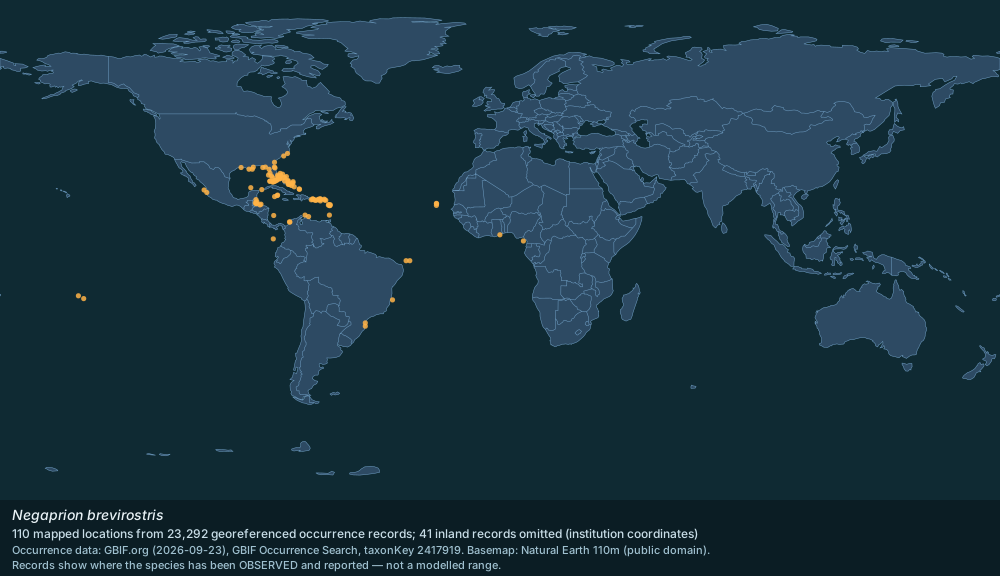
23,292 georeferenced occurrence records for Negaprion brevirostris are published through GBIF from 37 countries or marine areas. The map above plots 110 distinct locations from a sample of 3,000 records, omitting 41 inland records that carry an institution's coordinates rather than a collection site; it shows where the species has been observed and reported, not a modelled range.
Most records by country or area: United States of America (19,224); Puerto Rico (3,092); Brazil (468); Bahamas (149); Mexico (72).
The full country table, WoRMS marine regions and the sampling notes are on this species' Distribution page.
Source: GBIF Occurrence Search (taxonKey 2417919) — https://www.gbif.org/occurrence/search?taxon_key=2417919&has_coordinate=true (records CC0 / CC BY); WoRMS distribution records (MarineRegions) — https://www.marinespecies.org/aphia.php?p=taxdetails&id=105800 (CC BY 4.0); Natural Earth 110m basemap — https://www.naturalearthdata.com/ (public domain). Accessed 2026-09-23.
Conservation status (IUCN Red List)
The IUCN Red List assesses Negaprion brevirostris (Poey, 1868) as Vulnerable (code VU). No trend, population estimate or threat analysis is given here, because none is available from this source without the Red List API; follow the source link for the full assessment, including its date.
Source: IUCN Red List of Threatened Species (taxon 39380) — https://www.iucnredlist.org/species/39380/0; GBIF IUCN Red List category endpoint (taxonKey 2417919) — https://api.gbif.org/v1/species/2417919/iucnRedListCategory. Accessed 2026-09-23.
Description and natural history (Wikipedia)
The lemon shark is classified as a "vulnerable" species by the International Union for the Conservation of Nature.
Lemon sharks can grow to 3.4 m in length. They are often found in shallow subtropical waters and are known to inhabit and return to specific nursery sites for breeding. Often feeding at night, these sharks use electroreceptors to find their main source of prey, fish. Lemon sharks enjoy the many benefits of group living, such as enhanced communication, courtship, predatory behavior, and protection. This species gives birth to live young, and the females are polyandrous and have a biennial reproductive cycle. Lemon sharks are not thought to be a large threat to humans; only 10 bites have been recorded, none of which were life-threatening. The lemon shark's lifespan is unknown, but the typical shark is 25 to 30 years old.
In 2023, the oldest recorded lemon shark in captivity died at the age of 40 years.
In 1868, Felipe Poey was the first to name and describe the lemon shark. He originally called it Hypoprion brevirostris, but later reclassified the species as Negaprion brevirostris, which is the accepted scientific name today.
The lemon shark has also appeared in the scientific literature as Negaprion fronto and Carcharias fronto (Jordan and Gilbert, 1882), Carcharias brevirostris (Gunther, 1870), and Carcharhinus brevirostris (Henshall, 1891).
The earliest fossil remains of this species are known from the Early Miocene of Odisha (India), Peru, and Cuba. Fossils become more widespread in the Americas and western Africa from the Middle Miocene onward.
The lemon shark's yellow coloring serves as an excellent camouflage when swimming over the sandy seafloor in its coastal habitat.
The lemon shark commonly attains a length of 2.4 to 3.1 m and a weight up to 90 kg by adulthood, although sexual maturity is attained at 2.24 m in males and 2.40 m in females. The maximum recorded length and weight is 3.43 m and 183.7 kg, respectively.
The lemon shark has a flattened head with a short, broad snout, and the second dorsal fin is almost as large as the first. Like all cartilaginous fishes, lemon sharks have electroreceptors concentrated in their heads, known as the ampullae of Lorenzini. These receptors detect electrical pulses emitted by potential prey and allow these nocturnal feeders to sense their prey in the dark.
Lemon sharks can be confused with bull sharks; the former have quite similarly sized first and second dorsal fins, whereas those of the latter are differently sized.
Lemon sharks are found from New Jersey to southern Brazil in the tropical western Atlantic Ocean. They also live off the coast of west Africa in the southeastern Atlantic. In addition, lemon sharks have been found in the eastern Pacific, from southern Baja California to Ecuador and in Cape Verde in Sal Island.
Although the lemon shark species is known for occupying the subtropical, shallow waters of coral reefs, mangroves, enclosed bays, and river mouths, they have also been found in the open ocean down to depths of 92 m.
Lemon sharks have been observed swimming up rivers, but they do not appear to travel very far into fresh water. They are found in open water primarily during migrations, tending to stay along the continental and insular shelves for most of their lives.
Source: Wikipedia: Lemon shark — https://en.wikipedia.org/wiki/Lemon_shark (CC BY-SA 4.0). Accessed 2026-09-23.
Gallery
Related in Lemon shark
Links follow this subject's own source article.
Elsewhere in Lemon shark
Spotted an error? Know more?
Reader corrections go straight into our review queue. Suggest an edit · How this site is sourced