
Leach's spider crab (Inachus phalangium)
Source-cited species reference: taxonomy from WoRMS, biology from SeaLifeBase, occurrence map from GBIF, description from Wikipedia.

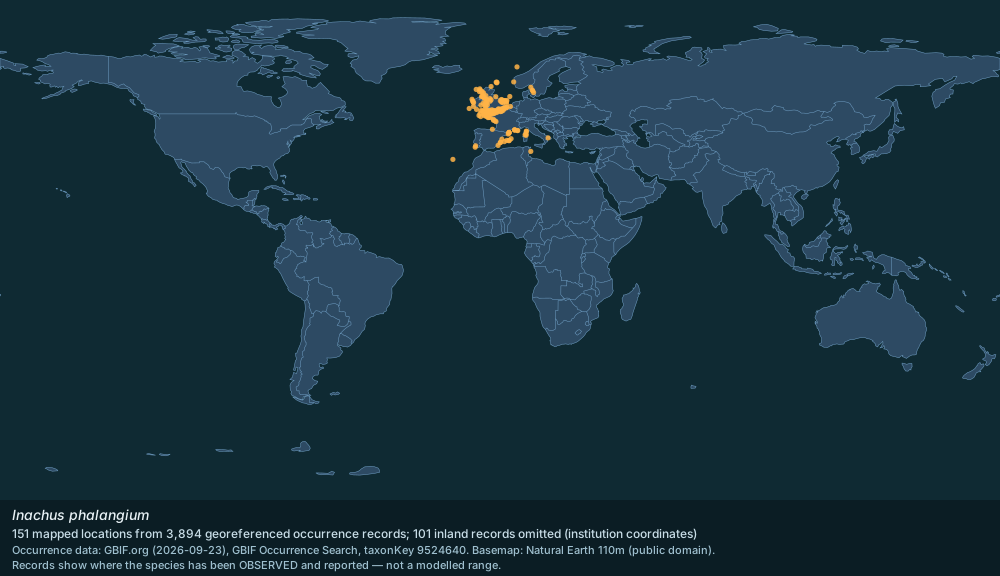
Distribution map plotted from GBIF.org occurrence records; basemap Natural Earth 110m · GBIF records CC0 / CC BY; Natural Earth public domain
Inachus phalangium, or Leach's spider crab, is a species of crabs from the north-eastern Atlantic Ocean and Mediterranean Sea. It is up to 20.5 mm wide, and is very similar to other species in the genus Inachus.
- Scientific name
- Inachus phalangium
- Authority
- (Fabricius, 1775)
- Family
- Inachidae
- Order
- Decapoda
- Habitat zone
- benthic
- Gbif occurrence records
- 3,894
Classification (WoRMS)
Full classification as recorded by WoRMS: Kingdom: Animalia · Phylum: Arthropoda · Class: Malacostraca · Order: Decapoda · Family: Inachidae · Genus: Inachus.
Accepted name: Inachus phalangium · Authority: (Fabricius, 1775) · Taxonomic status: accepted · AphiaID: 107333.
Synonyms and superseded combinations recorded for this taxon: Cancer Phalangium Fabricius, 1775; Cancer satuak Herbst, 1782; Cancer tribulus Linnaeus, 1767; Inachus dorhynchus Leach, 1815; Inachus dorynchus Leach, 1815; Macropus aracnides Risso, 1816; Stenorhynchus phalangium (Fabricius, 1775).
Source: World Register of Marine Species (WoRMS) — https://www.marinespecies.org/aphia.php?p=taxdetails&id=107333 (CC BY 4.0). Accessed 2026-09-23.
Biology and life history (SeaLifeBase)
Measured values published by SeaLifeBase for Inachus phalangium. Only fields the database actually holds for this species are shown; these are database values, not aquarium guidance.
Habitat zone: benthic.
Source: SeaLifeBase species summary (SpecCode 27052) — https://www.sealifebase.se/summary/Inachus-phalangium.html (CC BY-NC 3.0 — non-commercial use only). Accessed 2026-09-23.
Distribution and occurrence records (GBIF)
3,894 georeferenced occurrence records for Inachus phalangium are published through GBIF from 23 countries or marine areas. The map above plots 151 distinct locations from a sample of 3,000 records, omitting 101 inland records that carry an institution's coordinates rather than a collection site; it shows where the species has been observed and reported, not a modelled range.
Most records by country or area: France (1,727); United Kingdom of Great Britain and Northern Ireland (1,432); Spain (268); Ireland (203); Sweden (48).
The full country table, WoRMS marine regions and the sampling notes are on this species' Distribution page.
Source: GBIF Occurrence Search (taxonKey 9524640) — https://www.gbif.org/occurrence/search?taxon_key=9524640&has_coordinate=true (records CC0 / CC BY); WoRMS distribution records (MarineRegions) — https://www.marinespecies.org/aphia.php?p=taxdetails&id=107333 (CC BY 4.0); Natural Earth 110m basemap — https://www.naturalearthdata.com/ (public domain). Accessed 2026-09-23.
Description and natural history (Wikipedia)
Large males may reach a carapace size of 20.5 x 17.5 mm, and is brownish-yellow in colour. The carapace becomes narrower towards the front of the animal, and is often concealed by epibionts. I. phalangium resembles the closely related species Inachus dorsettensis, but has less prominent spines on the carapace.
Inachus phalangium is found in the eastern Atlantic Ocean, from Norway in the north to West Africa and the Cape Verde islands in the south, and extending into the Mediterranean Sea. It lives at depths of 11 - 55 m.
Inachus phalangium lives commensally with the sea anemone Anemonia sulcata (snakelocks anemone). The crab gains protection from potential predators by sheltering beneath the anemone's stinging tentacles. The crab eats particles of food dropped by the sea anemone, and mucus from the surface of the anemone.
The earliest scientific description of Leach's spider crab may have been Carl Linnaeus' description of "Cancer tribulus" in the 12th edition of his Systema Naturae in 1767. Linnaeus' description was, however, too vague to allow the species to be confidently identified. That name is therefore a nomen dubium, and it was suppressed by the International Commission on Zoological Nomenclature in 1964 at the request of Lipke Holthuis. The first valid description was Johan Christian Fabricius' publication of the name Cancer phalangium in his 1775 work Systema Entomologiae. The name Cancer phalangium was later protected by being placed on the Official List of Specific Names in Zoology.
Source: Wikipedia: Inachus phalangium — https://en.wikipedia.org/wiki/Inachus_phalangium (CC BY-SA 4.0). Accessed 2026-09-23.
Gallery
Related in Leach's spider crab
Links follow this subject's own source article.
Elsewhere in Leach's spider crab
Spotted an error? Know more?
Reader corrections go straight into our review queue. Suggest an edit · How this site is sourced