
Halloween hermit crab (Ciliopagurus strigatus)
Source-cited species reference: taxonomy from WoRMS, biology from SeaLifeBase, occurrence map from GBIF, description from Wikipedia, aquarium from Wikipedia (cited section).
The Halloween hermit crab (Ciliopagurus strigatus), also known as the striped hermit crab or orange-legged hermit crab, is a brightly colored species of aquatic hermit crab in the family Diogenidae. Besides its ability to routinely clean algae in aquaria, the Halloween hermit crab's festive striped coloration also appeals to enthusiasts; it is considered the most brightly colored hermit crab in normal aquarium use.
- Scientific name
- Ciliopagurus strigatus
- Authority
- (Herbst, 1804)
- Family
- Diogenidae
- Order
- Decapoda
- Depth range
- 0–90 m
- Habitat zone
- reef-associated
- Gbif occurrence records
- 492
Classification (WoRMS)
Full classification as recorded by WoRMS: Kingdom: Animalia · Phylum: Arthropoda · Class: Malacostraca · Order: Decapoda · Family: Diogenidae · Genus: Ciliopagurus.
Accepted name: Ciliopagurus strigatus · Authority: (Herbst, 1804) · Taxonomic status: accepted · AphiaID: 246257.
Synonyms and superseded combinations recorded for this taxon: Aniculus strigatus (Herbst, 1804); Cancer strigatus Herbst, 1804; Pagurus annulipes H. Milne Edwards, 1848; Pagurus strigatus (Herbst, 1804); Trizopagurus strigatus (Herbst, 1804).
Source: World Register of Marine Species (WoRMS) — https://www.marinespecies.org/aphia.php?p=taxdetails&id=246257 (CC BY 4.0). Accessed 2026-09-23.
Biology and life history (SeaLifeBase)
Measured values published by SeaLifeBase for Ciliopagurus strigatus. Only fields the database actually holds for this species are shown; these are database values, not aquarium guidance.
Depth range: 0–90 m · Habitat zone: reef-associated · Aquarium trade: commercial.
SeaLifeBase notes: Found along the neritic zone (Ref. 97241). Intertidal (Ref. 106854). Inhabits coral reefs, rock platforms or coral rubble (Ref. 81753). Corallivorous (carnivore) (Ref. 97241).
Source: SeaLifeBase species summary (SpecCode 21033) — https://www.sealifebase.se/summary/Ciliopagurus-strigatus.html (CC BY-NC 3.0 — non-commercial use only). Accessed 2026-09-23.
Distribution and occurrence records (GBIF)
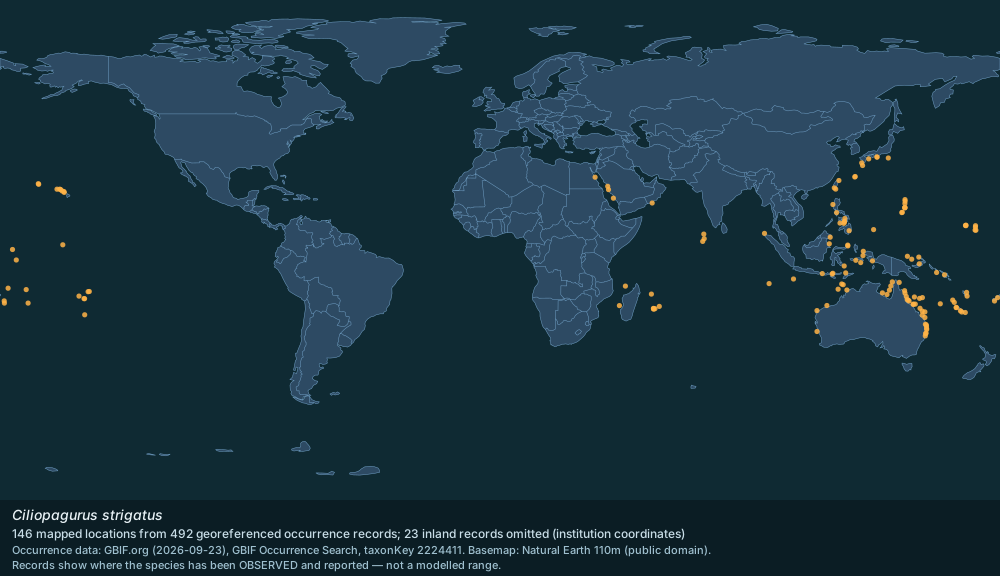
492 georeferenced occurrence records for Ciliopagurus strigatus are published through GBIF from 36 countries or marine areas. The map above plots 146 distinct locations from a sample of 492 records, omitting 23 inland records that carry an institution's coordinates rather than a collection site; it shows where the species has been observed and reported, not a modelled range.
Most records by country or area: United States of America (129); Australia (104); Réunion (27); Indonesia (26); Papua New Guinea (24); French Polynesia (22); Japan (20); Philippines (18); Marshall Islands (16); Chinese Taipei (16); New Caledonia (13); Christmas Island (11); Northern Mariana Islands (11); Fiji (5); Guam (5).
Marine regions with a valid WoRMS distribution record: Gulf of Mexico; Wallis and Futuna Exclusive Economic Zone; French Polynesian Exclusive Economic Zone; Réunion Exclusive Economic Zone; New Caledonian Exclusive Economic Zone; Halmahera.
Source: GBIF Occurrence Search (taxonKey 2224411) — https://www.gbif.org/occurrence/search?taxon_key=2224411&has_coordinate=true (records CC0 / CC BY); WoRMS distribution records (MarineRegions) — https://www.marinespecies.org/aphia.php?p=taxdetails&id=246257 (CC BY 4.0); Natural Earth 110m basemap — https://www.naturalearthdata.com/ (public domain). Accessed 2026-09-23.
Description and natural history (Wikipedia)
The Halloween hermit crab is commonly found along coral substrates in the ocean, along sandy areas surrounding reefs, but not typically on top of the reefs, in shallow (less than 50 ft) tropical, coastal waters. It is native to the Indo-Pacific region, including the Red Sea and Hawaii. It is very similar in appearance to three other species in the same genus: C. tricolor, C. vakovako, and C. galzini, only distinguishable by the color of its striae.
The Halloween hermit crab typically grows to 2 in in length, which is fairly large in comparison to other hermit crabs. It has a noticeably flattened, pure white shield, about.315 in long. It is a nocturnal species, and has been described as "conspicuous". It lives primarily in empty cone shells, mainly those of snails or tritons. Like other hermit crabs, it wears shells to protect itself from predators. Its ocular peduncles and antennae are a solid orange and the antennal flagella are transparent. The propodus has parallel ridges on the palm, with similar ridges on the dactyls (the movable part of the pincers). The Halloween hermit crab can live for up to 10 years.
The Halloween hermit crab is well known for its distinct and vibrant coloration. It has been described as an unusual hermit crab and the brightest of the hermit crabs typically available, with vividly colored walking legs, a red body, and alternating horizontal bright orange and white bands, giving it the likeness of the festive colors of Halloween. These characteristics make the Halloween hermit crab attractive to aquarists.
The Halloween hermit crab is omnivorous and a scavenger, eating nearly anything that appears in its environment, including small animals. It feeds on live and dead animal material, including filamentous algae and detritus. If a Halloween hermit crab's shell is too small, it may attack a snail for a larger shell. The Halloween hermit crab can eat quickly.
Aquarium owners may use the Halloween hermit crab because it is visually unlike other aquarium-cleaning crabs. It can eat any leftover food that settles along the bottom, sifts through the sand, which aerates the aquarium substrate, and is well known to eat cyanobacteria, unsightly brown bacteria, and filamentous green algae efficiently. Because it can become aggressive towards other tank animals and may even kill fish and other invertebrates, feeding it meats, such as clams, mussels, scallops and shrimp along with various vegetation may reduce this behavior. Overall, it can support a healthy aquarium environment.
Source: Wikipedia: Halloween hermit crab — https://en.wikipedia.org/wiki/Halloween_hermit_crab (CC BY-SA 4.0). Accessed 2026-09-23.
In the aquarium (Wikipedia, cited section)
Aquarium owners may use the Halloween hermit crab because it is visually unlike other aquarium-cleaning crabs. It can eat any leftover food that settles along the bottom, sifts through the sand, which aerates the aquarium substrate, and is well known to eat cyanobacteria, unsightly brown bacteria, and filamentous green algae efficiently. Because it can become aggressive towards other tank animals and may even kill fish and other invertebrates, feeding it meats, such as clams, mussels, scallops and shrimp along with various vegetation may reduce this behavior. Overall, it can support a healthy aquarium environment.
This block reproduces what the species' own Wikipedia article states about it in captivity, with that article's 8 inline citations. No care parameters — tank size, temperature, reef-safety, temperament — are published by any of the databases used on this page, and none have been added.
Source: Wikipedia: Halloween hermit crab — section "Use in aquaria" — https://en.wikipedia.org/wiki/Halloween_hermit_crab (CC BY-SA 4.0). Accessed 2026-09-23.
Gallery
Spotted an error? Know more?
Reader corrections go straight into our review queue. Suggest an edit · How this site is sourced