
Horned wrack (Fucus ceranoides)
Source-cited species reference: taxonomy from WoRMS, biology from SeaLifeBase, occurrence map from GBIF, description from Wikipedia.
Fucus ceranoides is a species of brown algae found in the littoral zone of the sea shore.
- Scientific name
- Fucus ceranoides
- Authority
- Linnaeus, 1753
- Family
- Fucaceae
- Order
- Fucales
- Habitat zone
- sessile
- Gbif occurrence records
- 3,286
Classification (WoRMS)
Full classification as recorded by WoRMS: Kingdom: Chromista · Phylum: Ochrophyta · Class: Phaeophyceae · Order: Fucales · Family: Fucaceae · Genus: Fucus.
Accepted name: Fucus ceranoides · Authority: Linnaeus, 1753 · Taxonomic status: accepted · AphiaID: 145542.
Synonyms and superseded combinations recorded for this taxon: Chondrus ceranoides (Linnaeus) Stackhouse, 1797; Fucus ceranoides f. divergens (J.Agardh) Kjellman, 1880; Fucus ceranoides f. harveyanus (Decaisne ex J.Agardh) Kjellman, 1880; Fucus divergens J.Agardh, 1872; Fucus harveyanus Decaisne ex J.Agardh, 1868; Virsodes ceranoides (Linnaeus) Kuntze.
Source: World Register of Marine Species (WoRMS) — https://www.marinespecies.org/aphia.php?p=taxdetails&id=145542 (CC BY 4.0). Accessed 2026-09-23.
Biology and life history (SeaLifeBase)
Measured values published by SeaLifeBase for Fucus ceranoides. Only fields the database actually holds for this species are shown; these are database values, not aquarium guidance.
Habitat zone: sessile.
Source: SeaLifeBase species summary (SpecCode 113480) — https://www.sealifebase.se/summary/Fucus-ceranoides.html (CC BY-NC 3.0 — non-commercial use only). Accessed 2026-09-23.
Distribution and occurrence records (GBIF)
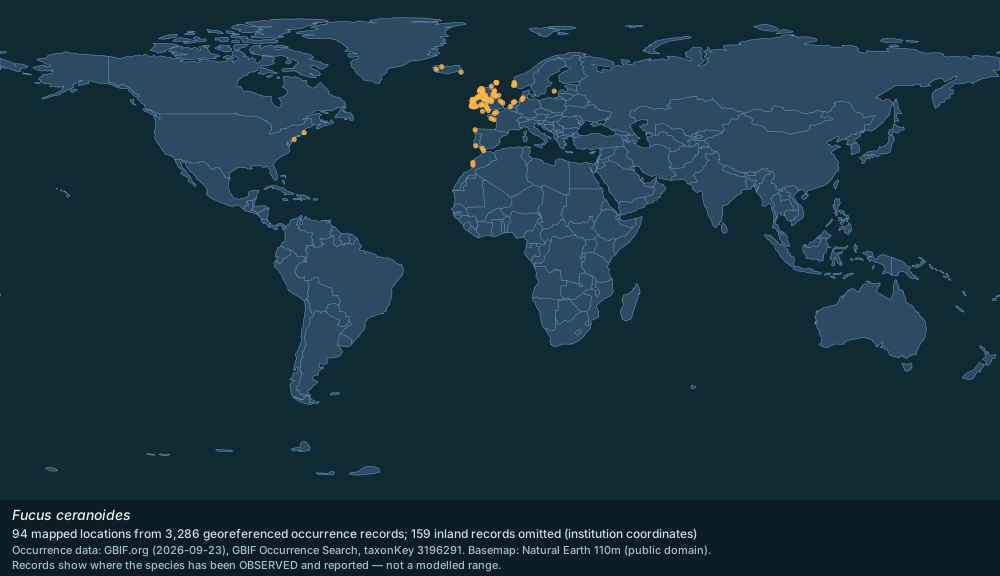
3,286 georeferenced occurrence records for Fucus ceranoides are published through GBIF from 21 countries or marine areas. The map above plots 94 distinct locations from a sample of 3,000 records, omitting 159 inland records that carry an institution's coordinates rather than a collection site; it shows where the species has been observed and reported, not a modelled range.
Most records by country or area: United Kingdom of Great Britain and Northern Ireland (1,290); United States of America (1,195); Ireland (275); France (112); Spain (110).
The full country table, WoRMS marine regions and the sampling notes are on this species' Distribution page.
Source: GBIF Occurrence Search (taxonKey 3196291) — https://www.gbif.org/occurrence/search?taxon_key=3196291&has_coordinate=true (records CC0 / CC BY); WoRMS distribution records (MarineRegions) — https://www.marinespecies.org/aphia.php?p=taxdetails&id=145542 (CC BY 4.0); Natural Earth 110m basemap — https://www.naturalearthdata.com/ (public domain). Accessed 2026-09-23.
Description and natural history (Wikipedia)
Fucus ceranoides is a species similar to other species of Fucus. It is linear to about 1 cm wide and is attached by a discoid holdfast. The branches grow to a length of 60 cm and show a clear midrib. Its margin is entire and it differs from Fucus serratus in not having a serrated edge and unlike Fucus vesiculosus it does not have air vesicles, however irregular swellings gives it a resemblance to F. vesiculosus. Fucus spiralis has spirally twisted fronds.
Fucoids have no planktonic dispersal stages, restricting gamete dispersal. They can be found on the shores of Ireland and Great Britain including the Isle of Man and Shetland.
Fucus ceranoides is restricted to estuarine intertidal habitats under fluctuating salinities. The modern distribution of Fucus ceranoides ranges from Portugal to Norway and Iceland. This includes the rocky shores in the littoral generally where fresh water flows into the sea, brackish water in sheltered bays. Fucus ceranoides are well adapted to abiotic conditions encountered across estuarine salinities. Increased levels of salinity present the most stress to Fucus ceranoides, hence their absence from marine conditions and its inability to colonize the coasts. At levels of high salinity, Fucus ceranoides will decay to a rust brown color.
Source: Wikipedia: Fucus ceranoides — https://en.wikipedia.org/wiki/Fucus_ceranoides (CC BY-SA 4.0). Accessed 2026-09-23.
Gallery
Related in Horned wrack
Links follow this subject's own source article.
Elsewhere in Horned wrack
Spotted an error? Know more?
Reader corrections go straight into our review queue. Suggest an edit · How this site is sourced