
Striking sea star (Euretaster insignis)
Source-cited species reference: taxonomy from WoRMS, biology from SeaLifeBase, occurrence map from GBIF, description from Wikipedia.

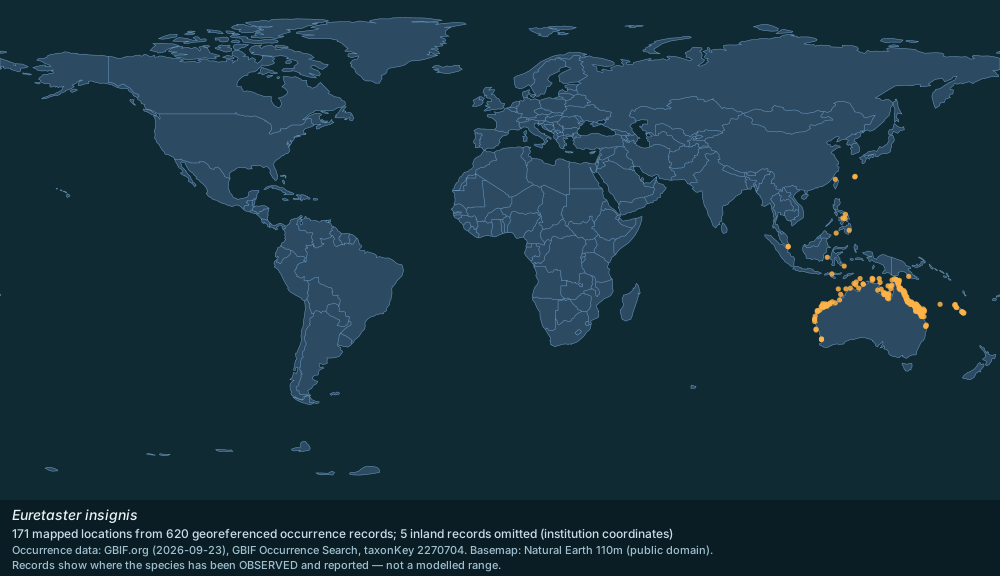
Distribution map plotted from GBIF.org occurrence records; basemap Natural Earth 110m · GBIF records CC0 / CC BY; Natural Earth public domain
Euretaster insignis, commonly known as the striking sea star, is a species of starfish in the family Pterasteridae found in the central west Pacific Ocean. It is one of only three species in the order Velatida to be found in shallow water in the tropics. The young are brooded in a cavity underneath a "supradorsal" membrane.
- Scientific name
- Euretaster insignis
- Authority
- (Sladen, 1882)
- Family
- Pterasteridae
- Order
- Velatida
- Depth range
- 0–132 m
- Habitat zone
- benthic
- Gbif occurrence records
- 620
Classification (WoRMS)
Full classification as recorded by WoRMS: Kingdom: Animalia · Phylum: Echinodermata · Class: Asteroidea · Order: Velatida · Family: Pterasteridae · Genus: Euretaster.
Accepted name: Euretaster insignis · Authority: (Sladen, 1882) · Taxonomic status: accepted · AphiaID: 292741.
Synonyms and superseded combinations recorded for this taxon: Retaster insignis Sladen, 1882.
Source: World Register of Marine Species (WoRMS) — https://www.marinespecies.org/aphia.php?p=taxdetails&id=292741 (CC BY 4.0). Accessed 2026-09-23.
Biology and life history (SeaLifeBase)
Measured values published by SeaLifeBase for Euretaster insignis. Only fields the database actually holds for this species are shown; these are database values, not aquarium guidance.
Depth range: 0–132 m · Habitat zone: benthic · Aquarium trade: never/rarely.
SeaLifeBase notes: Inhabits rocky shores and coral reefs in intertidal areas (Ref. 85384).
Source: SeaLifeBase species summary (SpecCode 130955) — https://www.sealifebase.se/summary/Euretaster-insignis.html (CC BY-NC 3.0 — non-commercial use only). Accessed 2026-09-23.
Distribution and occurrence records (GBIF)
620 georeferenced occurrence records for Euretaster insignis are published through GBIF from 8 countries or marine areas. The map above plots 171 distinct locations from a sample of 620 records, omitting 5 inland records that carry an institution's coordinates rather than a collection site; it shows where the species has been observed and reported, not a modelled range.
Most records by country or area: Australia (559); New Caledonia (33); Japan (9); Philippines (8); Indonesia (4); Singapore (4); Papua New Guinea (2); Chinese Taipei (1).
Source: GBIF Occurrence Search (taxonKey 2270704) — https://www.gbif.org/occurrence/search?taxon_key=2270704&has_coordinate=true (records CC0 / CC BY); WoRMS distribution records (MarineRegions) — https://www.marinespecies.org/aphia.php?p=taxdetails&id=292741 (CC BY 4.0); Natural Earth 110m basemap — https://www.naturalearthdata.com/ (public domain). Accessed 2026-09-23.
Description and natural history (Wikipedia)
This starfish was first described in 1882 by marine biologist Percy Sladen as Retaster insignis, Retaster being a small segregate genus of Pteraster. In 1940, the genus had to change its name after Walter Kenrick Fisher noted that the type species of Retaster he had himself designated (as Perrier, the original coiner, had failed to do so), Pteraster capensis was in fact a sound species of Pteraster, which automatically made the former genus a synonym of the latter. The genus known as Retaster required a new name, and the one Fisher coined was Euretaster, with R. insignis as its type species.
The order Velatida are presumed to be the earliest lineage of living sea stars to diverge from the ancestral line, their closest living relatives being the abyssal sea daisies in the order Peripodida. The three members of the genus Euretaster are the only tropical, shallow-water species in the order Velatida, the remaining members living at abyssal depths. It might be presumed that the order has its origin in deep water, however there are numerous shallow-water fossils of velatidans dating from the Cretaceous period and it seems that these ancient forms have largely been driven out of shallow water habitats by competition from recent, more-advanced taxa.
This small starfish is star-shaped and has five stubby arms. The aboral (upper) surface has an inflated appearance due to it being covered by a "supradorsal" membrane; this is supported by bundles of spinelets borne on the flat plates that are arranged in a mosaic pattern on the cuticle below. This membrane encloses a supradorsal cavity filled with sea water, which is connected to the water column by a central osculum (aperture), which opens and closes periodically. The membrane has a reticulated pattern of ridges and small conical protrusions. It is patterned in some combination of red, white and brown.
Euretaster insignis is native to the tropical western central Pacific Ocean from the intertidal zone down to about 132 m. It is found on coral reefs, rocky coasts, sand and muddy rubble.
The sexes are separate in Euretaster insignis. Instead of being planktonic, the developing embryos are brooded in the supradorsal cavity, and even receive nourishment from the mother in the form of a mucosal secretion from the cuticle; they receive this because their presence irritates the lining of the cavity causing it to secrete the fluid in a process that has been described as "cannibalistic ectoparasitism". The larvae are brooded until they are about 1 cm in diameter at which time they are liberated as juvenile starfish into the sea.
Source: Wikipedia: Euretaster insignis — https://en.wikipedia.org/wiki/Euretaster_insignis (CC BY-SA 4.0). Accessed 2026-09-23.
Gallery
Spotted an error? Know more?
Reader corrections go straight into our review queue. Suggest an edit · How this site is sourced