
Echinocyamus pusillus
Source-cited species reference: taxonomy from WoRMS, biology from SeaLifeBase, occurrence map from GBIF, description from Wikipedia.
Echinocyamus pusillus, commonly known as the pea urchin or green urchin, is a species of sand dollar, a sea urchin in the family Fibulariidae, native to the northeastern Atlantic Ocean and the Mediterranean Sea. It buries itself in gravel or coarse sand at depths down to about 1250 m.
- Scientific name
- Echinocyamus pusillus
- Authority
- (O.F. Müller, 1776)
- Family
- Fibulariidae
- Order
- Echinolampadacea
- Maximum length
- 1.5 cm
- Depth range
- 0–1250 m
- Habitat zone
- benthic
- Gbif occurrence records
- 32,481
Classification (WoRMS)
Full classification as recorded by WoRMS: Kingdom: Animalia · Phylum: Echinodermata · Class: Echinoidea · Order: Echinolampadacea · Family: Fibulariidae · Genus: Echinocyamus.
Accepted name: Echinocyamus pusillus · Authority: (O.F. Müller, 1776) · Taxonomic status: accepted · AphiaID: 124273.
Synonyms and superseded combinations recorded for this taxon: Clypeaster pulvinulus (Pennant, 1812); Echinocyamus angulosus Lütken, 1856; Echinocyamus minimus Girard, 1850; Echinocyamus minutus (Gmelin, 1791); Echinocyamus parthenopaeus Costa, 1868; Echinocyamus speciosus Costa, 1868; Echinocyamus tarentinus (Lamarck, 1816); Echinus minutus Gmelin, 1791; Echinus pulvinulus Pennant, 1812; Echinus pusillus (O.F. Müller, 1776); Fibularia equina Aradas, 1850; Fibularia pusilla (O.F. Müller, 1776); Fibularia tarentina Lamarck, 1816; Spatagus pusillus O.F. Müller, 1776.
Source: World Register of Marine Species (WoRMS) — https://www.marinespecies.org/aphia.php?p=taxdetails&id=124273 (CC BY 4.0). Accessed 2026-09-23.
Biology and life history (SeaLifeBase)
Measured values published by SeaLifeBase for Echinocyamus pusillus. Only fields the database actually holds for this species are shown; these are database values, not aquarium guidance.
Maximum length: 1.5 cm · Depth range: 0–1250 m · Habitat zone: benthic · Vulnerability index: 10 of 100.
SeaLifeBase notes: Oval, flattened body measuring up to 1.5 cm long for species from the North Sea off Belgium (Ref. 7882). Found along the near-coastal and coastal zones usually in medium- to coarse-grained sand with low mud content (maximum of 10%). Turns completely green in color when injured (Ref. 7882). Also occurs on substrates exposed to extensive waves and tidal activity and found on shelly gravel (Ref. 121547).
Source: SeaLifeBase species summary (SpecCode 49339) — https://www.sealifebase.se/summary/Echinocyamus-pusillus.html (CC BY-NC 3.0 — non-commercial use only). Accessed 2026-09-23.
Distribution and occurrence records (GBIF)
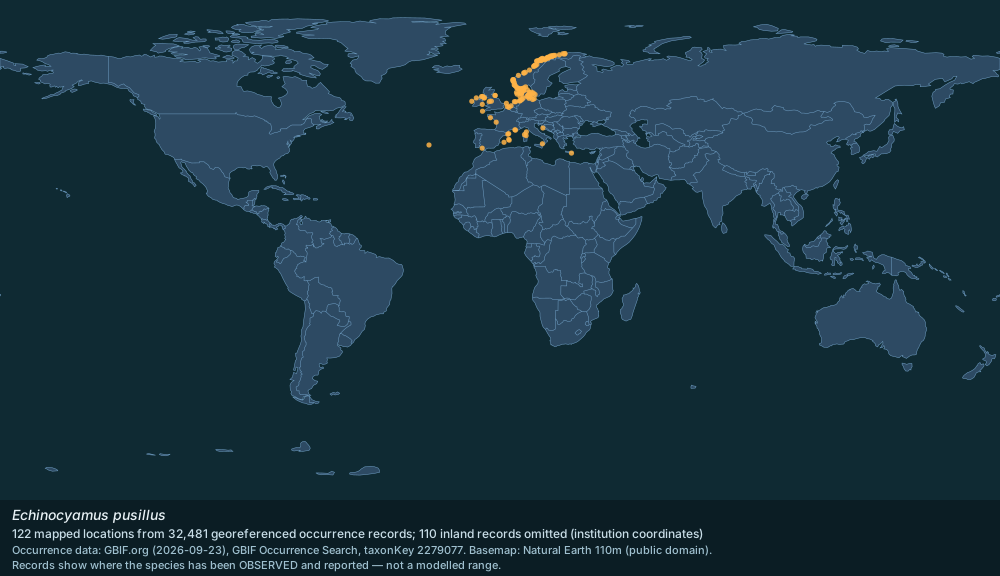
32,481 georeferenced occurrence records for Echinocyamus pusillus are published through GBIF from 29 countries or marine areas. The map above plots 122 distinct locations from a sample of 3,000 records, omitting 110 inland records that carry an institution's coordinates rather than a collection site; it shows where the species has been observed and reported, not a modelled range.
Most records by country or area: United Kingdom of Great Britain and Northern Ireland (13,934); Norway (6,262); Denmark (3,937); Netherlands (3,700); France (1,571).
The full country table, WoRMS marine regions and the sampling notes are on this species' Distribution page.
Source: GBIF Occurrence Search (taxonKey 2279077) — https://www.gbif.org/occurrence/search?taxon_key=2279077&has_coordinate=true (records CC0 / CC BY); WoRMS distribution records (MarineRegions) — https://www.marinespecies.org/aphia.php?p=taxdetails&id=124273 (CC BY 4.0); Natural Earth 110m basemap — https://www.naturalearthdata.com/ (public domain). Accessed 2026-09-23.
Description and natural history (Wikipedia)
Echinocyamus pusillus is a small sea urchin with a flattened, oval body up to 15 mm long. The anterior end is slightly pointed. The aboral (upper) surface is convex while the oral (lower) surface is flat. The ambulacral plates widen and form a petal-like pattern on the aboral surface, and it is through each of these areas that six to nine pairs of tube feet protrude. The whole test is clad in short dense spines, giving the living animal a furry appearance; spines of two types are present, relatively long, sharply-pointed ones and shorter ones with serrated tips. The mouth is in the centre of the oral surface and the anus is also on the oral surface but further back. The colour of this sea urchin is greenish or yellowish-grey, and it turns bright green if it gets injured.
Echinocyamus pusillus has a wide distribution in the northeastern Atlantic Ocean. Its range extends southwards from Iceland, Norway and Denmark to the Azores, Cape Bojador in Western Sahara, and the Mediterranean Sea. It is common in the North Sea and round the coasts of Britain. It occurs at depths from the lower subtidal down to about 1250 m. Gravel and coarse sand provide suitable habitat in which it can bury itself.
The spines are covered with fine, hair-like cilia, and are used to burrow or creep through the sediment while the animal searches for its food. It feeds on detritus, Foraminifera, diatoms and other edible particles, moving these with its tube feet to its mouth, where they are crushed by its jaws, and the organic matter is separated from the sediment. It is often found in association with such sea urchins as Spatangus purpureus and Psammechinus miliaris, the starfish Asterias rubens and the brittle star Ophiura albida.
Source: Wikipedia: Echinocyamus pusillus — https://en.wikipedia.org/wiki/Echinocyamus_pusillus (CC BY-SA 4.0). Accessed 2026-09-23.
Gallery
Related in Echinocyamus pusillus
Links follow this subject's own source article.
Elsewhere in Echinocyamus pusillus
Spotted an error? Know more?
Reader corrections go straight into our review queue. Suggest an edit · How this site is sourced