
Bull kelp (Durvillaea antarctica)
Source-cited species reference: taxonomy from WoRMS, biology from SeaLifeBase, occurrence map from GBIF, description from Wikipedia.

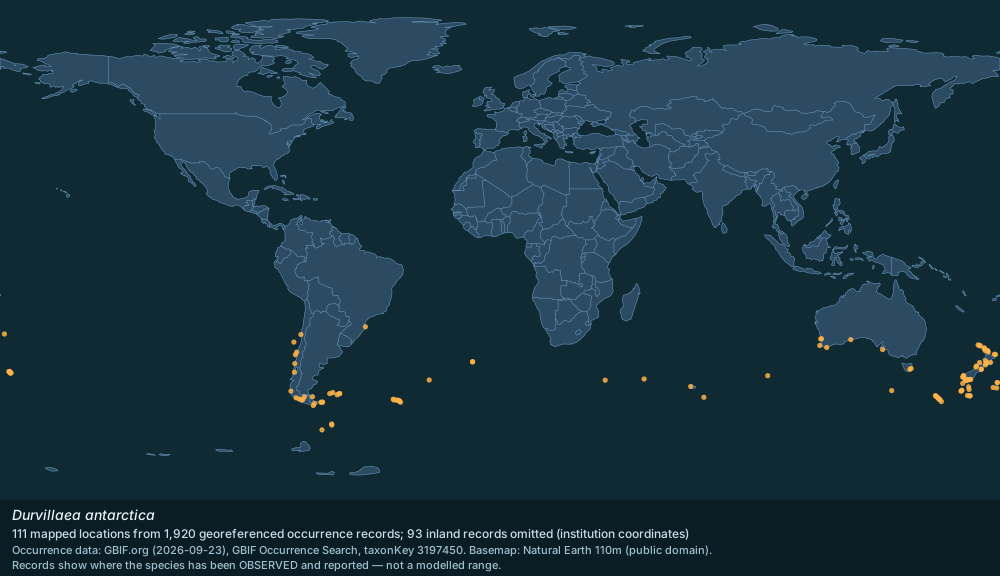
Distribution map plotted from GBIF.org occurrence records; basemap Natural Earth 110m · GBIF records CC0 / CC BY; Natural Earth public domain
Durvillaea antarctica, also known as bull kelp, and, is a large, robust species of southern bull kelp found on the coasts of Chile, southern Peru, New Zealand, and Macquarie Island. D. antarctica, an alga, does not have air bladders, but floats due to a unique honeycomb structure within the alga's blades, which also helps the kelp avoid being damaged by the strong waves.
- Scientific name
- Durvillaea antarctica
- Authority
- (Chamisso) Hariot, 1892
- Family
- Durvillaeaceae
- Order
- Fucales
- Maximum length
- 1000 cm
- Habitat zone
- sessile
- Gbif occurrence records
- 1,920
Classification (WoRMS)
Full classification as recorded by WoRMS: Kingdom: Chromista · Phylum: Ochrophyta · Class: Phaeophyceae · Order: Fucales · Family: Durvillaeaceae · Genus: Durvillaea.
Accepted name: Durvillaea antarctica · Authority: (Chamisso) Hariot, 1892 · Taxonomic status: accepted · AphiaID: 373370.
Synonyms and superseded combinations recorded for this taxon: Durvillaea caepaestipes (Montagne) Skottsberg, 1919; Durvillaea harveyi J.D.Hooker, 1845; Durvillaea mastix Suhr, 1841; Durvillaea montagnei Kützing, 1849; Durvillaea utilis Bory de Saint-Vincent, 1825; Ecklonia caepaestipes (Montagne) Endlicher, 1843; Fucus antarcticus Chamisso, 1822; Halymenia incurvata Suhr, 1839; Laminaria caepaestipes Montagne, 1839; Sarcophycus simplex Kützing, 1860.
Source: World Register of Marine Species (WoRMS) — https://www.marinespecies.org/aphia.php?p=taxdetails&id=373370 (CC BY 4.0). Accessed 2026-09-23.
Biology and life history (SeaLifeBase)
Measured values published by SeaLifeBase for Durvillaea antarctica. Only fields the database actually holds for this species are shown; these are database values, not aquarium guidance.
Maximum length: 1000 cm · Habitat zone: sessile · Vulnerability index: 90 of 100.
SeaLifeBase notes: Found in lower third of intertidal zone (Ref. 26875).
Source: SeaLifeBase species summary (SpecCode 119561) — https://www.sealifebase.se/summary/Durvillaea-antarctica.html (CC BY-NC 3.0 — non-commercial use only). Accessed 2026-09-23.
Distribution and occurrence records (GBIF)
1,920 georeferenced occurrence records for Durvillaea antarctica are published through GBIF from 13 countries or marine areas. The map above plots 111 distinct locations from a sample of 1,920 records, omitting 93 inland records that carry an institution's coordinates rather than a collection site; it shows where the species has been observed and reported, not a modelled range.
Most records by country or area: New Zealand (1,453); Chile (283); Australia (98); South Georgia and the South Sandwich Islands (18); French Southern Territories (16).
The full country table, WoRMS marine regions and the sampling notes are on this species' Distribution page.
Source: GBIF Occurrence Search (taxonKey 3197450) — https://www.gbif.org/occurrence/search?taxon_key=3197450&has_coordinate=true (records CC0 / CC BY); WoRMS distribution records (MarineRegions) — https://www.marinespecies.org/aphia.php?p=taxdetails&id=373370 (CC BY 4.0); Natural Earth 110m basemap — https://www.naturalearthdata.com/ (public domain). Accessed 2026-09-23.
Description and natural history (Wikipedia)
The blades of Durvillaea antarctica are green to golden brown with a leathery texture. The honeycomb structure of the blade gives strength and buoyancy. This novel structure is thought to be responsible for the wide distribution of this genus, as the kelp is able to float when its holdfast fails. It can colonise other coastlines in this manner, and has been shown to carry communities of invertebrates across vast ocean distances from one shore to another. Specimens of D. antarctica have been found to float for up to 210 days, during which time high wind speeds transport kelp rafts up to 10,000 km. Environmental factors such as temperature, solar radiation and surface winds (all of which vary with latitude) affect buoyancy of rafts and their rate of travel. Rafts of D. antarctica are more likely to disperse offshore if plants detach during outgoing tides during autumn and winter. It is thought that this 'rafting' with Durvillaea antarctica and other floating seaweeds allowed a wide range of species to recolonise sub-Antarctic shores scoured clean by ice during the last Ice Age.
The holdfast of D. antarctica is large and is very difficult to remove. D. antarctica has to resist forces equivalent to 1100 km/h on land. The holdfast failing is usually the result of worms and molluscs which feed on the tissue because of the sheltered habitat it creates. It is also common for its host rock to be broken off without the holdfast losing its grip, with this contributing significantly to erosion in some areas. Recruitment rates of this species are very low, therefore the ecological impact of harvesting this species is too great.
The species was first described in 1822, as Fucus antarcticus, and revised in 1892 as Durvillaea antarctica.
In 2012, a taxonomic revision led to the recognition of a new species, Durvillaea poha, based on genetic, morphological and ecological evidence, which was previously recognised as the 'cape' lineage of Durvillaea antarctica. D. poha is the only other species in the genus to share the honeycombed structure and buoyancy of D. antarctica. D. poha occurs only in southern New Zealand and on subantarctic islands (including Snares and Auckland Islands), whereas D. antarctica has a wider distribution, and is found around New Zealand, Chile and other subantarctic islands. In southern New Zealand, D. poha and D. antarctica can be found growing together, although D. poha normally grows higher up or further back on the rock platforms, or in more sheltered bays, where wave force is weaker. D. poha generally has wider fronds than D. antarctica, and can appear more 'orange' across the frond area. Mitochondrial introgression has been observed between the two species, where some plants in Wellington exhibited the nuclear DNA of D. poha but also mitochondrial DNA belonging to D. antarctica.
Further diversity, with additional unclassified lineages have been identified within the species.
The genus name Durvillaea was given in memory of the French explorer Jules Dumont d'Urville, while the Latin derived epithet refers to antarctic, due to the species' distribution in the southern oceans.
The Māori language name is based on a common Polynesian word for seaweed-like living things, rimu, and is likely the basis for the Māori language name for pasta (). The common English language name bull kelp is unknown, but likely relates to the whip-like shape or the leathery texture of the species.
Durvillaea antarctica reproduces sexually by producing egg and sperm that are released into the water. Eggs and sperm are produced on specific sites of the frond. A large individual can produce 100 million eggs in twelve hours. The season when reproduction occurs varies with location, but is generally during winter months. Eggs are small and disperse over short distances, and they generally require calm or moderate wave action to settle and successfully attach to substrates.
Holdfasts of D. antarctica are often inhabited by a diverse array of epifaunal invertebrates, many of which burrow into and graze on the kelp. In New Zealand, epifaunal species include the crustaceans Parawaldeckia kidderi, P. karaka and Limnoria stephenseni, and the molluscs Cantharidus roseus, Onchidella marginata, Onithochiton neglectus, and Sypharochiton sinclairi. The intertidal spider Desis marina also inhabits the holdfasts of D. antarctica.
Plants of D. antarctica can detach from substrates, particularly during storms. The kelp floats as a raft and can travel vast distances at sea, driven by ocean currents. Kelp-associated invertebrates can be transported inside of drifting holdfasts, potentially leading to long-distance dispersal and a significant impact upon the population genetic structure of those species.
Fronds of D. antarctica can be infected by an endophytic, phaeophycean algal parasite Herpodiscus durvillaeae (Lindauer) G. R. South. Fronds can also be infected Maullinia, a genus of intracellular, protistan parasites. Based on genetic evidence, both H. durvillaeae and Maullinia have likely been dispersed across the Southern Hemisphere via rafting bull kelp.
Durvillaea antarctica has a circumpolar distribution between the latitudes of 29°S and 55°S, found in Chile, southern New Zealand, and Macquarie Island. The type locality is Cape Horn, Chile.
It is found on exposed shores, especially in the northern parts of its range, and attaches itself with a strong holdfast.
Source: Wikipedia: Durvillaea antarctica — https://en.wikipedia.org/wiki/Durvillaea_antarctica (CC BY-SA 4.0). Accessed 2026-09-23.
Gallery
Related in Bull kelp
Links follow this subject's own source article.
Elsewhere in Bull kelp
Spotted an error? Know more?
Reader corrections go straight into our review queue. Suggest an edit · How this site is sourced