
Small hermit crab (Diogenes pugilator)
Source-cited species reference: taxonomy from WoRMS, biology from SeaLifeBase, occurrence map from GBIF, description from Wikipedia.
Diogenes pugilator is a species of hermit crab, sometimes called the small hermit crab or south-claw hermit crab. It is found from the coast of Angola to as far north as the North Sea, and eastwards through the Mediterranean Sea, Black Sea and Red Sea. Populations of D. pugilator may be kept in check by the predatory crab Liocarcinus depurator.
- Scientific name
- Diogenes pugilator
- Authority
- (Roux, 1829)
- Family
- Diogenidae
- Order
- Decapoda
- Habitat zone
- benthic
- Gbif occurrence records
- 55,448
Classification (WoRMS)
Full classification as recorded by WoRMS: Kingdom: Animalia · Phylum: Arthropoda · Class: Malacostraca · Order: Decapoda · Family: Diogenidae · Genus: Diogenes.
Accepted name: Diogenes pugilator · Authority: (Roux, 1829) · Taxonomic status: accepted · AphiaID: 107199.
Synonyms and superseded combinations recorded for this taxon: Clibanarius misanthropus var. intermedius Bouvier, 1891; Diogenes pugilator orientalis Codreanu & Balcesco, 1968; Diogenes pugilator var. gracillima Miers, 1881; Diogenes pugilator var. intermedius Bouvier, 1891; Diogenes varians (O.G. Costa, 1838); Diogenes varians var. gracilimana Miers, 1881; Diogenes varians var. gracillimanus Miers, 1881; Pagurus algarbiensis de Brito Capello, 1875; Pagurus arenarius Lucas, 1846; Pagurus Bocagii de Brito Capello, 1875; Pagurus dillvyni Spence Bate, 1851; Pagurus Dillwynii Spence Bate, 1851; Pagurus dilwynnii Spence Bate, 1851; Pagurus pugilator Roux, 1829; Pagurus varians O.G. Costa, 1838.
Source: World Register of Marine Species (WoRMS) — https://www.marinespecies.org/aphia.php?p=taxdetails&id=107199 (CC BY 4.0). Accessed 2026-09-23.
Biology and life history (SeaLifeBase)
Measured values published by SeaLifeBase for Diogenes pugilator. Only fields the database actually holds for this species are shown; these are database values, not aquarium guidance.
Habitat zone: benthic · Aquarium trade: never/rarely.
SeaLifeBase notes: Inhabits fine well sorted sand (Ref. 2780).
Source: SeaLifeBase species summary (SpecCode 89764) — https://www.sealifebase.se/summary/Diogenes-pugilator.html (CC BY-NC 3.0 — non-commercial use only). Accessed 2026-09-23.
Distribution and occurrence records (GBIF)
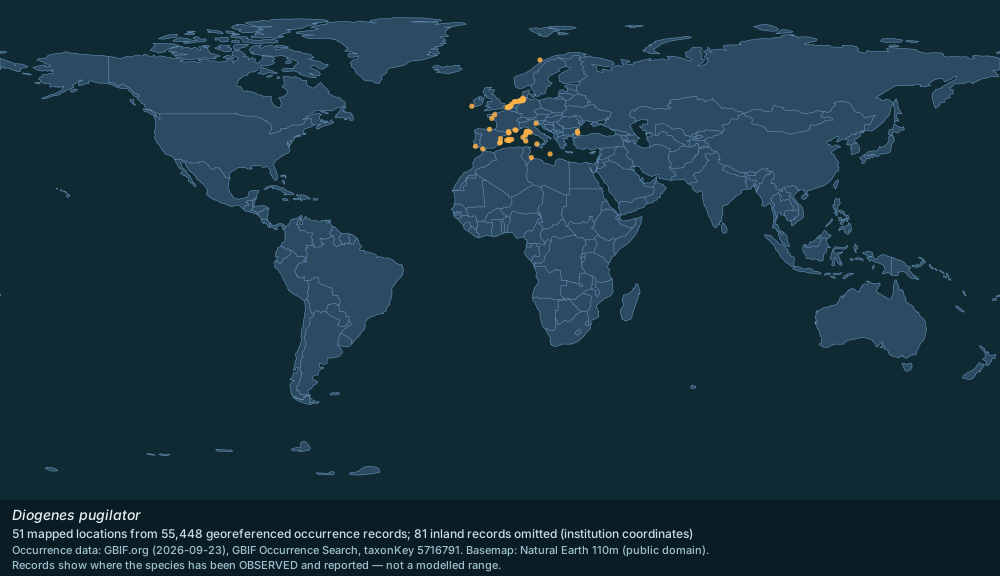
55,448 georeferenced occurrence records for Diogenes pugilator are published through GBIF from 34 countries or marine areas. The map above plots 51 distinct locations from a sample of 3,000 records, omitting 81 inland records that carry an institution's coordinates rather than a collection site; it shows where the species has been observed and reported, not a modelled range.
Most records by country or area: Netherlands (47,072); Portugal (2,228); Belgium (1,441); France (1,390); Israel (1,229).
The full country table, WoRMS marine regions and the sampling notes are on this species' Distribution page.
Source: GBIF Occurrence Search (taxonKey 5716791) — https://www.gbif.org/occurrence/search?taxon_key=5716791&has_coordinate=true (records CC0 / CC BY); WoRMS distribution records (MarineRegions) — https://www.marinespecies.org/aphia.php?p=taxdetails&id=107199 (CC BY 4.0); Natural Earth 110m basemap — https://www.naturalearthdata.com/ (public domain). Accessed 2026-09-23.
Description and natural history (Wikipedia)
This crab was first described in 1829 by Jean Louis Florent Polydore Roux as Pagurus pugilator.
Like other hermit crabs, D. pugilator conceals its soft abdomen inside an empty gastropod mollusc shell; the abdomen is twisted to fit the contours of the shell. The carapace protects the anterior part of the crab and can be up to 11 mm long; it is squarish in shape, has triangular projections along the front edge, and is clad with hairs on the front two corners. The eyes are on stalks which are about half as long as the width of the carapace. The left chela (claw) is very much larger than the right one, and both claws are covered with short hairs. The chelae and other legs can be contracted into the entrance of the shell.
D. pugilator is native to the temperate and subtropical eastern Atlantic Ocean. Its range extends from the southern North Sea southwards to Angola, the Mediterranean Sea, the Black Sea and the Red Sea. Its northern limit was at one time thought to be Swansea in South Wales, but it has since been found as far north as Anglesey, and the coasts of southwestern Ireland. It is found on soft substrates from the shallow sub-tidal to depths of as much as 1800 m, but is most common in shallow water.
This is a small hermit crab which tends to occupy shells of the netted dog whelk Tritia reticulata. These crabs are often present on flattish beaches composed of medium to fine grained sand where the waves sweep up the shore. When exposed, they rapidly bury themselves in the sand, using the enlarged left chela to stabilise themselves in the wet sand and limit the extent to which they are rolled about by the waves.
Near Cádiz in southern Spain, there are three species of hermit crab, D. pugilator, Paguristes eremita and Pagurus forbesii. Of these, P. eremita is the biggest and strongest, and makes use of the most robust gastropod shells with the widest apertures. D. pugilator is the most numerous but tends not to use the shells of the most common gastropod, Turritella turbona, which are used preferentially by P. forbesii. D. pugilator instead uses the less common Tritia reticulata, even when the crab's carapace is so large that it overlaps the shell's aperture.
Source: Wikipedia: Diogenes pugilator — https://en.wikipedia.org/wiki/Diogenes_pugilator (CC BY-SA 4.0). Accessed 2026-09-23.
Gallery
Related in Small hermit crab
Links follow this subject's own source article.
Elsewhere in Small hermit crab
Spotted an error? Know more?
Reader corrections go straight into our review queue. Suggest an edit · How this site is sourced