Stareye hermit (Dardanus venosus)
Source-cited species reference: taxonomy from WoRMS, biology from SeaLifeBase, occurrence map from GBIF, description from Wikipedia.

Dardanus venosus, the starry-eyed crab or stareye crab, is a species of hermit crab in the family Diogenidae. It occurs in shallow water on the eastern coasts of America from Florida southward to Brazil. It is sometimes kept in reef aquaria.
- Scientific name
- Dardanus venosus
- Authority
- (H. Milne Edwards, 1848)
- Family
- Diogenidae
- Order
- Decapoda
- Depth range
- 18–225 m
- Habitat zone
- benthic
- Gbif occurrence records
- 328
Physical Form and the Starry Gaze
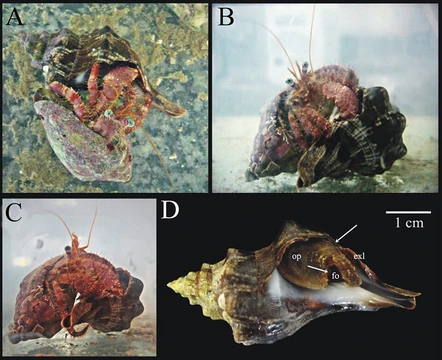
Dardanus venosus reaches a body length between seven and twelve centimetres, a modest size for a hermit crab. Its most striking feature is undoubtedly the eyes: viewed up close, they appear as tiny star-bursts, glowing green or blue around dark central pupils, which gives the species its common name. The crab's dactyls—its projecting claws—carry a distinctive mauve hue, produced by dense clusters of small bluish bristles that coat the appendages. Like all members of the family Diogenidae, this species is left-handed, with its dominant chela positioned on the left front limb. When the animal perceives danger, it retracts its soft abdomen and most limbs into the borrowed gastropod shell, sealing the aperture with that powerful left pincer. Only the bristled dactyls remain visible, projecting from the shell's opening like a pair of velvet-tipped antennae.
Geographic Range and Substrate Preferences
The stareye hermit crab inhabits shallow coastal waters along the entire eastern American seaboard, stretching from Florida southward through the Caribbean Sea, the Gulf of Mexico, the Bahamas, the Antilles, Venezuela, and down to Brazil. Its vertical range spans from the low-tide mark down to roughly forty metres, a depth that places it well within the photic zone. The species shows no strong preference for a single bottom type; it has been recorded on rock, gravel, sand, mud, shell beds, coral structures, and among seaweed. This broad substrate tolerance, combined with its wide latitudinal spread, suggests a highly adaptable forager capable of exploiting varied benthic environments. In the wild it is a scavenger, picking through detritus and any edible material it encounters on the seabed. Its presence in reef aquaria reflects both its visual appeal and its manageable size for hobbyist tanks.
Life Cycle and Larval Development
Although the full reproductive biology of Dardanus venosus remains only partially understood, what is known paints a picture of a species with a complex early life. Females likely brood their eggs attached to the underside of the abdomen, a common strategy among hermit crabs. Once the eggs hatch, the tiny larvae are released into the open water column, where they drift through several zoeal stages as planktonic organisms. After these early phases, the larvae develop into glaucothoë—a relatively large form distinguished by elongated telsons, the rear body segments, and characteristic hooks on the dactyls of the walking legs. This stage represents a transitional body plan between the free-swimming planktonic phase and the benthic adult. After a period in the water, glaucothoë larvae settle onto the seabed and undergo metamorphosis into juvenile crabs. At this critical point, each young animal must locate a suitable empty gastropod shell to inhabit, beginning its lifelong association with a borrowed home.
The Anemone Partnership
Perhaps the most ecologically fascinating aspect of Dardanus venosus is its well-documented mutualism with the sea anemone Calliactis tricolor. The crab frequently carries this anemone attached to its gastropod shell, and the relationship is actively maintained rather than accidental. When the crab outgrows its current shell and moves into a larger one, it deliberately retrieves the anemone, either plucking it from a rock or removing it from the old, too-small shell. To detach the anemone, the crab delivers a series of taps near the anemone's base, a stimulus that causes the animal to relax its grip. The anemone then reattaches to the new shell, initially holding on with its tentacles until its base secures a firm foothold. Both partners benefit: the crab gains protection from the anemone's stinging cells, while the anemone receives free transportation and access to a wider flow of food particles. In a Brazilian study, the crab was found occupying eleven different gastropod shell types, including three species of turban snail, suggesting flexibility in housing choices even as it maintains its anemone partnership.
Spotted an error? Know more?
Reader corrections go straight into our review queue. Suggest an edit · How this site is sourced