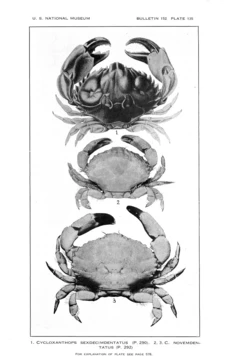
Ninetooth pebble crab (Cycloxanthops novemdentatus)
Source-cited species reference: taxonomy from WoRMS, biology from SeaLifeBase, occurrence map from GBIF, description from Wikipedia.

Cycloxanthops novemdentatus, commonly referred to as the ninetooth pebble crab, is a small crab in the family Xanthidae.
- Scientific name
- Cycloxanthops novemdentatus
- Authority
- (Lockington, 1877)
- Family
- Xanthidae
- Order
- Decapoda
- Habitat zone
- benthic
- Gbif occurrence records
- 531
Physical Appearance & the Origin of Its Name
The ninetooth pebble crab earns its common name from a distinctive anatomical feature: two rows of anterolateral teeth along the front edge of its carapace, with each row containing exactly nine teeth. In terms of coloration, individuals typically present in shades of brown or red, though some specimens display a striking purple hue. Dark or light markings adorn the shell and, notably, these patterns persist even after the crab molts, suggesting they are not merely surface-level traits. However, the overall shell color can shift over the animal's lifetime, adding a layer of variability to its appearance. In terms of size, the carapace can grow to a maximum width of 3.75 inches, making it the largest member of the family Xanthidae encountered along California's coastline. This combination of size, color variation, and the memorable tooth arrangement gives the species a distinctive profile among its relatives.
Development & Sexual Dimorphism
Distinguishing young ninetooth pebble crabs from mature adults requires attention to several morphological details. Immature individuals can be told apart by the relative width of the third and sixth abdominal segments, the length of hair along the abdominal margins, and a sparse covering of hair on the swimmerets. In young males, a specialized structure called a lock mechanism is also present. As crabs grow and their carapace width reaches approximately 6.5 millimeters, sexual dimorphism becomes clearly visible, primarily through differences in the size and shape of abdominal segments between the sexes. This developmental progression means that a crab's body plan shifts noticeably as it matures, with the abdominal region serving as the most reliable indicator of both age and sex. For researchers and naturalists examining specimens in the field, these subtle structural cues provide essential tools for classifying individuals without relying on behavior or habitat alone.
Geographic Range & Habitat Preferences
The ninetooth pebble crab inhabits the eastern Pacific Ocean, with its known range stretching from Monterey, California, southward to Baja California. Within this span, the species is most densely populated along the southernmost stretches of California's coast. Its preferred environments are rocky intertidal and subtidal zones, and it can be encountered at depths reaching as far as 240 meters below the surface. Interestingly, the vertical distribution of the species shifts with age: younger crabs tend to occupy higher positions within the intertidal zone, while adults are found in different zones. This age-related shift in habitat use suggests that the crab's relationship with the tidal environment changes as it matures. As the largest xanthid crab found in California, C. novemdentatus occupies a notable ecological niche among the region's rocky shore communities, where its size and coloration likely play a role in both foraging and survival.
Feeding Behavior & Defensive Strategies
In terms of diet, the ninetooth pebble crab has been directly observed cracking open purple sea urchins and consuming them, demonstrating a capacity for handling hard-shelled prey. It is also known to prey upon other crab species, indicating a somewhat opportunistic carnivorous strategy within its rocky habitat. On the defensive side, when confronted with a perceived threat, C. novemdentatus may simply freeze in place rather than fleeing or raising its claws. This immobility is believed to serve as a camouflage strategy, allowing the crab to remain undetected by potential predators. Given its typical brown, red, or purple coloration and the persistent markings on its shell, a motionless crab against a rocky substrate could blend remarkably well with its surroundings. The combination of a varied diet and a low-energy defensive tactic paints a picture of a crab that relies on stealth and opportunistic feeding rather than aggressive confrontation to navigate its intertidal and subtidal world.
Spotted an error? Know more?
Reader corrections go straight into our review queue. Suggest an edit · How this site is sourced