
Cushion star (Culcita novaeguineae)
Source-cited species reference: taxonomy from WoRMS, biology from SeaLifeBase, occurrence map from GBIF, description from Wikipedia.

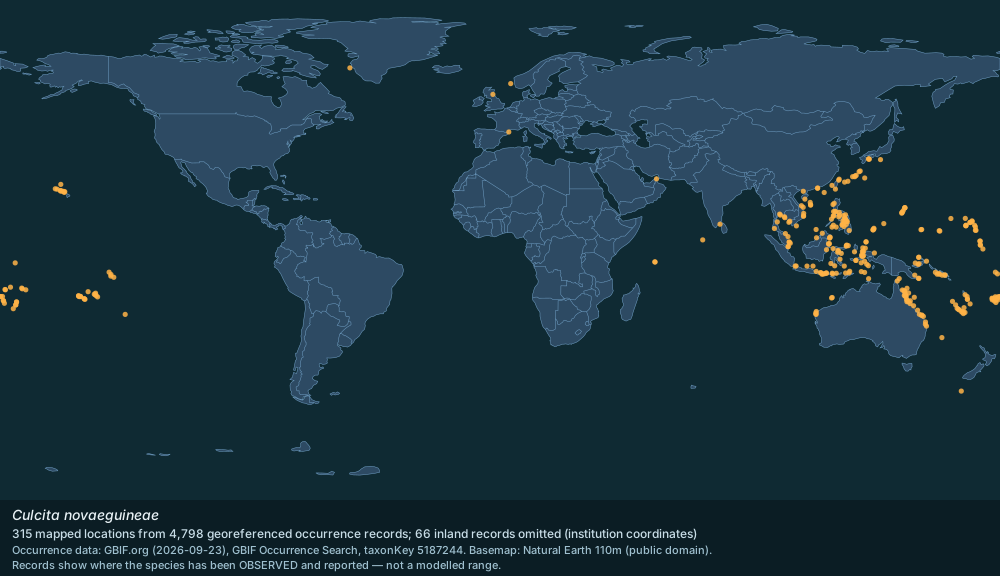
Distribution map plotted from GBIF.org occurrence records; basemap Natural Earth 110m · GBIF records CC0 / CC BY; Natural Earth public domain
Culcita novaeguineae (common name, cushion star) is a species of starfish. It has short arms and an inflated appearance and resembles a pentagonal pincushion. It is variable in colour and can be found in tropical warm waters in the Indo-Pacific.
- Scientific name
- Culcita novaeguineae
- Authority
- Müller & Troschel, 1842
- Family
- Oreasteridae
- Order
- Valvatida
- Maximum length
- 40 cm
- Depth range
- 0–90 m
- Habitat zone
- reef-associated
- Gbif occurrence records
- 4,798
Classification (WoRMS)
Full classification as recorded by WoRMS: Kingdom: Animalia · Phylum: Echinodermata · Class: Asteroidea · Order: Valvatida · Family: Oreasteridae · Genus: Culcita.
Accepted name: Culcita novaeguineae · Authority: Müller & Troschel, 1842 · Taxonomic status: accepted · AphiaID: 212298.
Synonyms and superseded combinations recorded for this taxon: Anthenea spinulosa (Gray, 1847); Culcita acutispinosa Bell, 1883; Culcita arenosa Valenciennes (MS) in Perrier, 1869; Culcita grex Müller & Troschel, 1842; Culcita novaeguineae f. nesiotis Fisher, 1925; Culcita novaeguineae f. novaeguineae Muller & Troschel, 1842; Culcita novaeguineae var. acutispinosa Bell, 1883; Culcita novaeguineae var. arenosa Valenciennes (MS) in Perrier, 1869; Culcita novaeguineae var. leopoldi Engel, 1938; Culcita novaeguineae var. plana Hartlaub, 1892; Culcita novaeguineae var. typica Doderlein, 1896; Culcita pentangularis Gray, 1847; Culcita plana Hartlaub, 1892; Culcita pulverulenta Valenciennes (MS) in Perrier, 1869; Goniaster multiporum Hoffman in Rowe, 1974; Goniaster sebae (de Blainville, 1830); Goniodiscides sebae (Müller & Troschel, 1842); Goniodiscus sebae Müller & Troschel, 1842; Hippasteria philippinensis Domantay & Roxas, 1938; Hosia spinulosa Gray, 1847; Pentagonaster spinulosus (Gray, 1847); Randasia granulata Gray, 1847; Randasia spinulosa Gray, 1847.
Source: World Register of Marine Species (WoRMS) — https://www.marinespecies.org/aphia.php?p=taxdetails&id=212298 (CC BY 4.0). Accessed 2026-09-23.
Biology and life history (SeaLifeBase)
Measured values published by SeaLifeBase for Culcita novaeguineae. Only fields the database actually holds for this species are shown; these are database values, not aquarium guidance.
Maximum length: 40 cm · Depth range: 0–90 m · Habitat zone: reef-associated · Vulnerability index: 30 of 100 · Aquarium trade: never/rarely.
SeaLifeBase notes: Diameter: 30 to 40 cm. Occurs on living coral reefs at reef edge and slope at depths of 1 to 20 m. Feeds on coral polyps, other small sessile invertebrates (Ref. 800) and other encrusting invertebrates (Ref. 129602). Associated with Periclimenes soror (commensal) found on its undersurface (Ref. 800).
Source: SeaLifeBase species summary (SpecCode 86706) — https://www.sealifebase.se/summary/Culcita-novaeguineae.html (CC BY-NC 3.0 — non-commercial use only). Accessed 2026-09-23.
Distribution and occurrence records (GBIF)
4,798 georeferenced occurrence records for Culcita novaeguineae are published through GBIF from 57 countries or marine areas. The map above plots 315 distinct locations from a sample of 3,000 records, omitting 66 inland records that carry an institution's coordinates rather than a collection site; it shows where the species has been observed and reported, not a modelled range.
Most records by country or area: Indonesia (679); French Polynesia (541); United States of America (541); Wallis and Futuna (345); Philippines (312).
The full country table, WoRMS marine regions and the sampling notes are on this species' Distribution page.
Source: GBIF Occurrence Search (taxonKey 5187244) — https://www.gbif.org/occurrence/search?taxon_key=5187244&has_coordinate=true (records CC0 / CC BY); WoRMS distribution records (MarineRegions) — https://www.marinespecies.org/aphia.php?p=taxdetails&id=212298 (CC BY 4.0); Natural Earth 110m basemap — https://www.naturalearthdata.com/ (public domain). Accessed 2026-09-23.
Description and natural history (Wikipedia)
Culcita novaeguineae has numerous synonyms, at least in part because it has a "goniasterid" phase; the juveniles exhibit little resemblance to the mature form and gradually change in morphology as they grow. A number of different "species" were described in the literature before they were found to be different developmental stages of the same species. Some were even considered to be in a different family, the Goniasteridae, rather than in the correct family, Oreasteridae.
A mature C. novaeguineae is pentagonal to subglobose in shape with an inflated appearance and much-abbreviated arms. It can grow to a diameter of 30 cm. Rows of tube feet are on the underside, and it has a central mouth. The colour is very variable and includes a mottling with darker and lighter shades of fawn, brown, orange, yellow and green. The armoured body wall is made of calcareous ossicles which are supported internally by pillars which buttress the ambulacra. The armouring contains pits into which the tube feet can be retracted. The body cavity is filled with water. On the dorsal face, they can be covered with small conical tubercles, as well inside as outside of papular areas.
Small cushion stars are very different in appearance. They are star-shaped, with five short, broad arms and a low profile. As they grow, the inter-arm areas fill in and expand relative to the tube-feet areas, and the arms get shorter relative to the disc which becomes inflated and more massive.
Culcita novaeguineae is found in the Indian and Pacific Oceans. Its range extends from Madagascar and the Seychelles to the Philippines, New Guinea (for which it is named), Australia and Hawaii.
Culcita novaeguineae feeds on detritus and small invertebrates, including stony corals. It can be kept in a reef aquarium of sufficient size stocked with suitable corals on which it can feed.
A number of organisms live in or on C. novaeguineae. The small shrimp Periclimenes soror lives as a commensal hiding under the cushion star. Astroxynus culcitae, Stellicola oreastriphilus and Stellicola parvulipes are copepods which live parasitically on the outside of the cushion star. The star pearlfish (Carapus mourlani) sometimes lives as a commensal inside the cushion star, working its way into the large body cavity through an ambulacral groove and emerging periodically to feed.
Culcita grex Müller & Troschel, 1842
Goniaster multiporum Hoffman in Rowe, 1974
Goniaster sebae (Muller & Troschel, 1842)
Goniodiscides sebae (Müller & Troschel, 1842)
Goniodiscus sebae Müller & Troschel, 1842
Hippasteria philippinensis Domantay & Roxas, 1938
Source: Wikipedia: Culcita novaeguineae — https://en.wikipedia.org/wiki/Culcita_novaeguineae (CC BY-SA 4.0). Accessed 2026-09-23.
Gallery
Related in Cushion star
Links follow this subject's own source article.
Elsewhere in Cushion star
Spotted an error? Know more?
Reader corrections go straight into our review queue. Suggest an edit · How this site is sourced