
Clibanarius erythropus
Source-cited species reference: taxonomy from WoRMS, biology from SeaLifeBase, occurrence map from GBIF, description from Wikipedia.
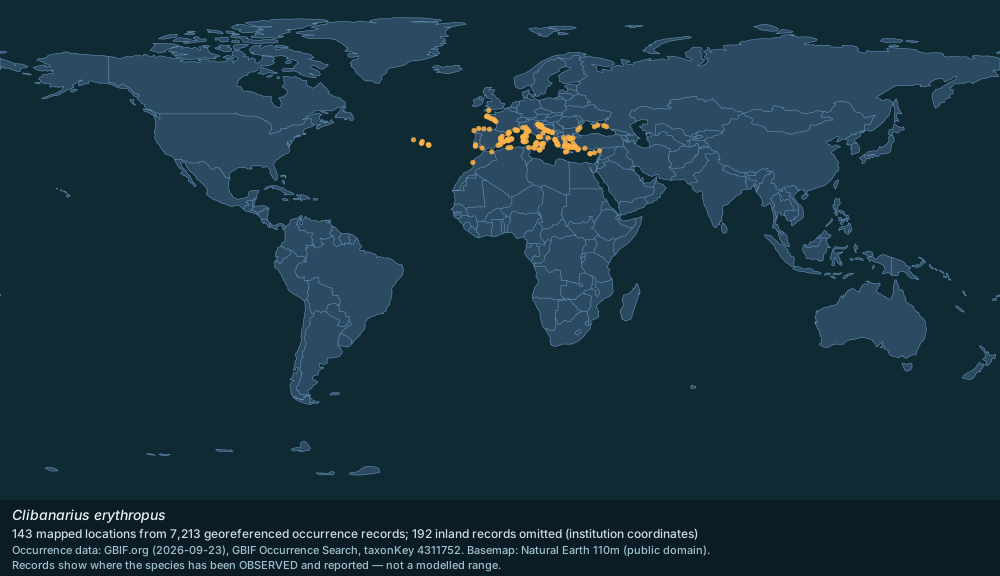
Clibanarius erythropus is a species of hermit crab that lives in rockpools and sublittoral waters. It is found in the Mediterranean Sea, Black Sea and eastern Atlantic Ocean from the Azores to Brittany, the Channel Islands and as far north as the south Cornwall coast. Individuals may grow up to a carapace length of 15 mm.
- Scientific name
- Clibanarius erythropus
- Authority
- (Latreille, 1818)
- Family
- Diogenidae
- Order
- Decapoda
- Habitat zone
- benthic
- Gbif occurrence records
- 7,213
Classification (WoRMS)
Full classification as recorded by WoRMS: Kingdom: Animalia · Phylum: Arthropoda · Class: Malacostraca · Order: Decapoda · Family: Diogenidae · Genus: Clibanarius.
Accepted name: Clibanarius erythropus · Authority: (Latreille, 1818) · Taxonomic status: accepted · AphiaID: 107196.
Synonyms and superseded combinations recorded for this taxon: Clibanarius misanthropus (Risso, 1827); Clibanarius misanthropus f. jaltensis Czerniavsky, 1884; Clibanarius misanthropus f. suchumica Czerniavsky, 1884; Pagurus erythropus Latreille, 1818; Pagurus hirsutus Costa, 1838; Pagurus Labillardieri Audouin, 1826; Pagurus misanthropus Risso, 1827; Pagurus nigritarsis Lucas, 1846.
Source: World Register of Marine Species (WoRMS) — https://www.marinespecies.org/aphia.php?p=taxdetails&id=107196 (CC BY 4.0). Accessed 2026-09-23.
Biology and life history (SeaLifeBase)
Measured values published by SeaLifeBase for Clibanarius erythropus. Only fields the database actually holds for this species are shown; these are database values, not aquarium guidance.
Habitat zone: benthic · Aquarium trade: never/rarely.
Source: SeaLifeBase species summary (SpecCode 92424) — https://www.sealifebase.se/summary/Clibanarius-erythropus.html (CC BY-NC 3.0 — non-commercial use only). Accessed 2026-09-23.
Distribution and occurrence records (GBIF)
7,213 georeferenced occurrence records for Clibanarius erythropus are published through GBIF from 27 countries or marine areas. The map above plots 143 distinct locations from a sample of 3,000 records, omitting 192 inland records that carry an institution's coordinates rather than a collection site; it shows where the species has been observed and reported, not a modelled range.
Most records by country or area: Spain (2,228); Portugal (1,323); France (1,198); United Kingdom of Great Britain and Northern Ireland (513); Croatia (504).
The full country table, WoRMS marine regions and the sampling notes are on this species' Distribution page.
Source: GBIF Occurrence Search (taxonKey 4311752) — https://www.gbif.org/occurrence/search?taxon_key=4311752&has_coordinate=true (records CC0 / CC BY); WoRMS distribution records (MarineRegions) — https://www.marinespecies.org/aphia.php?p=taxdetails&id=107196 (CC BY 4.0); Natural Earth 110m basemap — https://www.naturalearthdata.com/ (public domain). Accessed 2026-09-23.
Description and natural history (Wikipedia)
A variety of different gastropod shells are used by C. erythropus, the most frequent being Littorina striata, Mitra, Nassarius incrassatus and Stramonita haemastoma, which collectively account for 85% of all the individuals studied in the Azores; in the Mediterranean, shells of Cerithium, Alvania montagui and Pisania maculosa are most used by C. erythropus.
Like other hermit crabs, C. erythropus feeds on "organic debris, decayed and fresh macro-algae with associated fauna and epiphytic algal flora, small invertebrates, and macroscopic pieces of dead and live animal tissues". It has been shown that C. erythropus individuals select substrates where they can cover large distances, and that globose shells allow them greater mobility than elongate ones.
In 2016 the BBC Springwatch programme highlighted C. erythropus and ran a competition to provide a vernacular name. The winning name was St Piran's crab, a process supported by National Trust West Cornwall and the Cornwall Wildlife Trust. Saint Piran is generally regarded as the patron saint of Cornwall, and was a hermit who survived being thrown into the sea.
Source: Wikipedia: Clibanarius erythropus — https://en.wikipedia.org/wiki/Clibanarius_erythropus (CC BY-SA 4.0). Accessed 2026-09-23.
Gallery
Related in Clibanarius erythropus
Links follow this subject's own source article.
Elsewhere in Clibanarius erythropus
Spotted an error? Know more?
Reader corrections go straight into our review queue. Suggest an edit · How this site is sourced