Yellow hawkfish (Cirrhitichthys aureus)
Source-cited species reference: taxonomy from WoRMS, biology from FishBase, occurrence map from GBIF, conservation from IUCN Red List, description from Wikipedia.
Last updated

via Wikipedia: Cirrhitichthys aureus · CC BY-SA 2.5
Cirrhitichthys aureus, the yellow hawkfish, the golden hawkfish or golden curlyfin, is a species of marine ray-finned fish, a hawkfish belonging to the family Cirrhitidae. It is native to tropical reefs of the Indian Ocean and the western Pacific Ocean.
Scientific classification
- KingdomAnimalia
- PhylumChordata
- ClassActinopterygii
- DivisionTeleostei
- OrderCentrarchiformes
- FamilyCirrhitidae
- GenusCirrhitichthys
- SpeciesCirrhitichthys aureus
Named by (Temminck & Schlegel, 1842)
Close relatives
Other species of Cirrhitichthys with a Codexery entry.
- Cirrhitichthys aprinus Cirrhitichthys aprinus
- Coral hawkfish Cirrhitichthys oxycephalus
- Dwarf hawkfish Cirrhitichthys falco
Sources: Wikipedia taxobox: Cirrhitichthys aureus (CC BY-SA 4.0) · order, family and genus agree with WoRMS AphiaID 277544 (CC BY 4.0)
Conservation status
Least Concern (LC)
- LC▲ this species
- NT
- VU
- EN
- CR
- EW
- EX
Source: IUCN Red List assessment · GBIF copy of the Red List category
How big is it?
Largest length in the source, 0.14 m, next to a 1.8 m person.
Diagram: drawn by Codexery, schematic shapes to scale (not a likeness). Length: Wikipedia: Cirrhitichthys aureus
Where the yellow hawkfish (cirrhitichthys aureus) has been recorded
Each dot is a place where the species has been observed and reported (175 records, half-degree grid) — not a modelled range. 14 inland records left out (institution coordinates). 1 isolated far-off record not drawn.
Map: drawn by Codexery. Data: GBIF occurrence search (records CC0 / CC BY) · Natural Earth basemap (public domain) · place coordinates: Wikipedia (CC BY-SA 4.0)
Classification (WoRMS)
Full classification as recorded by WoRMS: Kingdom: Animalia · Phylum: Chordata · Class: Teleostei · Order: Centrarchiformes · Family: Cirrhitidae · Genus: Cirrhitichthys.
Accepted name: Cirrhitichthys aureus · Authority: (Temminck & Schlegel, 1842) · Taxonomic status: accepted · AphiaID: 277544.
Synonyms and superseded combinations recorded for this taxon: Cirrhites aureus Temminck & Schlegel, 1842.
Source: World Register of Marine Species (WoRMS) — https://www.marinespecies.org/aphia.php?p=taxdetails&id=277544 (CC BY 4.0). Accessed 2026-09-25.
Biology and life history (FishBase)
Measured values published by FishBase for Cirrhitichthys aureus. Only fields the database actually holds for this species are shown; these are database values, not aquarium guidance.
Maximum length: 14 cm · Depth range: 5–20 m · Habitat zone: reef-associated · Body shape: short and / or deep · Vulnerability index: 10 of 100.
FishBase notes: Occurs on rocky cliffs in deep water (Ref. 9710). Also inhabits muddy substrates in protected bays where wave action has no influence (Ref. 48636). Solitary (Ref 90102).
Source: FishBase species summary (SpecCode 10473) — https://www.fishbase.se/summary/Cirrhitichthys-aureus.html (CC BY-NC 3.0 — non-commercial use only). Accessed 2026-09-25.
Distribution and occurrence records (GBIF)
175 georeferenced occurrence records for Cirrhitichthys aureus are published through GBIF from 9 countries or marine areas. The map above plots 26 distinct locations from a sample of 175 records, omitting 14 inland records that carry an institution's coordinates rather than a collection site; it shows where the species has been observed and reported, not a modelled range.
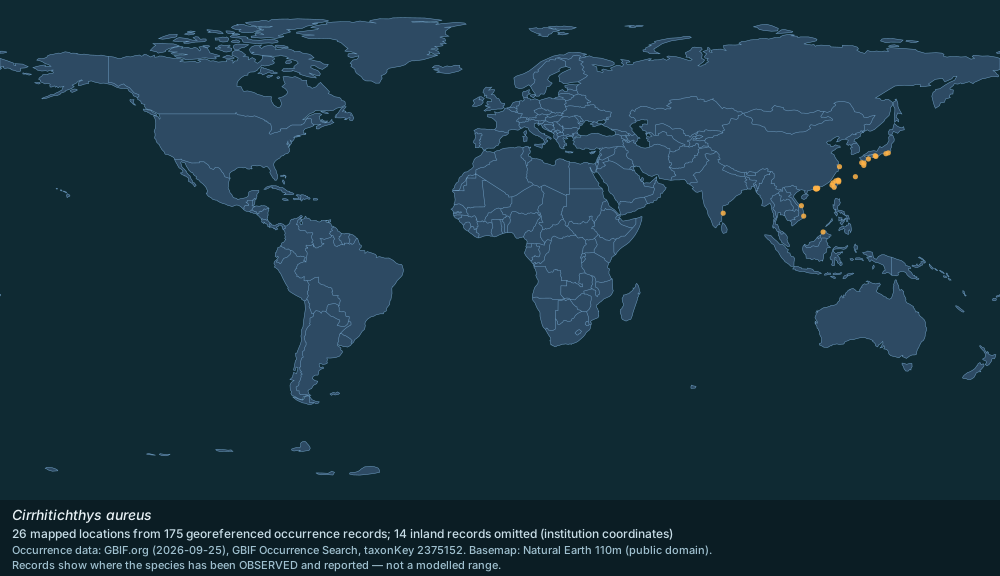
Most records by country or area: Japan (69); Hong Kong (66); Chinese Taipei (25); China (8); Viet Nam (3); Brunei Darussalam (1); India (1); Sri Lanka (1); Malaysia (1).
Source: GBIF Occurrence Search (taxonKey 2375152) — https://www.gbif.org/occurrence/search?taxon_key=2375152&has_coordinate=true (records CC0 / CC BY); WoRMS distribution records (MarineRegions) — https://www.marinespecies.org/aphia.php?p=taxdetails&id=277544 (CC BY 4.0); Natural Earth 110m basemap — https://www.naturalearthdata.com/ (public domain). Accessed 2026-09-25.
Conservation status (IUCN Red List)
The IUCN Red List assesses Cirrhitichthys aureus (Temminck & Schlegel, 1843) as Least Concern (code LC). No trend, population estimate or threat analysis is given here, because none is available from this source without the Red List API; follow the source link for the full assessment, including its date.
Source: IUCN Red List of Threatened Species (taxon 67997188) — https://www.iucnredlist.org/species/67997188/0; GBIF IUCN Red List category endpoint (taxonKey 2375152) — https://api.gbif.org/v1/species/2375152/iucnRedListCategory. Accessed 2026-09-25.
Description and natural history (Wikipedia)
Cirrhitichthys aureus was first formally described in 1842 as Cirrhites aureus by Coenraad Jacob Temminck and Herman Schlegel with the type locality given as the outer bays of Nagasaki. The specific name aureus means “gold”, a reference to its golden yellow colour.
Cirrhitichthys aureus has a dorsal fin which contains 10 spines and 12 soft rays, the first soft ray is extended. The anal fin has 3 spines and 6 soft rays. The pelvic fin extends past the anus and the caudal fin is weakly emarginate. This species reaches a maximum total length of 14 cm.
The overall colour is yellow to orange with large, indistinct, dusky brown blotches along the back. There is a pair of poorly defined brown spots just above the gill cover. The fins are yellowish in colour with spots on the soft rayed part of the dorsal fin.
Cirrhitichthys aureus is found in the Indo-Pacific region from India east to Japan and China, it has also been recorded in southern Indonesia. Thus species is found around rocky cliffs within reefs and is found at depths between 5 and 20 m.
Cirrhitichthys aureus have been shown, at least in captivity, to be able to change sex in either direction. They lay pelagic eggs. Their diet is made up of fishes and crustaceans. In the wild these fish are largely solitary.
Cirrhitichthys aureus are not often collected for the aquarium trade.
Source: Wikipedia: Cirrhitichthys aureus — https://en.wikipedia.org/wiki/Cirrhitichthys_aureus (CC BY-SA 4.0). Accessed 2026-09-25.
Sources
Compiled from Wikipedia and the sources listed below. Text from Wikipedia is available under CC BY-SA 4.0; this entry is adapted from it.
- Wikipedia: Cirrhitichthys aureus (CC BY-SA 4.0).
- Classification: the source article's taxobox; order, family and genus checked against WoRMS, the World Register of Marine Species (CC BY 4.0).
- Conservation status: IUCN Red List assessment.
- Occurrence records: GBIF (CC0 / CC BY). Basemap: Natural Earth (public domain).
- Biology values: FishBase species summary (CC BY-NC 3.0, non-commercial).
- Word definitions: the , each quoted from its Wikipedia article.
Spotted an error? Know more?
Reader corrections go straight into our review queue. Suggest an edit · How this site is sourced