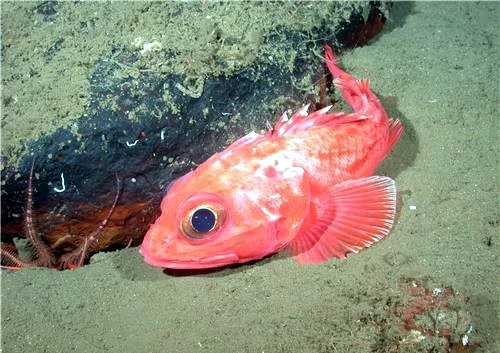
Channeled rockfish (Setarches guentheri)
Source-cited species reference: taxonomy from WoRMS, biology from FishBase, occurrence map from GBIF, conservation from IUCN Red List, description from Wikipedia.

The channelled rockfish (Setarches guentheri), commonly known as the deepwater scorpionfish, is a marine ray-finned fish belonging to the subfamily Setarchinae, which is a part of the family Scorpaenidae. This species is found in various tropical and subtropical oceans and has a wide distribution.
- Scientific name
- Setarches guentheri
- Authority
- Johnson, 1862
- Family
- Setarchidae
- Order
- Perciformes
- Maximum length
- 31.399999618530273 cm
- Depth range
- 150–840 m
- Habitat zone
- benthopelagic
- Iucn red list
- Least Concern
- Gbif occurrence records
- 2,194
Classification (WoRMS)
Full classification as recorded by WoRMS: Kingdom: Animalia · Phylum: Chordata · Class: Teleostei · Order: Perciformes · Family: Setarchidae · Genus: Setarches.
Accepted name: Setarches guentheri · Authority: Johnson, 1862 · Taxonomic status: accepted · AphiaID: 127258.
Synonyms and superseded combinations recorded for this taxon: Bathysebastes albescens Döderlein, 1884; Scorpaena remigera Gilbert & Cramer, 1897; Sebastes albescens (Döderlein, 1884); Setarches fidjiensis Günther, 1878; Setarches guntheri Johnson, 1862; Setarches marleyi Fowler, 1935; Setarches parmatus Goode, 1881; Setarches remiger (Gilbert & Cramer, 1897); Starches guentheri Johnson, 1862.
Source: World Register of Marine Species (WoRMS) — https://www.marinespecies.org/aphia.php?p=taxdetails&id=127258 (CC BY 4.0). Accessed 2026-09-23.
Biology and life history (FishBase)
Measured values published by FishBase for Setarches guentheri. Only fields the database actually holds for this species are shown; these are database values, not aquarium guidance.
Maximum length: 31.399999618530273 cm · Depth range: 150–840 m · Habitat zone: benthopelagic · Body shape: fusiform / normal · Vulnerability index: 21.4 of 100 · Fishery importance: minor commercial · Aquarium trade: never/rarely.
FishBase notes: Found on soft bottom, at a bottom temperature range of about 5.5°-12.5°C and usually at a depth of about 400 m. They live on or near the bottom but feed in the water column (Ref. 47377). Specimens usually brought to the surface with the stomach everted. Stomach contents included parts of bathypelagic crustaceans of family Oplophoridae, Oplophorus sp., and an amphipod (Ref. 11015). Anterolateral glandular grooves with venom gland (Ref. 57406). Sold in small quantities in markets. Minimum depth range taken from Ref. 27000.
Source: FishBase species summary (SpecCode 5029) — https://www.fishbase.se/summary/Setarches-guentheri.html (CC BY-NC 3.0 — non-commercial use only). Accessed 2026-09-23.
Distribution and occurrence records (GBIF)
2,194 georeferenced occurrence records for Setarches guentheri are published through GBIF from 63 countries or marine areas. The map above plots 380 distinct locations from a sample of 2,194 records, omitting 47 inland records that carry an institution's coordinates rather than a collection site; it shows where the species has been observed and reported, not a modelled range.
Most records by country or area: Equatorial Guinea (775); United States of America (425); Australia (103); Nigeria (80); Gabon (64).
The full country table, WoRMS marine regions and the sampling notes are on this species' Distribution page.
Source: GBIF Occurrence Search (taxonKey 2336894) — https://www.gbif.org/occurrence/search?taxon_key=2336894&has_coordinate=true (records CC0 / CC BY); WoRMS distribution records (MarineRegions) — https://www.marinespecies.org/aphia.php?p=taxdetails&id=127258 (CC BY 4.0); Natural Earth 110m basemap — https://www.naturalearthdata.com/ (public domain). Accessed 2026-09-23.
Conservation status (IUCN Red List)
The IUCN Red List assesses Setarches guentheri Johnson, 1862 as Least Concern (code LC). No trend, population estimate or threat analysis is given here, because none is available from this source without the Red List API; follow the source link for the full assessment, including its date.
Source: IUCN Red List of Threatened Species (taxon 15622835) — https://www.iucnredlist.org/species/15622835/0; GBIF IUCN Red List category endpoint (taxonKey 2336894) — https://api.gbif.org/v1/species/2336894/iucnRedListCategory. Accessed 2026-09-23.
Description and natural history (Wikipedia)
The channelled rockfish was first formally described in 1862 by the English zoologist James Yate Johnson with the type locality given as Madeira. In his description Johnson placed the new species in the new monotypic genus Setarches. Subsequent workers added other species to this genus but in 1966 William N. Eschmeyer and Bruce B. Collette synonymised most of these with S. guentheri making Setarches consist only of this species and S. longimanus. This was later re-examined and 3 species were accepted as belonging to the genus Setarches: S. armata, S. guentheri and S. longimanus. A review in 2021 by Wada, Kai & Motomura resurrected the genus Lythrichthys, they type species of which was L. eulabes, one of the names Eschmeyer and Collette had regarded as synonymous with S. longimanus, placing S. cypho (which had also been treated as a synonym of Setarches longimanus) and S. longimanus and two newly described species in the resurrected genus Lythrichthys. S. armata is now considered to be a synonym of the flathead Thysanophrys armata. This left the channelled rockfish (Setarches guentheri) as the only species in the now monotypic Setarches. As of January 2022 this change has been accepted by Catalog of Fishes. The genus name Setarches was not explained by Johnson, it may be derived from saeta meaning "bristle" while the specific name honours Johnson's friend, the German-born British ichthyologist and herpetologist Albert Günther.
The channelled rockfish has a body which has a depth that is equivalent to 28-37% of its standard length, with the larger fish having less deep bodies than the smaller fish. There are 11-13 spines and 9-11 soft rays in the dorsal fin and the anal fin has 3 spines and 4-6 soft rays. The lateral line is almost continuous and is a trough covered by thin membranous scales, which are deciduous. The second spine on the preoperculum is longer and better developed than the first and the third which are of similar length. Living specimens are pinkish red to orange with reddish black spots on the head and body. In smaller individuals the colour is more reddish grey with black spots and the smallest fishes, c. 40 mm, have dark colouration concentrated in a patch above the pectoral fin and below the soft rayed part of the dorsal fin, with a smaller amount of dark colour on the caudal peduncle. This species grows to a maximum total length of 31.4 cm.
The channelled rockfish has the widest distribution of any scorpaenid. It has a circumglobal range on continental shelves in tropical and warm temperate oceans. In the eastern Atlantic it is found from Madeira south to South Africa, In the western Atlantic it is found from off southern Rhode Island south to northern Brazil, including the Gulf of Mexico. It occurs along the Pacific coasts of the Americas from southern British Columbia to Chile and across the Pacific and Indian Ocean to the east coast of Africa. Despite this wide range there is very little genetic difference between widely separated populations of the channelled rockfish. It is a benthopelagic species which has a depth range of 150 to 780 m over soft bottoms and with a water temperature between 5.5 to 12.5 °C.
The channelled rockfish live close to the bottom but tends to feed in the water column. It feeds predominantly on pelagic invertebrates. In the Gulf of Mexico, the diet is dominated by benthic crustaceans, like the shrimp and prawns in the genus Oplophorus and a variety of amphipods. The spines in the fins bear venom glands and they can envemonate humans if handled.
Channelled rockfish are sometimes caught in fisheries in the Gulf of Mexico and are of slight commercial value in Mexico.
Source: Wikipedia: Channelled rockfish — https://en.wikipedia.org/wiki/Channelled_rockfish (CC BY-SA 4.0). Accessed 2026-09-23.
Frequently Asked Questions
Who is Channeled rockfish (Setarches guentheri)?
The channeled rockfish is a deep-sea ray-finned fish placed in the scorpionfish family (Scorpaenidae), specifically within the subfamily Setarchinae. It was first formally described by Johnson in 1862 and is also widely known by its common name, the deepwater scorpionfish.
Where does Channeled rockfish (Setarches guentheri) live?
This species ranges across tropical and subtropical oceans worldwide, giving it a notably broad geographic footprint. It is a true deepwater resident, typically encountered between roughly 150 and 840 meters below the surface.
How big does Channeled rockfish (Setarches guentheri) get?
The maximum recorded total length for this species is approximately 31.4 centimeters, making it a modestly sized member of the rockfish and scorpionfish groups.
What is Channeled rockfish (Setarches guentheri)'s taxonomic placement?
Setarches guentheri sits in the order Perciformes and the family Scorpaenidae (sometimes listed under Setarchidae), within the subfamily Setarchinae. This positions it among a small circle of deepwater species closely related to scorpionfishes rather than to the better-known Pacific rockfishes.
Why is Channeled rockfish (Setarches guentheri) called the 'deepwater scorpionfish'?
The common name captures both its preferred habitat—well below 150 meters in warm, open-ocean waters—and its evolutionary kinship with the scorpionfish family. Although it carries the word 'rockfish' in its English name, it is taxonomically a scorpionfish relative living in the deep sea.
Related in Channeled rockfish
Links follow this subject's own source article.
Elsewhere in Channeled rockfish
Spotted an error? Know more?
Reader corrections go straight into our review queue. Suggest an edit · How this site is sourced