Frequently Asked Questions
The most-asked questions about Bluespotted angelfish.
What exactly is a Bluespotted angelfish?
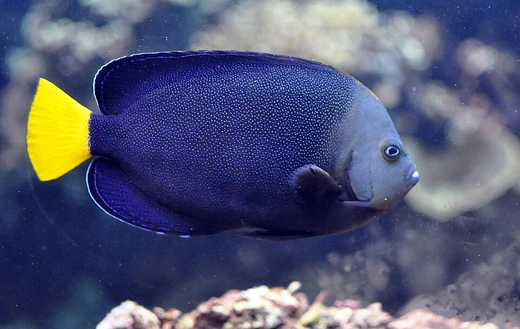
It is a medium-to-large marine angelfish (Pomacanthus annularis) belonging to the family Pomacanthidae, found in the western Atlantic Ocean. Adults are easily recognized by their dark indigo body covered in vivid, raised blue spots.
Where in the world can you find them in the wild?
They inhabit coral reefs and rocky outcrops throughout the Caribbean Sea, the Gulf of Mexico, off the coast of Florida, around Bermuda, and as far south as northeastern Brazil. They typically stay near the reef structure at depths ranging from a few meters to around 40 meters.
How do juveniles look compared to adults?
Young Bluespotted angelfish are strikingly different: they are bright yellow with bold black and blue vertical bars and a blue-ringed pattern around the eyes. As they mature over roughly two to three years, the coloration shifts to the familiar dark body with scattered electric-blue spots.
How large do they get?
Adults commonly reach a total length of about 30 to 35 centimeters (roughly 12–14 inches), making them one of the larger reef-dwelling angelfish. Their body is strongly laterally compressed, giving them a tall, disc-like silhouette.
What do they eat in the ocean?
Their diet is dominated by sponges and tunicates, supplemented with algae, small crustaceans, and other invertebrates. They use their small, sharp teeth to pick food from the reef surface rather than chasing it.
Can I keep one in a home aquarium?
Technically yes, but only in a very large reef tank (well over 1,500 liters) with established parameters and a varied diet that includes sponge-based foods. They are sensitive to water quality and can be difficult to acclimate, so they are generally recommended for experienced marine keepers.
Are they aggressive or good tankmates?
They are mostly peaceful toward other fish and can coexist with many reef species, though they may show mild territorial behavior toward their own kind. Their main risk in a tank is accidentally eating small, slow-moving invertebrates like shrimp or small crabs.
How long can they live?
In the wild, individuals have been documented living well past 20 years, and captive specimens can reach similar ages with proper care. They are slow-growing, so reaching full adult coloration and size takes several years.
What is their conservation status?
The IUCN currently lists Pomacanthus annularis as Least Concern, as their range is broad and populations appear stable. They are, however, occasionally collected for the aquarium trade, so sustainable sourcing and CITES considerations are worth checking before purchasing.
What's a cool fact most people miss about them?
The bright blue spots on an adult are not pigment in the usual sense but small, raised dermal tubercles that scatter light, giving them an almost iridescent glow under sunlight. This structural coloration means the spots can appear to shift in intensity depending on the viewing angle and water clarity.