Frequently Asked Questions
The most-asked questions about Purplemask angelfish.
What is the Purplemask angelfish?
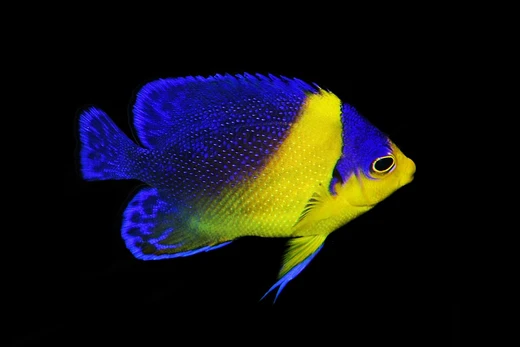
The Purplemask angelfish (Genicanthus marginatus) is a species of marine angelfish in the family Pomacanthidae, native to coral-reef environments across the Indo-Pacific. It is most easily recognized by the deep violet-purple coloration that covers its face and upper body, giving it the 'purplemask' common name.
Who are the key figures associated with this species?
The species was formally described by ichthyologist John E. Randall, whose mid-20th-century cataloguing of Pacific reef fishes established much of the taxonomic groundwork for the Genicanthus genus. Randall's collections and publications remain a primary reference for identifying this and closely related angelfishes.
Where should a newcomer start learning about Purplemask angelfish?
Begin with basic identification—body shape, the purple facial mask, and fin patterns—then explore its native reef habitat and depth range. Standard Indo-Pacific reef-fish field guides and the FishBase online database are reliable, freely accessible starting points.
What is its typical size and general build?
Adults generally reach roughly 15–20 cm (about 6–8 in) in total length, placing it in the mid-range for angelfishes. The body is laterally compressed and oval, with a small terminal mouth adapted for picking food from reef surfaces.
Where does it live in the wild?
It inhabits coral-reef slopes, lagoons, and rocky ledges across the western and central Pacific, typically at depths of around 10 to 40 metres. It favours areas with moderate current and a mix of hard coral and sandy substrate where it can forage.
What does it eat?
Like most Genicanthus species, it is a small-scale omnivore that picks invertebrates, filamentous algae, and organic detritus from the reef floor and crevices. Its fine, pointed teeth are well suited to this grazing-and-picking feeding style.
What makes its coloration notable?
The saturated purple-to-violet 'mask' across the head and upper flank contrasts sharply with the paler yellowish or silvery lower body and fins. This pattern is thought to aid species recognition and may provide partial camouflage in the blue-green light of open reef water.
Is it kept in home aquariums?
It occasionally appears in the marine-aquarium trade but is generally considered a species for experienced keepers, needing a large, well-established reef tank with ample open swimming space. It can be initially shy and may show mild aggression toward similarly shaped or similarly coloured tankmates.
What is its conservation outlook?
The species is not currently listed as threatened by the IUCN, reflecting its broad Indo-Pacific range and the fact that it is not a major target of commercial fisheries. Localised reef degradation and bycatch from adjacent-target fisheries remain the principal long-term concerns.
How is it told apart from similar Genicanthus species?
It is separated from look-alikes such as the blue-masked angelfish (G. caeruleus) by the specific hue and extent of its purple facial markings, along with subtle differences in lateral-line scale count and pelvic-fin shape. A careful side-by-side comparison of fin-ray counts and body barring in a good field guide confirms the identification.