Frequently Asked Questions
The most-asked questions about Keyhole angelfish.
What exactly is a Keyhole angelfish?
It is a species of marine angelfish in the family Pomacanthidae, scientifically named Pomacanthus annularis. It is a reef-associated saltwater fish native to the tropical Indo-Pacific region.
Where does the name 'keyhole' come from?
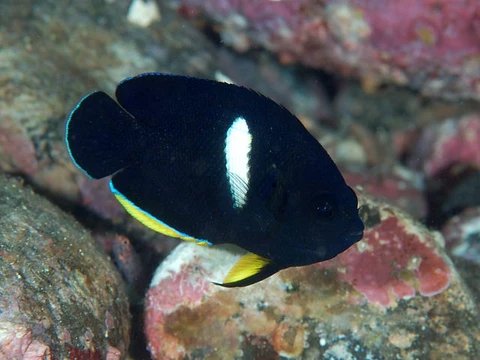
The fish has a distinctive dark, roughly oval marking on the top of its head that resembles the shape of an old-fashioned keyhole. This spot is the single most reliable field mark for telling it apart from look-alike species.
What does a Keyhole angelfish look like?
Adults are predominantly pale yellow to cream with a network of thin blue lines and spots across the body and fins. The head features the dark keyhole mark, and the overall palette is softer than the bolder Queen angelfish.
How large do they grow?
They typically reach a total length of about 25 to 30 centimeters (roughly 10–12 inches) in the wild, making them a medium-sized angelfish.
What is their natural range?
They occur across the central and western Indo-Pacific, from the Red Sea and East African coast eastward through Indonesia, the Philippines, and into the western Pacific islands.
What do they eat in the wild?
Their diet is mixed: they graze on sponges, small invertebrates, and algae found on reef structures and the surrounding sandy bottom. They are often seen hovering just above rubble or open sand near reef edges.
How is it different from the Queen angelfish?
While both are yellowish Pomacanthus species, the Keyhole angelfish has a more subdued blue pattern and, most importantly, that single dark keyhole-shaped spot on the forehead. The Queen angelfish (P. maculosus) lacks that mark and instead shows a denser, more uniform blue spot pattern.
Can you keep one in a home aquarium?
They are considered challenging for most hobbyists because they need a very large, well-established reef tank, stable water parameters, and a varied diet that is difficult to replicate in captivity. They are not recommended for beginners or small systems.
How long can they live?
In their natural environment, individuals have been estimated to live well over a decade, with some sources suggesting 15 years or more under optimal conditions. Captive longevity is generally shorter due to the difficulty of meeting their long-term needs.
What is a notable behavior or fact fans often mention?
They are frequently observed in small groups or pairs patrolling open water just beyond the reef crest, which gives them a more pelagic impression than many other angelfish. This open-water foraging habit is one of the traits that sets their ecology apart from strictly reef-bound relatives.